I've wanted to film crows anting for quite a while. Anting is a behaviour carried out by a range of birds (I dealt with Blackbirds anting in a previous post), but it is rare to observe it. Anting can be active - the birds picks an ant (or ants) and rubs it on its feathers - or passive - the bird allows the ants to climb onto its plumage. The behaviour involves distinctive movements such as sitting close to the ground or partially opening the wings and tail dragging. The bird movements on top of the ant's nest or direct disturbing of the nest will also encouraging the ants to come out of the nest and climb over their feathers, as anyone who has had a picnic on an anthill will attest.
A Carrion Crow anting at my local park. 27/07/2016.
The first time I watched anting behaviour in crows I was driving, waiting on a red light. It is a very distinctive behaviour, but I had no chance for a video or a photo! I have seen it a few more times, but didn't get a good video of it. Today, as I got out of my car I noticed the local pair of crows on the verge opposite. I used the car as a hide and filmed them. First, one of them first seemed intent in getting some nest lining material, but the other went to the base of a tree trunk and pecked, and pulled some vegetation from around the tree. Then it pressed its body against the ground. The second crow joined the first and both enjoyed an 'anting' session.
Watch both clips and a clip of the ants nest:
Why anting?
It might be surprising, but is still unclear why birds carry out anting behaviour and there are a range of hypotheses. Some claim that it is some form of feather maintenance. Species of ants that eject formic acid (Formica, Lasius and Camponotus) as part of nest defence are preferred for anting. Formic acid has insecticidal and acaricidal properties. One of the first hypothesis is that the formic acid kills or repels bird ectoparasites such as feather lice or mites. This has had some support. In the summer of 1943, in Transbaikalia, Dubinin killed four Blyth's Pipits that had been anting, counted all the feather mites and checked the mites behaviour. Many mites were already dead and a total of a third of the mites died over the next 12 h, and the rest seemed very mobile. The birds feather smelled very strongly of formic acid even 12 h after the shooting. The control for this experiment were four pipits that hadn't been anting. Only 0.9% of the mites died after 24 h, and they stayed more or less immobile. However, other experiments tested this hypothesis were inconclusive.
Another hypothesis draws on the formic acid has anti-bacterial and anti-fungal properties, and could be beneficial to keep in check bacteria and fungi that feed on feathers. Although the experiment showed that pure formic acid inhibits feather bacteria and fungi's growth, the results were not conclusive when more natural doses were used that reflected ant's formic acid content. An ornithological enigma!
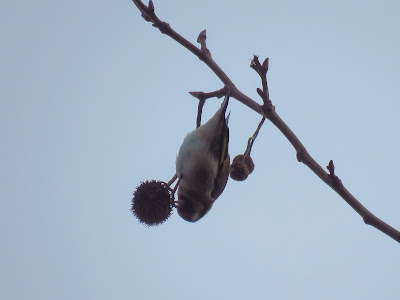
This morning I took a walk near a local park. On a square lined with Plane Trees, some pollarded, a flock of Goldfinches fed on the bauble-like fruits, often hanging from them acrobatically, as they often do.
Then I noticed the crows. They flew to the tip of the branches, where the plane tree fruits clustered, once they gained their balance they moved to the tip of the branch, and picked on the fruits, pulling at their stem. Then they purposefully hanged down from their legs, then only one leg while holding the fruit on the other and attempting to break the stem. What complex thing to do! Some of the fruits had frayed stems, like they had been chewed a few times. If a crow breaks the stem but drops the fruit, the other crows will be quick to go and steal the price. I didn't see this, but I did see chases and close guarding of the fruit by the owner crow, often flying to a safer place holding onto it.
All three crows did this, often the three of them hanging from branches at the same time. At least twice I saw they were successful, and then they flew with the fruit on their bill, once transferring it to their feet before landing and starting breaking the fruit open for their seeds. I'm always amazed at crows, I have covered how they crack mussels and periwinkles at the beach.
Today's behaviour, however, really topped it up. Were they copying the Goldfinches? Crows are always to the alert, they must have noticed the Goldfinches feeding on these fruits and had a go at getting them!
This is a video made with three clips I took from them
And a few photos of the behaviour.
Hanging from one leg, holding onto the fruit with the other.
Crow with its prize.
The pink gape suggests this is a young crow, feeding on the plane fruit. I wonder if this is a family, with the young copying the adults in learning this skill.
I'll be very interested to head from anyone that have seen this behaviour in their local crows!
From my office I hear several Herring Gulls start calling plaintively, kyeoh! kyeoh! a loud, far carrying call that I associate to buzzards overhead. I looked through the window. The local Carrion Crows had assembled atop a large poplar, watching nervously, calling and displaying wing shuffling and tail fanning.
A dozen gulls soared and called - all the local Herring gulls - slowly assembling and ascending on the thermals. Then I see a Buzzard, soaring higher. The gulls didn't reach the buzzard's height and it eventually drifted away and the gull calls died off.
Gulls often alert me to raptors. A couple of years back it was a Honey Buzzard, migrating over town. I pay a lot of attention to the gulls alarm call since then!
Later, at home, the scene appears to repeat itself. Alarm calling gulls. I grab the camera and go out into the garden. Two Lesser Black-backed gulls are mobbing a Buzzard.
This gull alarm call is persistent and sounds distressed, it is hard to ignore. It seems to attract other gulls too, who soar and chase the potential predator. I wonder if it is how young gulls learn to identify the predators they are likely to come across in their lives. Crowd knowledge of the enemies, initiated by older gulls with previous experience, who in turn learned it in their youth. Immature offspring of the gulls initiating the mobbing are likely to be around. The adults could be 'teaching' young about potential predators and the young are likely to benefit from this at some point in the future. This is a hypothesis called 'cultural transmission of mobbing' which was explored in some experiments by E. Curio and collaborators in 1978. They showed that exposure of a novel object to a 'naive' Blackbird at the same time a 'teacher' blackbird is mobbing results in learning to mob the new object (in one of their experiments a colourful bottle). This teaching could be passed through six rounds of learning in which the learner becomes the teacher of a new bird, and so on. The fact that enemies often have to be recognised culturally was put to a sad test when captive reared endangered Hawaii crows (or Alalā) were released into their natural habitat. The last wild Alalā had died in 2002. Two of six newly released birds were predated by native hawks, to which the captive reared birds were completely naive in the first week after release. The conservationist recaptured the surviving birds and started an intensive 'predator training' program in which the captive crows were exposed to hawks calls, hawks flying overhead and simulated hawk attacks. Hopefully the savvy crows will do better when they are released next.
This time of the year there seem to be a passage of migrating or dispersing Buzzards over the city. The gulls are breeding, probably incubating now, and a buzzard could be a predator likely not for them, but for eggs left unattended or young chicks. It makes sense that the gulls see off the potential predator.
I got this short clip from the garden:
Corvid researchers have ample anecdotal evidence that crows recognise individual humans: crows are unusually alert and often direct mobbing calls to researchers that have previously ringed them, while ignoring other researchers. Other crows follow and harass individuals who feed them in order to obtain food, something that Ralph Hancock has described to me in comments to this blog (see previous post), and amply illustrated in his blog (Charley and Melissa are the pair of crows that often pester him for food). Unlike predators, who tend to be dangerous in general, people can be either very dangerous, mildly dangerous, neutral or good to crows. Some people, e.g. farmers who treat them as pests persecute and kill crows (see photo below) and crows might learn to be cautious when they see them and fly away before being shot. Other people are plain annoying, as bird ringers who trap them, and it may pay to learn who they are so that the trap is avoided next time. Yet others people are good to crows, such as people who feed them, and it may pay to be confiding and even harass them to get more food. It is not surprising that intelligent birds like crows pay attention and learn to discriminate between 'good' 'neutral' and 'bad' people and act accordingly.
Two Carrion Crow carcasses on the cows feeder of a local farm.
John Marzluff, a researcher at the University of Washington has studied crows for many years, and part of his research has involved trapping and ringing crows in Seattle. Marzluff was aware of the crow's mobbing behaviour towards the specific researchers that had trapped and ringed them but he wanted formal proof. He incorporated ringing into an experiment to test if crows recognise individual humans. He worked with American crows, Corvus brachyrhynchos, a close relative of the Carrion Crow with a similar social organisation. The research included urban populations that included previously trapped and ringed individuals, and also 'naive' populations that had not been ringed before. Experiments included a single negative event: the setting a trap (a net launcher) to capture feeding crows in 5 different sites. The people activating the trap, capturing and ringing the birds wore specific masks and/or hats (a 'dangerous' mask). Masks were used so that they were interchangeable and effects due to inadvertent researcher behaviour, outfit or body size could be removed. During transects around the crow territories, researchers (wearing either the dangerous mask or a 'neutral' mask) assessed crow activity towards them before and after the trapping event. They in particular noted if crows displayed the 'scolding' response to them (defined as a harsh, alarm ‘kaw’ directed repeatedly at the observer, and accompanied by agitated wing and tail flicking) or were indifferent. The experiments were repeated by people unaware of the experimental design or objectives, which were asked to walk around the crows territories wearing or not the mask used during the trapping event or a different, neutral masks. This experiment removed any subjective bias by the experimenters themselves.
The experiments show that crows rapidly learn to recognise the 'dangerous mask' used during the trapping in their local site, with more scolding in response to the dangerous mask than to neutral mask during and after the trapping event, but no differences before the trapping event. In addition, the percentage of local crows scolding the person wearing the dangerous mask increases from 26% steadily with time over 2.7 years to 66%, suggesting that the local crows learn from each other about the dangerous person. The masks used in one of the experiments were of ordinary people and the crows learned to mob the specific mask associated to the trapping and not similar masks.
The crows today calling and wing-flicking.
Today I walked around the park today with my camera. Three crows at the end of the park, in the same area where they mobbed and followed me three weeks ago immediately flew to the top of a tree and cawed harshly looking in my direction, wing-flicking, then one of them flew towards the tree by which I was standing. I took a video that shows how it is scolding me and records the call. The top shot is a screen gan of the video. As I left the park they stopped cawing. I seem to have become the not so good people to the local crows, maybe I will wear a mask next time.
In my way to work as I crossed the park I saw a pair of crows with a fledgling. The young one hopped to one adult and was fed. I took my camera out and started taking photos, but all feeding and begging stopped. The young one started looking around for tidbits on the grass. One of the adults, after eyeing me (the one in the background above), flew to the top of the tree under which I was standing, and cawed loudly and repeatedly. The other adult followed. I didn't think much about this until I carried on with my walk and the crows flew from tree to tree above me, calling all the way, sounding pretty angry. It took that for me to realise that I was being mobbed! I thought about the episode by Konrad Lorenz when his tame jackdaws apparently mistook his wet swimming trucks, which he was holding, by a dead jackdaw and actually attacked his hand, drawing blood. I saw my black camera with dangling cap and immediately put it away. I do hope the crows don't remember me tomorrow!
Curiously, but not surprisingly, this call is completely different to the mobbing call uttered when chasing sparrowhawks or gulls away (the call that gave name to this blog), which is a dry rattling. Instead is a long, harsh caw. I found a video of a crow attacking a fox and using the same call.
The adult, on the right, eyeing me.
The young crow stops feeding, as the adults caw above me.
The young crow is taking everything in, looking at the parents reaction.
The Carrion Crow pair in the local park have fledged two young. One of them sat on a carpet of poplar fluff, looking sleepy, and unable to fly very high. It looked like it had flown the nest a bit early. It was very tame, and allowed me to crouch by it and take his portrait. You can see that the chest and head feathers lack the metallic lustre of the adult plumage and the young's eyes are blue. The wing feathers are more metallic. A parent was nearby, furiously chasing a squirrel away. The sibling was much more active, and was intrigued by water, it opened it's bill to the water, like it was testing it or finding out what the best way of drinking was.
Today at Sewerby beach I was intrigued by a Carrion Crow, part of a large winter flock, appeared to drop something onto the rocks at the top of the beach, then come down to eat. Sometimes the crow would fail and repeat the action. The tide was low, exposing a flat platform of rocks with rich mussel beds, and the objects being dropped were actually mussels that the crows were collecting and carrying up the beach before dropping them on the solid rock to smash them (above).
Dropping potential food items to break them open has been previously documented, and best known in Golden Eagles (breaking open tortoises) and Lammergeiers (bones). Gulls and crows of various species have been recorded dropping intertidal hard-shelled molluscs hard substates, including roads. Intertidal foraging can be an important part of the diet of coastal crows in the winter, when insects are scarce. Crows will scavenge at the tide-line, or feed on small crabs, but some of these intertidal organisms, in particular periwinkles, cockles and mussels, are consumed after smashing them open by dropping onto hard substrates. Controlled observations of wild Carrion and Hooded crows show that crows chose larger mussels, more likely to smash and also providing more food. Shell dropping is not instinctive, young crows appear to perform rather poorly. They need to perfect their technique of dropping so that the height at which the mussels are dropped is the minimum height for them to break at impact, but not much lower. Young crows take more attempts at being successful.
There are three reasons why the minimum height should be used. One, dropping from higher up means wasting more energy flapping up. Also, higher drops means higher bounces and higher chances of the shell being lost. Finally, crows and gulls often steal from each other, a behaviour called kleptoparasitism. Therefore researchers predicted that crows dropping mussels when other crows or gulls are nearby would be more wary of being robbed, indeed, crows with other crows or gulls nearby dropped their mussels from 2 m lower that lone crows.
Crow and gulls on mussel bed, the crow has already detached a mussel, while one of the gulls is still trying. Although many crows were actually busy either collecting mussels or breaking them up the beach today, I didn't see any gulls doing this.
Mussels are strongly attached to the rock and other mussels by threads, which can be hard to reach, as the mussels cover the rock very densely, not exposing the threads. It is quite a feat the crows manage to detach them
A view of the beach at low tide.
Despite the very bright light I managed a couple of clips here:
Carrion Crows have a complex social structure. Territory-owning Carrion Crows remain paired year round, often flying and feeding together or not far from one another. They remain near their nest during the breeding season, although they may range wider outside this period. Birds that don't hold a territory form part of a loose flock that roosts communally, usually in large trees. Both male and female of a pair participate in territory defence, keeping other crows (or potential predators) away from the nest. Males have a more prominent role: if a male loses his mate he is able to defend the territory until he remates, but a female losing his mate will also lose her territory, as she would rapidly be evicted by other pair.
In one of my local parks there is a very high density of Crows. There are several territories, but the park is also the main ranging area of the non-breeding flock (where there is also a winter roost). There are a lot of interactions going on, but without ringed birds, it is hard to make sense of what is actually happening. Yesterday, I observed several interesting interactions. First, a Black-headed gull appeared most annoyed with a Carrion Crow and mobbed it repeatedly, dive-bombing on it when the crow tried to stop on an aerial. The crow did not vocalise and deftly avoided the gull attacks. Later, I heard the rattling call of a crow and watched a chase between two crows, one of them calling with the call I usually associate to mobbing a raptor. Crows, it appears, can use this vocalisation to fend off conspecifics.
Finally, I watched a Crow it an amazing display: its head feathers raised, bill pointing down, looking really at its best. After taking a few photos, I realised it's partner was walking nearby using the same posture. Today I learned about this display in 'The Crows' by Franklin Coombs. It is called the 'Bristle head' display. It is a territory-owner display, used in territory boundaries to signal their occupancy, and also aimed at intruders within the territory. Both members of the pair display while they walk about. There is no vocalisation. Territory intrusions mostly occur during the spring, but there is also a peak in October-November.
I can only presume that this pair of crows are a pair ot territory owning breeders. They do look in great shape!
This is a still from a video, which shows both members of the pair with their 'bristle heads'.
A side view of the displaying crow.
This photo is a bit overexposed, but it shows the details and metallic iridescence of the crow really well.
Crows are opportunistic and generalist feeders and live in a wide diversity of habitats, from woods and cities to the sea shore. They have to go through a period of learning from their parents how to forage, in particular about the best way to obtain resources for each habitat. I've been staying by the sea on the south coast on the UK for a few days, and I've spent a fair amount of time watching a family of Carrion Crows with three young. They often feed on the beach, visiting especially at low tide. The young appear capable of finding their own food, but they still regularly beg for food from their parents. The beach crows probably get live invertebrates beachcombing from the tideline, but they will also scavenge wash out crabs or fish, in competition with the local gulls.
The adults, although tolerating the young nearby and allowing them to follow and watch what they eat, lunge to them aggressively if they are harassed too much.
Two of the young flanking one of the adults, note the size difference.
The adults are moulting and are, to put it mildly, not looking at their best. One of them is almost bald: many instances of sticking their face into the open bill of their nestlings (if, as I presume, it's the male, he will have also fed the incubating female) for a few weeks during the breeding season have taken its toll on its head feathers.
The bald adult, possibly the male.
Young are smaller than the adults, with legs that look long for their bodies and wing feathers that are not fully grown. They have a brown sheen to their head feathers and have pink mouths, obvious when they beg. This one has also some wing feather discolouration probably due to some nutritional deficiency.
The young, on the right, begs for food from both adults.
The young crows spend some time away from their parents, walking on the beach, picking seaweed or turning a little stone to peck underneath.
Young crow watching a young Herring gull, from the family they share the beach with.
One of the young crows picked on the empty shell of a spider crab demonstrating its deft foot use (above). Another got a small crab this morning, and a Herring gull chased him. The crow persevered and ate his crab. But as soon as one of the adult crows gets something, the young crowd around.
One adult (the one not bald, which I will regard as the female) crow stole an egg from a pigeon's nest. As she landed on the beach, carrying the egg deftly in her bill, and still dragging some nest material, the three young immediately surrounded her, begging. The adult did not want sharing though, she wanted the egg all to herself. She walked up and down the beach trying to find a suitable spot for dinner, but the young followed her closely. Eventually she placed the egg on a rock, opened it and started lapping the contents. The young harassed her no end, even pulling at his tail feathers, and they only managed to taste the egg after a kerfuffle when one of the young managed to grab the egg and the adult chased him and put him down with her foot. You can watch a short video of this here:
The finished Carrion Crows nests are very obvious atop the still bare trees. There are several breeding territories I cross on my way to work. Some of these seem to have used the same nest they built last year, others have built another one nearby, the older one still standing strong. If you are lucky you can get a glimpse of the incubating female's head or tail sticking out of the nest. The top shot, I took earlier today, shows that one of the campus pair have decorated their nest with white packaging material. Their nest, on a not very tall alder, is very visible. Only female crows get brood patches during the nesting season: two bare and highly vascularised areas on the chest, which are in direct contact with the eggs and make incubation more efficient. These patches are covered with the feathers surrounding them, which the female fluffs open before sitting on the eggs. The male doesn't get brood patches, and doesn't incubate. During this time, the male feeds the female, and sometimes stands guard near the nest, as this poor photo shows. The female's tail sticking out of the nest on the left and the male sitting on the right. During the breeding period, the male is very protective of the nest area, and these days I see them mobbing Herring Gulls and Sparrowhawks that come near the nest.
As I took the kids to school this morning, I noticed a couple of crows on the grass on the school grounds. One of them was hunched up and I thought it looked like a young one. As I was leaving I went to check. Still looking like it would be more comfortable sitting in its cosy nest, it looked curious as I approached, and it didn't flee. It's first encounter with a camera, taking things in. As human babies, Carrion Crows young ones have dark blue eyes, which will darken to rich brown as adults. The blue eyes, pink mouth and brownish feathers help tell young from adults, but the general attitude is different too, as young crows tend to be much tamer than the adults.
I haven't blogged on Carrion Crows this year at The Rattling Crow, and that needs to be amended. So today, I bring you a sequence from this morning, when I documented a Cawing Display. This is a series of movements carried on when cawing from a prominent perch, often by territory holders. The whole body arches and bows as the same time that they call loudly, giving the impression that they put all their might into it. This pair were sitting initially close together and I thought they were getting ready to preen each other, but then they must have spotted an intruder in their territory, as they started performing the cawing display in amazing synchrony. Each display involved cawing and bowing three times, while fanning their tails, and keeping their belly feathers raised. I noticed that in many of the photographs (see the top one, in the middle of a caw) the nictitating membrane - which makes their eyes look cloudy - was drawn at the same time that they called, something that is only possible to notice with photographs.
The pair watching intently. Their tails are touching and slightly fanned and their belly feathers are also a bit ruffled.
The start of a caw.
The end of a caw.
The intruded came closer and both birds called noisily and gave it chase.
Carrion Crows pair for life, which is often not that long (average 4 years, with a maximum recorded age of 9) and the pair remains together all year round. Only territory holders breed, with one year old birds and non-territory holders often moving in a flock and intruding in territories in search of food, leading to squirmishes with the territory holders, in which both members of the pair participate.
More information
Coombs, Franklin (1978) The Crows. B.T. Batsford Ltd, London. 255 pp.