Showing posts with label foraging. Show all posts

Friday, 24 March 2023

Siskins Galore


There is something about birdwatching that I find so rewarding: learning a simple thing, like a species contact call, opens a new world. Although they are regular wintering birds, I don't think Siskins are becoming more common around Hull. It is just that once I learned the beautiful soft, sad 'pew! call, then I am seeing them everywhere, and this year I have really enjoyed watching Siskins. 

Siskin feeding on Italian Alder this afternoon.

In the depths of the winter, when days are gloomy and cold, Siskin flocks rove around the city looking for Alders. They feed on both Common and Italian Alders, clinging from the cones sometimes upside down, deftly extracting seeds with their pointy bills. In quiet areas they might come down and feed on seeds on the ground.

In the last few weeks, the chattering singing chorus of Siskins have alerted me to flocks feeding in Lombardy Poplars in three different locations around the city, possibly as the seeds in Alders are becoming depleted. I was intrigued as I thought these catkins were pollen catkins. Lombardy Poplars are male clones, which produce red pollen catkins. Being wind pollinated I didn't think they had nectar (which would be odd for a finch to eat anyway), but I've never heard of a bird feeding on pollen. What are they feeding on then? Insects, possibly aphids, is a possibility, but it appears unlikely so early in the year.

Male Siskin feeding on Lombardy poplar catkins.

So, a bit like the Goldfinches feeding on lichen covered branches, I don't have an answer to what Siskins are feeding on, but Lombardy Poplars are plentiful around the city parks and playing fields, where they are planted as wind breakers, so hopefully they will stay around a little longer.

Please do let me know in the comments if you know the answer to the mystery!

Tuesday, 8 December 2020

Carrion Crows feeding on Plane Tree fruits

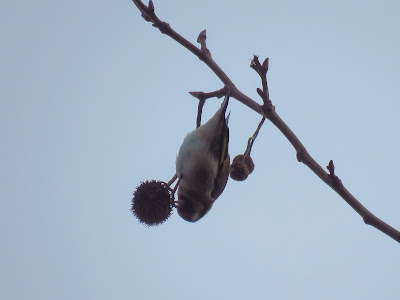
This morning I took a walk near a local park. On a square lined with Plane Trees, some pollarded, a flock of Goldfinches fed on the bauble-like fruits, often hanging from them acrobatically, as they often do.


Then I noticed the crows. They flew to the tip of the branches, where the plane tree fruits clustered, once they gained their balance they moved to the tip of the branch, and picked on the fruits, pulling at their stem. Then they purposefully hanged down from their legs, then only one leg while holding the fruit on the other and attempting to break the stem. What complex thing to do! Some of the fruits had frayed stems, like they had been chewed a few times. If a crow breaks the stem but drops the fruit, the other crows will be quick to go and steal the price. I didn't see this, but I did see chases and close guarding of the fruit by the owner crow, often flying to a safer place holding onto it.

All three crows did this, often the three of them hanging from branches at the same time. At least twice I saw they were successful, and then they flew with the fruit on their bill, once transferring it to their feet before landing and starting breaking the fruit open for their seeds. I'm always amazed at crows, I have covered how they crack mussels and periwinkles at the beach.

Today's behaviour, however, really topped it up. Were they copying the Goldfinches? Crows are always to the alert, they must have noticed the Goldfinches feeding on these fruits and had a go at getting them!

This is a video made with three clips I took from them


And a few photos of the behaviour.

Hanging from one leg, holding onto the fruit with the other.


Crow with its prize.
The pink gape suggests this is a young crow, feeding on the plane fruit. I wonder if this is a family, with the young copying the adults in learning this skill.
I'll be very interested to head from anyone that have seen this behaviour in their local crows!

Monday, 17 December 2018

Grey Wagtail feeding

Grey Wagtails breed in upland streams and rivers, but they are common passage and wintering birds in urban waterbodies, from small ponds to lakes. I watched one today in a local park,. Despite their name, they are surprisingly yellow, in the low winter sun this one shone very bright.

Grey Wagtails don't move much away from water, and often feed right at the water's edge picking tiny flies, beetles and other invertebrates, while wagging their long tails up and down. Today I was surprised by the behaviour of this wagtail when feeding on leaf litter by a puddle, as it was energetically lifting leaves and looking under them like a blackbird does.
This clip shows the behaviour:

Thursday, 29 November 2018

Bullfinches eating Guelder rose berries

A group of Bullfinches were feeding just outside Dalby Forest visitor centre this afternoon. We watched them from a window, just over them, and they seemed quite unaware of us, providing a great opportunity to watch this usually shy bird in action.
 Bullfinches are seed predators of many fruit trees. Blackbirds, Thrushes and Woodpigeons are seed dispersers, they eat the berry whole, digest the pulp and the seeds drop to the ground, undigested and prepared to germinate. This is the reason trees and bush species evolved fruits, as the way to disperse their seeds. In contrast, seed predators discard the flesh and eat the seeds inside each fruit. Many finches, like Hawfinches, Greenfinches and Goldfinches, are seed predators too.
Bullfinches favourite seeds include Honeysuckle, Rowan, Elder, Whitebeam and Blackberries, each ripening at different times of the year. Today, they were feeding on the bright red berries of the Guelder Rose, a late fruiting small tree. In their fantastic book "Birds and Berries", Barbara and David Snow document how bullfinches are one of the main seed predators of Guelder Rose.
 The bullfinches stretched to reach the berries (top shot) and used two techniques to get at the seed. They either opened up the fruit and picked the seed, leaving the flesh hanging from the bush or picked the berry and deftly extracted the seed. They will even hovering in front of the bunches of fruits to reach the most difficult ones.
A male picks a berry.
Female extracting a seed...
...and dropping the flesh.
There were not only bullfinches at the tree, a lone Robin, a seed disperser, was feeding on the berries, so even though there was a lot of seed predation going on, it's likely the Guelder Roses will manage to get some of their seed seeds to germinate.

More information
Snow, B. and D Snow 1988. Birds and Berries. T & AD Poyser. 268 pp.

Monday, 13 March 2017

Carrion crows dropping mussels

Today at Sewerby beach I was intrigued by a Carrion Crow, part of a large winter flock, appeared to drop something onto the rocks at the top of the beach, then come down to eat. Sometimes the crow would fail and repeat the action. The tide was low, exposing a flat platform of rocks with rich mussel beds, and the objects being dropped were actually mussels that the crows were collecting and carrying up the beach before dropping them on the solid rock to smash them (above).
Dropping potential food items to break them open has been previously documented, and best known in Golden Eagles (breaking open tortoises) and Lammergeiers (bones). Gulls and crows of various species have been recorded dropping intertidal hard-shelled molluscs hard substates, including roads. Intertidal foraging can be an important part of the diet of coastal crows in the winter, when insects are scarce. Crows will scavenge at the tide-line, or feed on small crabs, but some of these intertidal organisms, in particular periwinkles, cockles and mussels, are consumed after smashing them open by dropping onto hard substrates. Controlled observations of wild Carrion and Hooded crows show that crows chose larger mussels, more likely to smash and also providing more food. Shell dropping is not instinctive, young crows appear to perform rather poorly. They need to perfect their technique of dropping so that the height at which the mussels are dropped is the minimum height for them to break at impact, but not much lower. Young crows take more attempts at being successful.
There are three reasons why the minimum height should be used. One, dropping from higher up means wasting more energy flapping up. Also, higher drops means higher bounces and higher chances of the shell being lost. Finally, crows and gulls often steal from each other, a behaviour called kleptoparasitism.  Therefore researchers predicted that crows dropping mussels when other crows or gulls are nearby would be more wary of being robbed, indeed, crows with other crows or gulls nearby dropped their mussels from 2 m lower that lone crows.
Crow and gulls on mussel bed, the crow has already detached a mussel, while one of the gulls is still trying. Although many crows were actually busy either collecting mussels or breaking them up the beach today, I didn't see any gulls doing this.
Mussels are strongly attached to the rock and other mussels by threads, which can be hard to reach, as the mussels cover the rock very densely, not exposing the threads. It is quite a feat the crows manage to detach them
A view of the beach at low tide.

Despite the very bright light I managed a couple of clips here:


More information

Whiteley, J. D., Pritchard, J. S. & Slater, P. J. B. Strategies of mussel dropping by Carrion Crows Corvus c. corone. Bird Study 37, 12–17 (1990).

Davenport, J., O’Callaghan, M. J. A., Davenport, J. L. & Kelly, T. C. Mussel dropping by Carrion and Hooded crows: biomechanical and energetic considerations. J. Field Ornithol. 85, 196–205 (2014).

Berrow, S. D. , T. C. Kelly & A. A. Myers. The diet of coastal breeding Hooded Crows (Corvus corone cornix). Ecography 15, 337–346 (1992).

Sunday, 29 January 2017

Synchronised diving

I watched two drake Goosanders as they dived for food today. As soon as one dived, the other followed suit and they did this repeatedly, it was lovely to watch. Here is a distant clip.

 I then remembered a line of five fishing female Goosanders last year in a Swiss lake, swimming and diving in an orderly line along the shallows. They were behaving as if they were fishing cooperatively: by rounding up fish they would increase each of the individuals success rate. This cooperative fishing has also been observed in Cormorants and in the close relative of the Goosander, the Red-breasted Merganser.
The five female Goosanders fishing in a line, the individual at the far end peers under the water.

More information
Des Lauriers, J. R., & Brattstrom, B. H. (1965) Cooperative feeding behavior in Red-breasted Mergansers. The Auk, 639-639.

Saturday, 1 October 2016

Great tits feeding on horse-chestnut leaf miner

In a walk around the local park, a pair of Great Tits called my attention. They were calling and foraging in a horse chestnut. I watched how dexterously they grabbed the large leaves with their bills, pulled them towards them, and held them with one foot while feeding (top shot). They were looking for larvae or pupae of the horse chestnut leaf miner, Cameraria ohridella, a micromoth that has expanded its range throughout Europe from its native Balkans. The moth's larvae feed inside the leaves of the horse chestnut, leaving them speckled. Blue tits also feed on this leaf-miner (as do Marsh Tits), and I've seen them feeding on them before, but as they are lighter than Great Tits, they are able to just hang from the leaves themselves.

A short clip demonstrating this behaviour.


More information
Grabenweger, G., Kehrli, P., Schlick‐Steiner, B., Steiner, F., Stolz, M., & Bacher, S. (2005). Predator complex of the horse chestnut leafminer Cameraria ohridella: identification and impact assessment. Journal of Applied Entomology, 129(7), 353-362.

Sunday, 22 March 2015

Coot diving

We have a visiting Coot in our local park. It is quite used to people and a good photographic subject. Coots dive for a few seconds - they appear to be very buoyant - and lift pieces of vegetation from the bottom, to feed on the surface.

A front view of the coot.
Here is a short video of the coot diving for food.

Wednesday, 3 December 2014

Gritting greylag geese

Birds that feed on fibrous or hard food of vegetable origin often swallow sand or small stones ('grit'). Grit accumulates in the gizzard or crop, and together with the muscular action of the crop it helps macerate their food facilitating digestion and increasing food processing rate. The limited size of the gizzard means that herbivorous birds need to spend time just processing food, waiting until the gizzard empties, before another foraging bout. Grit can be ingested accidentally with the food or purposefully, by visiting places where it is easy to find. Wintering flocks of Greylag goose in Doñana National Park (Spain) visit sand dunes to ingest sand, and their crop can hold up to 10 g of sand.  Birds can adjust the amount of grit to their diet and in turn, crops containing more grit become more muscular, flexibly responding to the demands of different coarseness or amount of fibre in the diet.
 While watching the flock of wintering geese in my local park, I noticed them stopping in a bare area. First I thought they were feeding on the small tufts of grass there, but when I looked closer I realised they were ingesting grit. They spent a few minutes doing this, and then moved onto the grass to feed. The distinctive individual with a white head (above) serves as an identifier for this flock. I have seen him or her both at East Park and Pearson Park.
A pair gritting together.
Here is a short video of the behaviour:


More information
Amat, J. A., & Varo, N. (2008). Grit ingestion and size-related consumption of tubers by Graylag Geese. Waterbirds, 31(1), 133-137. here.

VerCauteren, K. C., Lavelle, M. J., & Shively, K. J. (2003). Characteristics of grit in Canada goose gizzards. Wildlife Society Bulletin, 265-269. Here.

Friday, 13 June 2014

Blue tit family and Sycamore aphids

I heard the rasping begging calls of blue tit fledglings coming from a Sycamore tree, which I find it is a very common occurrence. As I approached I noticed clouds of Sycamore Aphids cascading down from the tree as the adult Blue tits moved about, searching for the aphids themselves and green caterpillars (above). It was a very impressive spectacle as the light hit the aphids and amplified the effect. The tree leaves were thickly peppered with aphids, and fledglings were having a go at finding food by themselves. One of them found a long green caterpillar and wrestled with it for a while until it was able to swallow it.
I tried to capture the density of aphids flying off around the tree in this photo.
The evenly spaced, winged Sycamore aphids (Drepanosiphum platanoidis)
A fledgling begging for food.
The adult cuts the caterpillar in half before feeding the fledgling.
This young one had caught a caterpillar on its own.
You can watch one of the adults foraging and the aphids flying off here.

Friday, 28 March 2014

Problem solving Goldfinches

ResearchBlogging.orgI realised only recently that Goldfinch manipulation abilities are superb. They hold large seeds with one foot while manoeuvring them into position to feed, or fold stems back to hold berries or seeds securely, or hand upside down to reach the thinnest branches. Yesterday I watched a small flock feeding on the catkins of a silver birch. The closest bird to me held a catkin while feeding from it and even changed the foot it used to hold it.
 It happens that Goldfinch manipulation abilities have been known for a long time (Plinius and Gesner mention it). Golfinches used to feature in animal shows, as seen in this old British Pathe film demonstrating the string pulling ability of a Goldfinch. The bird alternatively pulls and holds a string to reach a container with water or food.


String pulling is a common experimental setup to investigate the problem solving ability in birds. Parrots, corvids parids and finches can pass the test. In a series of experiments on captive-reared Goldfinches and Siskins, Uta Seibt and Wolfgang Wickler set to explore the problem-solving abilities of individual birds and what factors influence success. The birds were reared in cages with no access to material with which they could experiment their manipulative abilities and were tested when less than 5 months old using a 7-cm string holding a thimble with food at the end.
The researchers found that there were three groups of bird. 'Inventors' (23% of goldfinches and 62% of siskins) solved the string-pulling test by themselves, some times in the first experimental session, whereas ‘imitators’ (25% of goldfinches; 10% of siskins) were successful after watching conspecifics solving the problem. The remaining birds failed the test even when exposed to an experimented model.
 Something the experiment highlighted was the remarkable behavioural plasticity of Goldfinches and Siskins as shown by the diverse repertoire of behaviours the birds used to solve the problem (getting the food in the thimble):
Several individuals of both species hovered in flight near the thimble. They never succeeded in taking food, but still tried to reach food this way when they were already able to eat via string pulling and holding. A few goldfinches and siskins stretched from the cage fence towards the thimble but without successfully touching it. Two siskins and one goldfinch reached the thimble while hanging down from the perch head down like bats. Several siskins climbed down the string and ate from the thimble. Three other siskins shed some food from the thimble by heavily shaking the string and pecked the grain from the floor. (Goldfinches never moved to the cage floor.) Eight goldfinches and seven siskins invented a special method to flick the string around the perch, thus lifting the thimble indirectly. Some individuals used several of these techniques.
In addition, some individuals showed a preference for one or the other foot to hold the string.
Additional experiments tested the effect of being reared with access to branchlets. These seemed to facilitate success, but they were not necessary in several individuals. Similarly, the presence of a model facilitates success for a large proportion of the birds (the 'imitators'). Finally, the presence of food in the thimble was also necessary for the goldfinches to lift the string.
Bird species which instinctively used their feet to clamp food or branches while foraging - like the Goldfinch - should be able to solve the test, but the experiments show that birds still vary in their predisposition to experiment with the string and in their success. What proportion of wild Goldfinches use foot-bill coordination when foraging is hard to assess, but one would expect that given that natural conditions this would be higher than in the experiments. The wild birds are exposed to a much richer rearing environment, as they have very diverse diets and have to extract seeds from an array of plants from small perennials with soft pliable stems to trees with variably flexible branchlets (dandelion, teasel, lavender birch, ash, alder, rowan to give some examples). In addition, Goldfinches are highly social birds that feed together in flocks, so the learning opportunities would be plentiful.
Goldfinch holding birch catkin with left foot. Note that the catkin is still attached to the branch and the foot helps immobilise it, facilitating food retrieval.
More information
Seibt, U., & Wickler, W. (2006). Individuality in Problem Solving: String Pulling in Two Carduelis Species (Aves: Passeriformes) Ethology, 112 (5), 493-502 DOI: 10.1111/j.1439-0310.2005.01172.x . Here.

Friday, 24 January 2014

Dancing for worms

I had blogged before on this curious gull behaviour, although that occasion I didn't manage to see the effects of the gull 'worm dance' or foot-paddling. This morning, on the university ground, a Herring gull did the worm dance energetically, and very effectively on the wet grass. I watched as it captured four or five good size worms more or less in the same spot in a few minutes. Breakfast sorted!


UPDATE 6/08/17. I just found this interesting article by Niko Tinbergen in which he discusses the behaviour in gulls and other birds. He calls it 'foot paddling' and the behaviorr includes paddling in shallow water:
Tinbergen, N. (1962). Foot-paddling in gulls. British Birds, 55(3), 117-120. Here.

Wednesday, 4 December 2013

Treecreepers and mixed flocks

ResearchBlogging.orgAs winter sets in, small, resident insectivorous birds including Long-tailed tits, Great Tits and Blue Tits, Coal Tits, Goldcrests and Treecreepers join in loose, vocal mixed-species flocks that travel and forage together. Why do they eschew from following the saying 'birds of a feather flock together'? Well, first, their small bodies lose heat easily and the days are short, so they need to obtain as much food as possible. On the other hand, the leafless trees makes them more exposed to predation, so, as they feed, they need to be vigilant, keeping an eye on predators and an eye on food, so to speak. Does flocking together help with this challenge: increasing foraging efficiency and reducing predation risk?
 Birds of different species can learn from each other while foraging together: where to find food and how to obtain it. Many of the birds in the mixed species flocks are young of the year, with much to learn. Also, birds spend less time watching for predators while in flocks than when solitary, which allows them to increase the time they can spend looking for food. Despite being 'in a crowd', Individuals in a flock made up of different species may be able to compete less amongst themselves than if they were in a single species flock, as different species often search for food in different microhabitats in trees and bushes. In these mixed flocks, there is a pecking order, with some species dominant, and others subordinate. In Wytham Wood, Oxford, the pecking order was from the more dominant, larger Great Tit, Blue Tit, Marsh Tit, Coal Tit, Long-tailed Tit, and finally the Goldcrest.
  Importantly, the more individuals in a flock, the more eyes and ears available to detect predators. There are similarities in the alarm calls of different species which can allow them to respond appropriately to each others calls.
 Treecreepers are specialists, exploiting the invertebrates found in the little nooks and crannies of tree trunks and thick branches, which they probe with their thin, curved bill while creeping up the trunk aided by their phenomenally curved nails and stiff tail, woodpecker style. This niche overlaps little with other members of the species flocks, and so, they are not expected to benefit from learning from other species or finding new food sources. What do they have to gain from joining mixed species flocks? Arevalo and Gosler investigated the behaviour of Treecreepers joining species flocks in Wytham Wood during two winters. When they found a treecreeper, they noted if if was part of a flock, and if it was, the size of the flock. They also recorded the number of hops and pecks to calculate the percentage of time the bird was looking for food.
 Treecrepers joined mixed flocks more often when the temperatures were lower, so all Treecreepers were found in mixed flocks in the coldest winter months, when flocks were also larger. When part of a flock, Treecreepers were most often found in the main trunk, where competition with other species was minimal, while when solitary, they used internal branches more, so they reduced their niche when in the flock.
Their key result is that the pecking rate was positively correlated with flock size, - indicating that treecreepers could devote more time to searching for food the larger the flock it was in. The pecking rate was not affected by temperature or by the species of tree. This suggests that treecreeper in mixed flocks reduced vigilance, concentrating their effort in foraging.
Overall, this research showed that Treecreepers make a decision to join a mixed flock based on the benefits and costs they are going to obtain. The colder the temperature, the more effort they need to make searching for food, and joining a flock allows them to use a larger proportion of their time feeding, as opposed to being vigilant. At higher temperatures the treecreeper could afford to spend more time keeping an eye on predators, and use a wider niche. The treecreeper, being very cryptic compared to the other species in the flock, might benefit directly from joining the noisy, more visible tits, if they are also less likely to be noticed by a potential predator finding the flock. Arevalo and Gosler also noted:
Treecreepers in flocks were seen to respond to the alarm calls of Long-tailed Tit and Coal Tit during Sparrowhawk attacks by 'freezing' and only resuming foraging after the other species had done so. Play-back experiments with Treecreepers have also shown that they can use information from other species within the flocks in which they usually participate.
You can see this short clip I took a couple of days ago of a Treecreeper showing this 'freezing' behaviour, when a Magpie was nearby. The treecreeper was not part of a flock.


More information

Morse, D. H. (1978). Structure and foraging patterns of flocks of tits and associated species in an English woodland during the winter. Ibis, 120(3), 298-312.

Morse, D. H. (1970). Ecological aspects of some mixed-species foraging flocks of birds. Ecological Monographs, 119-168.

J. E. Arévalo and A. G. Gosler (1994). The behaviour of Treecreepers Certhia familiaris in mixed-species flocks in winter. Bird Study, 41 (1), 1-6 : 10.1080/00063659409477190

Monday, 11 November 2013

Gobbling up acorns

In the last few weeks it has become apparent that this is an acorns mast year, a bumper year for these seeds - and also for many berries. The evergreen oaks in my local park have not been an exception: Grey Squirrels and Woodpigeons are enjoying this bonanza and feeding on fallen acorns on the ground and the remaining ones in the tree. Today a large flock of Woodpigeons, including many juveniles, feasted on acorns in the park. I managed to record some videos of the feeding activities of the Woodpigeons in the trees and the ground underneath. I find it amazing that the Woodpigeons swallow the acorns whole, presumably their digestive system dissolving the tough shells.
At some point in the sequence, something scared the woodpigeons and most of the flock took to the air. The one I was filming stayed put in the tree, looking up nervously.

Tuesday, 7 May 2013

Rook picnic

People were not the only ones enjoying the sunny and warm Sunday. A Rook walked around the picnic tables, intently looking around and underneath in search of scraps. A few people threw scraps to the rook and she filled her gular pouch with the tidbits. Its fledgling, precariously perched on a nearby tree, called. The Rook went back and forth taking food to its offspring.