Showing posts with label berries. Show all posts

Saturday, 4 December 2021

Mistle thrush pairs defending berry trees

Several bird species hold territories during the winter, like Robins or Wrens defending their patch and singing through the winter. It is rarer that a pair will defend a winter territory. I have covered examples like Stonechats and Pied Wagtails before. The former usually include a male and a female, but they are unlikely to be a mated pair.

A pair of Mistle Thrushes near their cotoneaster tree. Northern Cemetery 30/11/21.

Earlier in the week I saw some Rowans heavy with berries along a street. A Mistle Thrush sat on a taller tree nearby. Then another individual flew from the berry tree, a pair! Later in my walk, I saw another pair of Mistle Thrushes near their defended cotoneaster (above). I then realised seen paired Mistle Thrushes in the winter before, near their defended trees. Are they a resident pair? Is a pair better than a single individual defending their berry larders?

             
Clockwise from top left, Yew, Ivy, Rowan and Holly ripe berries.

The berries

Mistle Thrushes are well known for their winter defence of berry resources. Holly is one of the most important defended trees in the UK, followed by Hawthorn, Mistletoe, Yew and, later in the winter, Ivy. At Hull, I've seen Mistle Thrushes defend Holly, Yew, Rowan, Whitebeam and Cotoneaster. Often the same trees are defended year after year.

Mistle Thrush on defended holly, one of an Avenues of Hollies at East Park defended by a pair, 23rd November 2021.
Mistle Thrush overlooking its defenced Rowan, 1st February 2021.
Mistle Thrush on General Cemetery on its defenced Whitebeam at Pearson Park. 17th October 2014.
Mistle Thrush on its defended berry-laden Yew.
A Mistle Thrush atop the church rooftop checks the yew opposite, on Cottingham Road Community Church garden. 14th November 2017.

Defence behaviour

Aggressive tree defence behaviour is spectacular: The Mistle Thrushes use their loud rattling or churring calls, repeatedly and chases other birds away from their tree. Most aggressive interactions involve repelling other Mistle thrushes, but also any other thrushes, like Blackbird, and various finches, Great Spotted Woodpeckers, Waxwings and even single Woodpigeons. Defence consists on chasing intruders, often silently and even if the birds were feeding on fallen berries under the tree. If there is a conflict then the individual might flick its tail and wings, their white underwings flashing, while churring persistently. Churring also occurs in flight during chases. Their defence is effective due to their large body size - they are the largest European thrush. Curiously Barbara and David Snow, who studied this behaviour in the UK note how the Mistle Thrush chooses who to attack carefully and it will chase only some species away so long as they are food competitors for the particular tree it is defending. For example Starlings are left alone in hawthorn and holly (whose berries they rarely eat) but chased from Ivy, which they eat. Greenfinches and Great Tits, are chased from Yew (they feed on the seeds) but not from Holly, which they don't eat. Eventually, after a few attacks, the local birds will learn to avoid the defended trees, and the Mistle Thrush just watches from a distance, and often this is how you'll find a Mistle Thrush, sitting on a vantage point near its precious tree.

Establishment of the guarded tree

Snow and Snow describe that the system of tree defence is established in October or early November, when song might be occasionally heard and other Mistle Thrushes are vigorously driven off until the territory is set. That way they can exclusively feed on these berries through the winter when they are needed. The defended trees become their winter larders, standing out on the landscape, packed full of berries when all other trees have been stripped out. Mistle Thrushes actually avoid feeding on the berries of their defended tree if they can, especially when the weather is mild and the ground is soft and they can rely on worms and other invertebrates. You need to pay attention to these trees full of berries later in the winter to recognise that the reason they are there is that a Mistle Thrush is just sitting atop a tree or aerial nearby, preening or resting. Unfortunately this effort will be worth nothing if a hard weather spell drives flocks of winter thrushes or Waxwings onto their area, then the Mistle Thrushes despite their best efforts may be unable to maintain their tree defence and lose their berry crop in a day or two. If the weather is mild, the tree can hold its berries until spring, and then, usually by the end of March, trees stop being defended. The Mistle Thrushes start nest building, often nearby. In the case of their defence of holly, the long-lasting berries, which can remain in the tree for up to nine months, are often used to feed their young. The hard work of defending the tree through the winter pays off not only to increase adult survival but as parental investment.

A pair of Mistle Thrushes near berry laden rowans at Auckland Avenue, 14th November 2017.

Pair defence

If Mistle thrushes stay to breed on the area near their defended tree, it would make sense that the pair defends the tree, rather than one individual. Snow and Snow describe how pair defence is more common and successful than single individual defence, although no data is given as to the proportion of pair defence. They say that "nearly all trees successfully defended throughout the winter were jointly defended by a pair of Mistle thrushes" and that  “pairs or individuals centred on a source of fruit which, if all goes well, will be defended through the coming winter.” In contrast, research on Mistle Thrushes defending Mistletoe clumps in woodland in Poland did not find evidence of pair defence. Could it be that pair defence occurs in some situations or for some berry sources and not for others? Anecdotal observations, however, suggest that members of a pair can defend different trees in the same area, and join forces if one of the pair loses their tree. On their article on Mistle Thrush defence Barbara and David Snow comment:

"When fruit territories are first established, in autumn, each defended tree may be guarded by a single Mistle Thrush or by a pair. It is probably common for members of a pair to establish themselves at neighbouring fruit-trees. Thus we had three cases where two Mistle Thrushes began by defending separate trees quite near to one another (60-180 m) and later, when one of the trees was stripped (as a result of the onslaught by Fieldfares and Redwings in the severe weather of December 1981), the two jointly defended the tree that still had fruit. In another case a pair of Mistle Thrushes jointly guarded the same holly tree from October or November in the two successive years, continuing throughout the winter in the first year but losing the fruit to invading Fieldfares and Redwings in the second year."
Snow and Snow indeed suggests that the same individuals, if they survive, may defend the same trees year after year, but their birds weren't ringed, so we can't know for sure. I'm surprised there is still so much to known about this widespread bird!

More information
Skórka, P. & Wójcik, J. D. Population Dynamics and Social Behavior of the Mistle Thrush Turdus viscivorus During Winter. Acta Ornithol. 40, 35–42 (2005).

Snow, B. K. & Snow, D. W. Long-term defence of fruit by Mistle Thrushes Turdus viscivorus. Ibis 126, 39–49 (2008).

Snow, B., & Snow, D. (2010). Birds and berries. A&C Black.

Tuesday, 10 March 2020

Colour-ringed Waxwings

I went to see the Hessle waxwings this morning, where a flock has been present since last Friday. Straight away, I saw two photographers looking at a tree. I soon joined them and the 18-strong flock was there, in a small street-lining cherry tree, facing the strong westerly wind. The light was beautiful compared to my previous Waxwing sightings, most of the time in the depths of winter. The birds were quite mobile, trilling and moving from tree to tree before descending to the unlikely source of berries this time of year: hawthorns.
No supermarket car pars, but car dealerships this time.
The 18 strong flock. 
Berries, what berries?
Probably most hawthorns in the country were stripped of berries long ago. Not these. The leaves of some of them sprouting amongst last year’s crop of berries. The reason for the late berries could lay in the location of this hedge: a very narrow strip of land between the A63 and a busy local road on an industrial estate. Every time the waxwings descended to feed, roaring trucks on one side and fast delivery vans on the other, I feared for their safety. Photos don’t really convey the feeling of being there, the noise of the road and the wind, the feel of the acrid stench of the traffic fumes at the back of your throat. This stressful food location has probably kept the local thrushes and Woodpigeons away.
On the hawthorn: berries and fresh shoots.

Colour rings
Two of the waxwings had plastic rings with different colour combinations on their legs. The yellow plastic over metal of their right legs indicate that both birds are part of the 2019 ringing scheme by the Grampian Ringing Group. In fact, information supplied by Raymond Duncan from the Grampian ringing group indicates that both birds were ringed on the 7th December 2019, in Aberdeen. One of the birds, a female with white, black and red rings stayed put until the 5th of January at Aberdeen, the other, a male with light green over dark green and dark green ring was found in Thirsk (N Yorkshire) on the 30th December and 3rd of January. Waxwings move towards the UK at the beginning of winter, in large numbers when the berry crop in Scandinavia is poor, what is called irruptions, and then they move south and east through the country. Is it coincidence that both birds are together in Hessle? Although social birds, Waxwings are not known for forming strong individual bonds when they move about during winter. However, there are reports of the same birds returning to favoured spots in different irruption years, so the same individuals may meet again in these Waxwing hotspots.

The Grampian Ringing Group has many years of experience colour ringing waxwings: they have colour-ringed thousands of waxwings for over thirty years. This winter, their dedication has paid off with 100 ringed waxwings and some resightings across the country. Their blog is a treasure trove from everything waxwing including how to sex and age them. Resightings of colour ringed birds, particularly when the colour rings and their position can be ascertained, are crucial to follow the movements of Waxwings without need to recapture them.
The male was ringed in Aberdeen in December.
Female also ringed in Aberdeen in December.
Males, females and ageing
Waxwings of different sexes and ages appear similar at first sight, but they are subtly different. Examination of their plumage pattern can actually be used to age and sex them. Adults have their primaries edged with white and bright yellow, forming a ‘hook’, while young individuals have only one side of the primaries lined with white or pale yellow. When the wing is closed this forms a single line. First winter immatures also have a shorter crest. The ‘bib’ is larger and sharper in males, while the bib edges are diffuse in females. The yellow terminal tail band is wider in males. Males have over 6 waxy red feather tips, and these are longer in adult males, but there is some overlap between sexes. Females have a small number of smaller waxy tips. Some of these features are visible in flight, so you may want to have a go at sexing and aging your waxwings from photos.
The diffuse edge of the bib indicates this is a female.
After watching the Waxwings for a while, I went to their old haunts in Priory Park at Hessle. Trees lining the road between Sainsburys and Aldi supermarkets have been removed, but their favourite berry trees, rowans, are still there, of course, there wasn't a single berry left! 

Thursday, 29 November 2018

Bullfinches eating Guelder rose berries

A group of Bullfinches were feeding just outside Dalby Forest visitor centre this afternoon. We watched them from a window, just over them, and they seemed quite unaware of us, providing a great opportunity to watch this usually shy bird in action.
 Bullfinches are seed predators of many fruit trees. Blackbirds, Thrushes and Woodpigeons are seed dispersers, they eat the berry whole, digest the pulp and the seeds drop to the ground, undigested and prepared to germinate. This is the reason trees and bush species evolved fruits, as the way to disperse their seeds. In contrast, seed predators discard the flesh and eat the seeds inside each fruit. Many finches, like Hawfinches, Greenfinches and Goldfinches, are seed predators too.
Bullfinches favourite seeds include Honeysuckle, Rowan, Elder, Whitebeam and Blackberries, each ripening at different times of the year. Today, they were feeding on the bright red berries of the Guelder Rose, a late fruiting small tree. In their fantastic book "Birds and Berries", Barbara and David Snow document how bullfinches are one of the main seed predators of Guelder Rose.
 The bullfinches stretched to reach the berries (top shot) and used two techniques to get at the seed. They either opened up the fruit and picked the seed, leaving the flesh hanging from the bush or picked the berry and deftly extracted the seed. They will even hovering in front of the bunches of fruits to reach the most difficult ones.
A male picks a berry.
Female extracting a seed...
...and dropping the flesh.
There were not only bullfinches at the tree, a lone Robin, a seed disperser, was feeding on the berries, so even though there was a lot of seed predation going on, it's likely the Guelder Roses will manage to get some of their seed seeds to germinate.

More information
Snow, B. and D Snow 1988. Birds and Berries. T & AD Poyser. 268 pp.

Sunday, 26 January 2014

Redwing and berries

This lone Redwing feeding on cotoneaster berries in the park did not lose track of the sky above. When feeding alone, birds have to keep watch more often than when in flocks.

Tuesday, 26 November 2013

Having a very berry time

A few photos from my garden blackbirds taken yesterday, through two layers of glass. The rowan is still loaded with bright, fat berries, which seem to be keeping well. A female, above, about to swallow one. A male, below, had a quiet time after feeding.
This other male (below) has started visiting my garden recently. A quite distinctive individual due to the large white patches on his head. White feathers, often on the head, are quite common in my local blackbirds, but the extent of this individual white markings is the most extreme I've seen around here.


Sunday, 17 November 2013

Charming seed predators

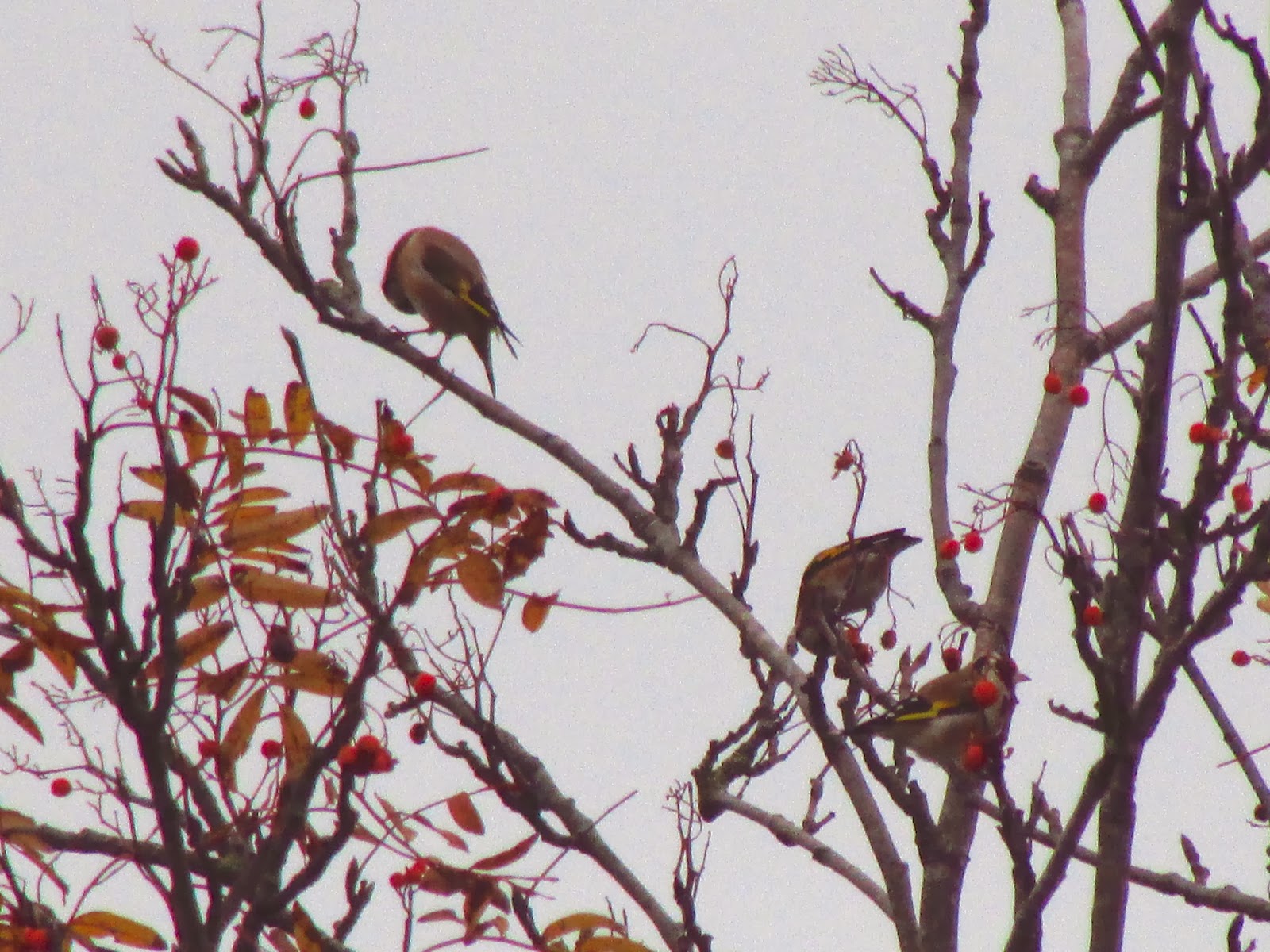
 ResearchBlogging.orgI find fascinating that when you seen something for the first time, then the chances are that you would see it again, seeing helps you see more. In the last couple of weeks a charm of goldfinches have been regular visitors in the garden feeders, gorging themselves on nyjer and sunflower seeds. I was watching the goldfinches and taking photos from inside of the house, when I noticed that one of the birds that couldn't get to the feeders was feeding on rowanberry seeds (above), discarding the pulp. This is typical of seed feeding birds like finches. Finches are seed predators, unlike thrushes, that eat the berries whole, passing the seed undigested and undamaged, in their droppings, and dispersing the seed away from the tree in the process.
 There was no mention of Goldfinches in the authoritative 'Birds and Berries' by Snow and Snow. I found a wonderful, if lone, photo on Flickr here and a line in a novel that suggested that this behaviour had been noticed before:
They went down the track through a wood where a flock of goldfinches was feeding on the rowanberries [...]
Tessa Hadley, Accidents in the home, 2002

Today on a walk in the park, I noticed a rowan on a garden and had a look. A charm of goldfinches looked busy on it. I wouldn't have normally had a closer look, but I did. They were feeding on the berries, hanging from the bunches like tits, not one, not two, but the whole flock seemed to be enjoying the berry seeds. The photos from today (below) are atrocious, as it was late and the light very poor, but a record nonetheless. After a while, something spooked the birds, a Sparrowhawk perhaps, and the Goldfinches went quiet and took to the air with a group of starlings and feral pigeons. I glimpsed what I think was a woodcock before if flew behind a roof, powerful wings and long bill, but just for a second. A Blackbird called: 'seee!' from a bush, their air predator alarm call.
 Indeed, a range of finches - including Goldfinches - are reported to feed on rowan seeds occasionally: Greenfinch, Crossbill, Brambling, Chaffinch, Hawfinch, Goldfinch, Redpoll and Siskin. Indeed, for some finches, particularly Bullfinch and Pine Grosbeak rowan seed in autumn can be their staple food. But rowan is a masting tree, where crop is very variable across years, with bumper crop, the 'masting years' interspeded with poor or failed crops in some. In the winter of 2004-2005, simultaneous irruptions of boreal Waxwing, Pine Grosbeak and northern Bullfinch occurred, all three birds liking rowan berries. Bullfinch local movements and irruptions in western and southern Europe have been linked to the strength of rowanberry fruiting crop.


This goldfinch appeared to use her foot to hold the berry in place

  A couple of weeks ago I spotted a juvenile Common Rosefinch, a rare visitor to these shores, feeding on rowan berries

Juvenile Common Rosefinch feeding on Rowan berries. 4/11/2013.

Some finches might use rowan depending on local availability. As this year rowan berries are plentiful and the thrushes have barely made a dent on the crop, Goldfinches and other birds may take advantage of this resource opportunistically.

References
Pennington, Mike G., and Eric R. Meek. (2006). The ‘Northern Bullfinch’ invasion of autumn 2004. British Birds 99: 2-24.

Munilla, I., and Guitián, J. (2012). Numerical response of Bullfinches Pyrrhula pyrrhula to winter seed abundance. Ornis Fennica, 89(3), 197-205.

Fox, A. D., Kobro, S., Lehikoinen, A., Lyngs, P., and Väisänen, R. A. (2009). Northern Bullfinch Pyrrhula p. pyrrhula irruptive behaviour linked to rowanberry Sorbus aucuparia abundance. Ornis Fennica, 86, 51-60.

Snow, B. K., and Snow, D. (2011). Birds and berries. A&C Black.

Raspe, O., Findlay, C., and Jacquemart, A. L. (2000). Sorbus aucuparia Journal of Ecology, 88 (5), 910-930 DOI: 0.1046/j.1365-2745.2000.00502.x

Saturday, 19 October 2013

Thrushes and whitebeam berries


Whitebeams, a tree related to the rowan, is fruiting now. They have contrasting good and bad years in fruiting (masting trees), and the fruits do not last long, becoming brown and shriveled in about a month from ripening, but berries are large fruits with a lot of pulp compared to the seed content, so they are very rewarding food when available.
Woodpigeons and Crows like the fruit, and so do all thrushes, but they are too large for Robins, Blackcaps and Starlings. They are also eaten (pecked as opposed to eaten whole) or their seeds predated by Blue Tits, Chaffinches and Greenfinches.
 In my local park yesterday, there was a strong contrast between the colour of the fruits of a line of whitebeams. One of them had the brightest red berries, and Woodpigeons and Blackbirds were feeding on it. Note the bulging crop of the Blackbird in the photo above.
 Two trees at the other end of the line had still many unripe berries and as a flock of mixed finches and tits, including goldfinches, chaffinches and great and blue tits descended on it. Suddenly, it became apparent this tree had an owner. A Mistle Thrush started churring vigorously from its centre, while flicking its wings and tail. It seems to make little impact on the little birds, although it kept going for quite a while.
Woodpigeon feeding amongst the berries
Mistle thrush on guard.

And the very nervous one in this short clip.


More information
Snow, B. K., & Snow, D. (2011). Birds and berries. A&C Black. In Google Books.

Friday, 6 September 2013

Woodpigeon eating elderberries

The elders are now fully laden with a plentiful berry harvest. Early this morning, a group of nervous starlings came up and down to one, feeding on the berries. A relaxed woodpigeon stretched and fed as well. The light wasn't perfect, and the birds a bit far, but I like that the berry bunches are still pretty much intact. Elder provides berries from mid August to early November. In their monograph on Birds and Berries, Barbara and David Snow recorded 16 species of seed dispersers and 6 of seed predators feeding on elder berries, the largest diversity of species for any other fruit. Numerically, Starlings were the most common, followed by Blackbirds, but other thrushes, migrating warblers, robins, corvids and even moorhens were recorded feeding on berries. Woodpigeons, after Blue Tits, were the main seed predators, although woodpigeons can also be seed dispersers of this fruit.

Sunday, 11 November 2012

Wandering Waxwings

ResearchBlogging.orgI have litte interest in watching birds swept away from their native grounds by a tropical storm, or inexplicably lost and found far away from their usual migratory routes. Waxwings are different, and I have been wanting to see them for years. They might be rare, or not present in great numbers every year, but the UK is part of their distribution range. The last couple of days, I have been popping in a local supermarket carpark to watch a large flock of these amazing birds. Bohemian Waxwings, Bombycilla garrulus, as other boreal bird species - like Crosbills, Siskins and Redpolls - do not fit into a regular migratory pattern, they are instead irruptive migrants. It is thought that the species common name, Bohemian, comes from these wandering habits. In irruption years, many thousands of individuals flock and wander well south of their summer grounds in the the Russian and northern Scandinavian taiga making it to the UK. Flocks then move nomadically in search of food, as it is not cold winters what prompts their movement, but unpredictable food resources. Irruption years in Waxwings correlate with poor crops on fruit and berries in their northern grounds following a good fruiting year. Waxwings are highly frugivorous birds, their exclusive diet in the winter consists of berries and fruits: Rowan, Hawthorn, Cotoneaster, Mistletoe, Rose Hips and many others both wild and cultivated. The main resource, Rowan berries, fluctuates erratically across years in their summer grounds, as Rowan is a masting species, as fruit production is synchronised in the population and totally fails some years. During these poor fruit years, Waxwings initiate their movements earlier in the year, and therefore earlier arrivals of waxwings indicate that it will be an irruption year.
 During irruptions, waxwings carry on moving through the winter as they deplete their food resources locally, and they are wanderers all year round, with little chance that they will return to the same areas where they were born in the following summer. This winter is going to be one of those irruption years, and the Waxwing invasion is well underway.
 Waxwings are surprisingly small birds, similar in size to Starlings, to which they also resemble in flight, as they flock and have pointy, triangular wings. At close range there is no mistaking them, with their soft plumage, characteristic crest and 'zorro' mask. At even closer range, you might get to see the striking bright scarlet waxy drops and yellow streaks adorning their wings. They do look smart.
 As most fruit eaters, Waxwings need to eat a large number of berries to survive - an estimation was double their body weight in berries. A flock can quickly strip down a tree. When not feeding, they like to sit atop trees, preening and just looking around, while constantly chattering, a pleasing cricket-like and jingly call.

A large flock of Waxwings resting and preening.
The top of this Rowan has already been stripped, but there are still plenty of berries at the bottom of the tree, which are harder to reach 
A circling flock of Waxwings deciding where to stop
 These three were looking up nervously, might well have been keeping an eye on the Sparrowhawk soaring above them.
The flock I was watching was resting on a Rowan tree and the birds were not quite daring to do to the bottom of the tree to start eating. They increased the rhythm of they calls like they were agreeing on something, and took to the wing. I am so pleased I finally managed to catch up with them. Bon voyage!

More information

Barbara and David Snow (1988) Birds and Berries. T & AD Poyser. 268 pp.

Ian Newton (2006) Advances in the study of irruptive migration. Ardea 94, 433-460.

Koenig, W., & Knops, J. (2001). Seed-crop size and eruptions of North American boreal seed-eating birds Journal of Animal Ecology, 70 (4), 609-620 DOI: 10.1046/j.1365-2656.2001.00516.x

Monday, 22 October 2012

Guarding the berries

The rowan in the garden is laden with succulent berries. Blackbirds have been showing an interest in the rowan since the beginning of the month. On the 9th, a male tried them, picking them up, and dropping them. It have me the impression it was checking how ripe they were, and he just felt they weren't quite right. Since them, I have flushed the blackbirds from the rowan a few times, often a pair. I watched a male feeding on honesuckle berries yesterday, while the cotoneaster does not seem to be ripe yet. This distinctive male - note the pair of white feathers on his chest - sat on the rowan for a while, surrounded by the colourful changing leaves of the tree and the clumps of heavy berries. Typical blackbird 'sitting' behaviour, quietly guarding his sweet red crop.

Monday, 28 November 2011

Woodpigeons and Holly

 There is a mature holly on a street in my way to work. It's leaves don't have any thorns and it is a very lush female specimen. A few weeks ago it was an impressive sight, laden with bright berries. All through October and November, it has been visited by Woodpigeons, balancing precariously and gorging themselves on the berries.