Returning home in the light evening today I noticed Blackbirds 'chinking'. This is a very persistent call, often by several individuals, that I usually associate to summer evenings. The blackbirds, up to four of them, were in the tree where the Tawny Owl nest box is. The owls are indeed in occupation, although they were nowhere to be seen from the ground. They have been calling at dusk, and every few days I have been able to watch one of them as it called, sat on the box for a few minutes and then left to go hunting. Often, later at night, one calls with a lovely gurgling sound from inside the nest. Two of the blackbirds got close to the entrance, calling non stop, if there was an owl in the nest, they might be able to see it. At some point they calmed and left, but then one returned, started calling and the others joined him in the tree.
I wondered that the 'chinking' is not a roosting call, but a mobbing call to an owl, which is more likely to be encountered active as nights become lighter in the summertime. In a couple of weeks, the leaves would obscure the view and although a blackbird calling is evident, a quiet owl sitting inside a tree is not. This is a lovely clip of blackbirds mobbing a Tawny Owl demonstrating the call and also how fearless they are towards the owl.
UPDATE 7 April 2017. From the living room at 20:05, I heard a Blackbird suddenly starting to 'chink' and I looked at the nest box. The round silhouette of a Tawny was sitting atop the nest. It was light enough to get a low resolution photo.
Showing posts with label Blackbird. Show all posts
Wednesday, 5 April 2017
Wednesday, 9 November 2016
Chok, chock, chock!
I've been wanting to take a photo of a Blackbird in this posture for a long time. Blackbirds do often cock their tails. When they alight they do that tail-cocking so as to keep their balance - in a similar way to Woodpigeons - they often do a jerky tail-cocking action when they do one of their various alarm calls 'chok, chok, chok' at the same time than they flap their wings. On Sunday, a windy day, this Blackbird perched on the side of a drinking trough, the wind made it lose its balance a bit and it stayed, tail cocked, for that second longer for me to press the shutter. Got you!
Labels:
alarm calls,
Blackbird,
portrait
Monday, 18 July 2016
Blackbird anting
This morning, on my way to work, I noticed a Blackbird behaving strangely by a kerb. When I looked closer I realised that it was 'anting', a behaviour involving the use use of ants by birds. The Blackbird had its tail and wings spread, squatting - probably on top of an ants nest - and the ants were climbing on the birds feathers. The blackbird was rubbing its wings, coming back to the same spot. An ant run by the back of its head and the blackbird wiped it off. You can watch a short clip of the behaviour.
Anting is thought to aid in cleaning or disinfecting the bird's plumage. The bird would be using the ants as tools, as ant's secretions, including formic acid have known bactericidal, insecticidal and fungicidal properties. The ants would behave agressively and defensively if they are picked up or rubbed by the bird or if the bird is disturbing their nest.
Blackbirds, other thrushes, starlings and corvids use anting. Some of the species sit on wood ants nests, or even apply individual ants on their plumage. Some bird species use a similar behaviour with millipedes, which also produce strong chemical secretions.
I think it is unlikely anting is a learned behaviour, as it is quite rare. I wonder if the ant's frenzied activity around nests today - it was flying ant day in Hull - stimulated the Blackbird to engage in anting behaviour.
More information
See this post at my other blog on birds and flying ant day
Anting is thought to aid in cleaning or disinfecting the bird's plumage. The bird would be using the ants as tools, as ant's secretions, including formic acid have known bactericidal, insecticidal and fungicidal properties. The ants would behave agressively and defensively if they are picked up or rubbed by the bird or if the bird is disturbing their nest.
Blackbirds, other thrushes, starlings and corvids use anting. Some of the species sit on wood ants nests, or even apply individual ants on their plumage. Some bird species use a similar behaviour with millipedes, which also produce strong chemical secretions.
I think it is unlikely anting is a learned behaviour, as it is quite rare. I wonder if the ant's frenzied activity around nests today - it was flying ant day in Hull - stimulated the Blackbird to engage in anting behaviour.
More information
See this post at my other blog on birds and flying ant day
Thursday, 3 December 2015
December songsters
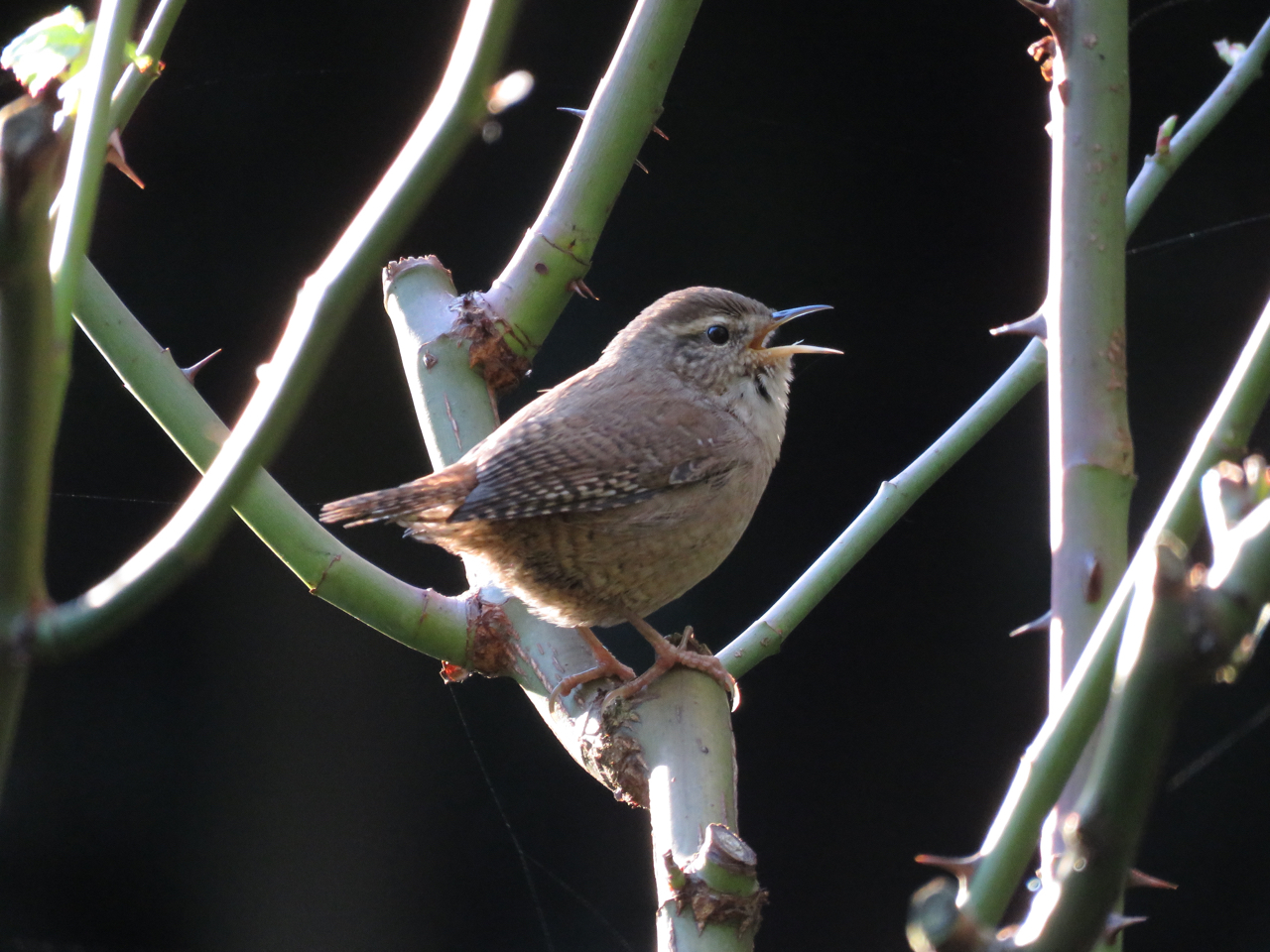
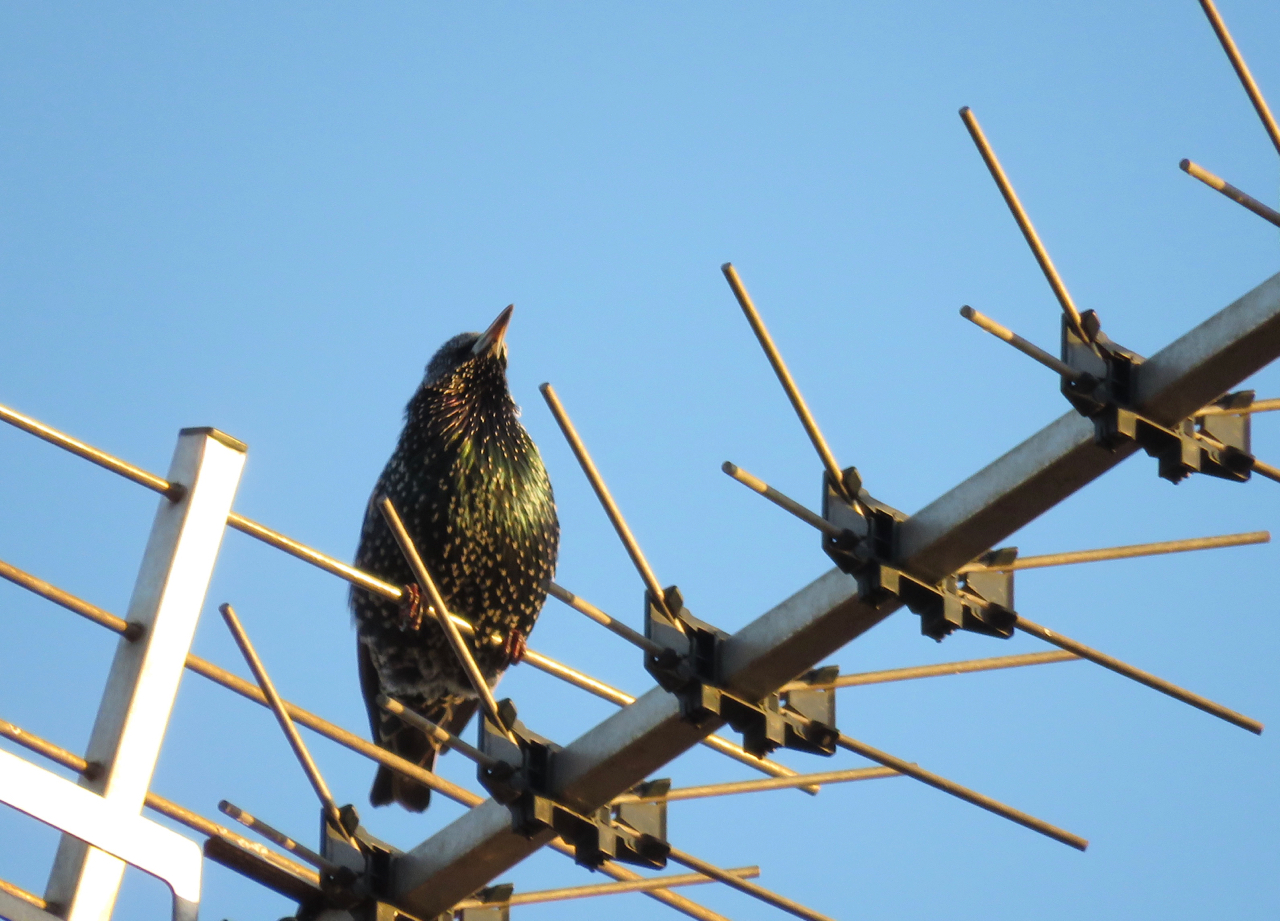
It is not unusual to hear bird song in December. Robins and Goldfinches sing year round, Wrens will burst into song at any time. Do Starlings ever stop singing? I don't think they do. Collared Doves and Stock Doves, after a short rest at the end of their breeding season, can now be heard calling again.
In sunny winter days, Song Thrushes will start singing, maybe more towards January.
Blackbirds, normally will sub-sing in the winter. This is an eery, very quiet song, that usually subadult individuals carry out, as if 'practising' singing, well hidden in bushes. But as I was leaving work today, as it happened last week, I heard the surreal full song of a blackbird, its beautiful notes raising over the cacophony of the Carrion Crow roost at campus, and transporting me into spring. I had to check this out. There it was a full adult male Blackbird was singing from a wall. Given that it was quite dark at 16:15, the photo on top was the best I could manage without using the flash, but I recorded a short video of it. A very very unusual thing to happen in early December. I wonder if the unseasonally mild weather we are having is confusing this normally spring songster.
In sunny winter days, Song Thrushes will start singing, maybe more towards January.
Wren in full song in October
Collared dove singing a couple of days ago.
Starling singing yesterday
Today I heard two bird species singing, however, which I've never heard singing at this time of year. This morning I heard distant fluting phrases that sounded like a Mistle Thrush. I went to investigate and there it was, a Mistle Thrust atop a tree, singing contentedly.Blackbirds, normally will sub-sing in the winter. This is an eery, very quiet song, that usually subadult individuals carry out, as if 'practising' singing, well hidden in bushes. But as I was leaving work today, as it happened last week, I heard the surreal full song of a blackbird, its beautiful notes raising over the cacophony of the Carrion Crow roost at campus, and transporting me into spring. I had to check this out. There it was a full adult male Blackbird was singing from a wall. Given that it was quite dark at 16:15, the photo on top was the best I could manage without using the flash, but I recorded a short video of it. A very very unusual thing to happen in early December. I wonder if the unseasonally mild weather we are having is confusing this normally spring songster.
Labels:
Blackbird,
Mistle Thrush,
singing,
sub-song
Monday, 23 March 2015
The soul thrush
This young male blackbird (recognisable for its brownish wings and black smudges on its bill) sung its beautiful song in front of my house yesterday. Were not for the fact that the blackbird song is so familiar we would herald the blackbird as one of the most pleasant songsters. The song thrush gets the name, but in comparison it's just an apprentice compared to the musical delivery of the blackbird. When I first moved to the UK, my garden's blackbird sung the first notes of Ella Fitzgerald 'Fascinating Rhythm', one of the blackbirds a couple of year back sung 'La Cucaracha' chorus really well. It really deserves the name of the soul thrush.
Tuesday, 6 May 2014
Fledglings
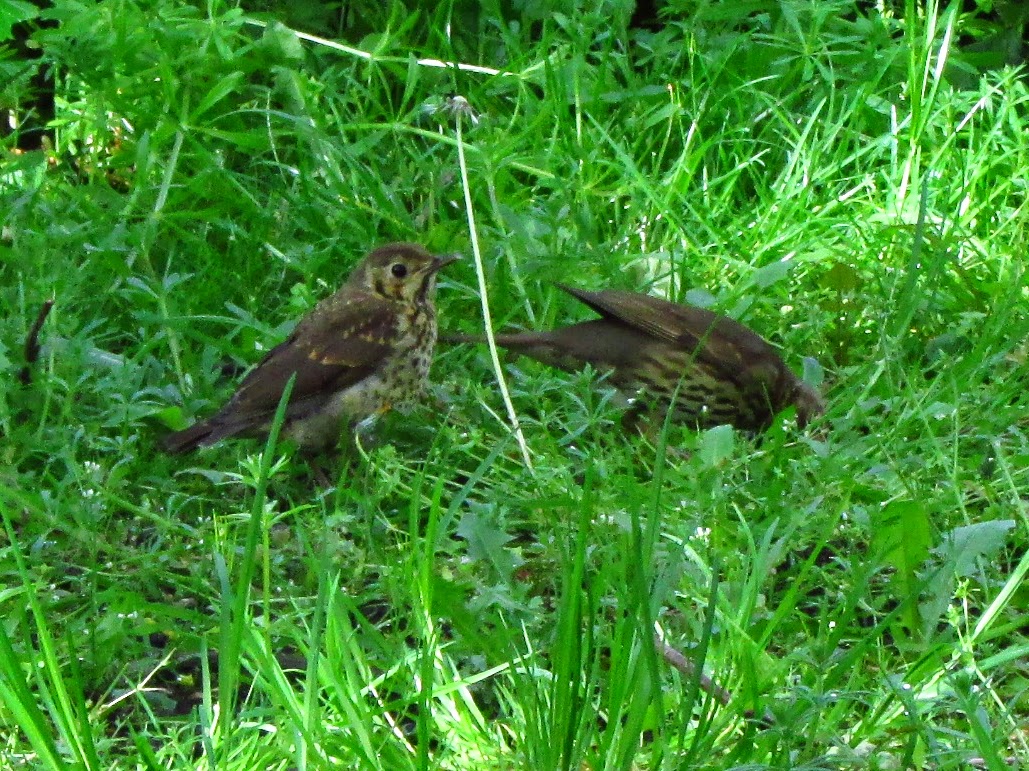
In the last couple of days I've come across a number of resident species with fledglings. Blackbirds were first, a short-tailed adventurous chick calling for food in the park, last week (below) and today (above) a Robin yesterday and a Song Thrush and Dunnock today. As the youngsters jump from the nest, they have to face a steep learning curve, they are more or less naive to predators, so in these days between fledgling and independence from parents they need to learn about them and also perfect their foraging skills, usually while they follow their parents, begging.
Magpies and Carrion Crows start showing an interest on trees and bushes, listening for calling chicks, so the alarm calls of the adults, associated to the different predators are part of the learning process. The first mallard brood in the park has already disappeared, probably due to predation by Herring and Lesser-black backed gulls.
Blackbird fledgling, 29/04/2014, from the same brood as the top photo, today.
These goslings from a local park already show a great interest in people, usual food providers here.
Young Robin
A sleepy Dunnock fledgling
A song thrush finding food for its youngster...
Young Song Thrush fledgling and busy parent.
A Magpie in search of nests or young birds in the undergrowth.
A Herring gull in the park having mallard for breakfast this morning.
Thursday, 3 April 2014
Blackbird singing by first pear blossom
In the last few days, all the resident blackbirds have started singing regularly. We pass through a few territories on our way back home from school playing 'who can spot the singing blackbird'. This one was sitting quite low on a front garden, with the beautiful first pear blossom opening around him.
Monday, 24 February 2014
The bill of the blackbird
Carotenoids are pigments obtained from the diet in animals that give yellow to red hues to many sexually selected ornaments. Carotenoids are antioxidants and have a role in the immune system and if they are supplemented in the diet they often increase the condition, growth and survivals of organisms, therefore, their use as honest signals of body condition in a sexually selected context is one of their most studied roles: Females may assess male quality by using signals, if they are good indicators of the male body condition.
Blackbirds are sexually dimorphic: males have a black plumage and orange bill and eye ring, while females are brown and their bills are brown or have a pale yellow base. There is intrapopulation variation in bill colour. Young males often have black streaks or a black bill in their first winter and adult bills range from yellow to bright orange. Several studies have investigated the role of sexual selection in bill colour variation. Results show that male blackbirds with orange bills are heavier and larger, have less blood parasites and pair with females in better condition than males with yellow bills. Females in good condition start breeding earlier and make more breeding attempts during the breeding season, which correlates with the number of fledglings produced per year. The correlation between female condition and her partners bill colour appears not to be due to direct female mate choice, that is, as no preference in females for more orange bills has been found in two studies. It is possible that this correlation is due to males with brighter bills being able to secure better territories during male-male conflict, and the female choice happens on territory quality. Although blackbirds are socially monogamous and form long-term pair bonds, there is a certain amount of extra-pair copulations and it is not known if polymorphism in bill colour determines how many extra-pair copulations can males achieve.
It is surprising how much there is to learn from such a common bird.
Here are some photographic examples of bill colour polymorphism in male blackbirds.
A young male subsinging (31/Jan/2010)
Another young male with brighter bill but streaks of black (18/Jan/2014)
An adult with bright orange bill
An adult male with yellow bill.
More informationB. Faivre, M. Preuault, M. Theury, J. Secondi, B. Patris & F. Ceuzilly (2001). Breeding strategy and morphological characters in an urban population of blackbirds, Turdus merula Animal Behaviour, 61, 969-974 DOI: 10.1006/anbe.2000.1669
Bright A, Waas JR, King CM, & Cuming PD (2004). Bill colour and correlates of male quality in blackbirds: an analysis using canonical ordination. Behavioural processes, 65 (2), 123-32 PMID: 15222961
Labels:
Blackbird,
mate choice,
sexual selection
Sunday, 9 February 2014
Male Blackbird courtship display
The Blackbird must be one of the birds I am most familiar with. Yet, I have only watched it courting once previously, and have never witnessed a copulation. Today I watched a male apparently subsinging inside a bush, but, upon approach, I realised it was an adult male adopting a strange, stretched-neck posture. I watched the bird and realised that there was a female low inside the bush. I couldn't include her in the photos, but I managed to get a few of the male. The one above is my favourite, there are a few more below.
This is David Snow's description of the blackbird's courtship display:
A brief form of the display occurs just after females solicit copulation in the days prior egg laying. According to David Snow, copulation is always interfered with by other males, who jump at the copulating male, often knocking him off the female.
More information
Snow, D.W. 1958. A study of blackbirds. George Allen and Unwin Ltd.
This is David Snow's description of the blackbird's courtship display:
The fully developed courtship behaviour of the male is the blackbird's most striking display. The head, with the crown feathers partially erected and the beak open, is stretched forward; the neck-feathers are compressed, and the body feathers fluffed out, especially the feathers of the rump, which form a conspicuous hump; and the tail is fanned and depressed. The displying bird has a curiously wild, staring appearence.[...] The whole time, with his beak held open, he usually utters a low 'strangled' song, made up of chattering alarm notes, rough warbles and subdued snatches of what sounds like true song. If the display is performed in a tree, the male remains stationary or at most occasionally shifts to another perch near by, while the bowing part of the display is more prominent, developing into a rhythmic up and down movement of the whole head and neck.This display takes its full form during pair formation, unpaired males - young males or widowers - court females most often in February-March. Paired females attack displaying males, unpaired females appeared indifferent, although they might later mate with the male.
A brief form of the display occurs just after females solicit copulation in the days prior egg laying. According to David Snow, copulation is always interfered with by other males, who jump at the copulating male, often knocking him off the female.
This is the first photo I managed of the blackbird singing
Snow, D.W. 1958. A study of blackbirds. George Allen and Unwin Ltd.
Labels:
Blackbird,
display,
pair-formation,
sub-song
Sunday, 1 December 2013
Singing mistle thrush
The local Mistle Thrushes have started to sing in the last few days. This one surprised us on our way home, on a tree in a front garden, quietly warbling, in a tentative way reminiscent of the blackbird's subsong.
Labels:
Blackbird,
Mistle Thrush,
sub-song
Thursday, 28 November 2013
Blackbird alarm calls
For a long time, I have been fascinated with the rich vocal repertoire of Blackbirds. I have recorded their alarm calls and what do they appear to react to, and did some research to find out what was known about them. Here I have compiled what I have found so far in my attempt to understand 'blackbirdese'. I have excluded male song and chick and fledgling begging calls from the post. Given how difficult is to transcribe bird sounds, I have illustrated each call with embedded sonograms and clips from the website Xeno-canto, which contains a fantastic collection of bird calls from around the world, published under Creative Commons licences.
Chink, chink, chink, chink, chink!'
A mobbing call given to owls, kestrel, magpie, carrion crow (and ornithologists checking nests!) which may be followed by attacks. The blackbird is exposed, agitated, flicks tail and wings - which are kept dangling -, from an obvious post (top shot and above) facing the potential predator, very nervous sounding and calling repeatedly and monotonously for a long time. It indicates a moderately aggressive tendency with a low escape tendency, although somewhat inhibited from attacking. Mobbing might be a way of cultural transmission of enemy recognition. Inexperience birds exposed to conspecifics mobbing a predator will join in the mobbing and mob the predator themselves in the future.
Alarm call before roosting or 'chinking'
Territory holding males give a persistent 'chink-chink' calls in the evening, possibly to deter other Blackbirds from roosting in its territory. Other territory holders might join in 'chinking'. This is interesting as it is very similar if not identical to the mobbing call. Is this a dishonest signal 'don't roost here, there are predators around'? or it is an assertion of territorial ownership with a general meaning 'move on'?
Seeee!
The bird sits tense, still, with feathers flat on the body and head. In response to crow and sparrowhawk, whether they are flying or just nearby. Slow, well spaced and high-pitched with open beak (above). Many other birds have a similar thin, high pitched alarm call for threats from aerial predators since the features of this sound makes the calling bird harder to locate, therefore the bird calling does not endangering itself. It has also been called 'hawk alarm', but it is also uttered in response to crows flying overhead or when the nest is threatened. Nestlings react to this call by becoming quiet and still. In experiments using magpie dummies, the parents uttered this call when the dummy was 6-7 m from the nest, while they used the mobbing call when the dummy was very close to the nest. Interestingly, there appear to be differences between urban and rural blackbirds use of this call, as D.W. Snow reported that woodland birds use this call also to humans (the one in the photo above is a woodland bird, so maybe was reacting to our presence), and then it indicates that the nest is very close.
Alarm rattle
A loud, sudden and accelerating outburst, ending on a noisy scream, with the bird flying away. Alarm call when the bird is suddenly startled, also during fights. May starts when the bird is perched but finished in flight. If this call has the same effect on a predator as if an observer disturbs a blackbird at close quarters - it has made me jump more than once - it might give the calling bird a few moments advantage to flee from danger.
Sriii
Also called 'trill' call. A flight or fight intention call. Perched and in flight. It can serve as an appeasement call by a subordinate bird indicating its intention to flee.
Soft call
Also known as 'pok' or 'pook' call, sounds like a soft bark, to me more like 'wow'. Usually from a tree, still or in flight. It is an alarm call to indicate the presence of ground predators, which in gardens usually means the presence of a cat, or a human approaching young or the nest. Fledglings respond to this call immediately by keeping silent and still and looking around, and especially below them. D.W. Snow used a playback of this call to a few day old nestlings reared by him and they acted in the same way.
Chooking
Low pitched, uttered with the beak closed. Anxiety call, mild alarm. Sometimes on its own, sometimes accelerating to the full-swing alarm call in flight. Flicks tail, horizontal body. To people, dogs, cats, etc. Females use it when disturbed while looking for nest site or nest building. Also used when the bird is foraging in an unfamiliar situation where the bird feels insecure.
Chook, chook, chink, chink, chink
A variant in which the chook combines with chinking as the bird becomes more aggressive or excited.
More information
Snow, D. W. (1988). A study of blackbirds. British Museum, Natural History.
Kryštofková, M., Haas, M., & Exnerová, A. (2011). Nest defense in blackbirds Turdus merula: effect of predator distance and parental sex. Acta Ornithologica, 46(1), 55-63.
Chink, chink, chink, chink, chink!'
A mobbing call given to owls, kestrel, magpie, carrion crow (and ornithologists checking nests!) which may be followed by attacks. The blackbird is exposed, agitated, flicks tail and wings - which are kept dangling -, from an obvious post (top shot and above) facing the potential predator, very nervous sounding and calling repeatedly and monotonously for a long time. It indicates a moderately aggressive tendency with a low escape tendency, although somewhat inhibited from attacking. Mobbing might be a way of cultural transmission of enemy recognition. Inexperience birds exposed to conspecifics mobbing a predator will join in the mobbing and mob the predator themselves in the future.
Alarm call before roosting or 'chinking'
Territory holding males give a persistent 'chink-chink' calls in the evening, possibly to deter other Blackbirds from roosting in its territory. Other territory holders might join in 'chinking'. This is interesting as it is very similar if not identical to the mobbing call. Is this a dishonest signal 'don't roost here, there are predators around'? or it is an assertion of territorial ownership with a general meaning 'move on'?
Seeee!
The bird sits tense, still, with feathers flat on the body and head. In response to crow and sparrowhawk, whether they are flying or just nearby. Slow, well spaced and high-pitched with open beak (above). Many other birds have a similar thin, high pitched alarm call for threats from aerial predators since the features of this sound makes the calling bird harder to locate, therefore the bird calling does not endangering itself. It has also been called 'hawk alarm', but it is also uttered in response to crows flying overhead or when the nest is threatened. Nestlings react to this call by becoming quiet and still. In experiments using magpie dummies, the parents uttered this call when the dummy was 6-7 m from the nest, while they used the mobbing call when the dummy was very close to the nest. Interestingly, there appear to be differences between urban and rural blackbirds use of this call, as D.W. Snow reported that woodland birds use this call also to humans (the one in the photo above is a woodland bird, so maybe was reacting to our presence), and then it indicates that the nest is very close.
Alarm rattle
A loud, sudden and accelerating outburst, ending on a noisy scream, with the bird flying away. Alarm call when the bird is suddenly startled, also during fights. May starts when the bird is perched but finished in flight. If this call has the same effect on a predator as if an observer disturbs a blackbird at close quarters - it has made me jump more than once - it might give the calling bird a few moments advantage to flee from danger.
Sriii
Also called 'trill' call. A flight or fight intention call. Perched and in flight. It can serve as an appeasement call by a subordinate bird indicating its intention to flee.
Soft call
Also known as 'pok' or 'pook' call, sounds like a soft bark, to me more like 'wow'. Usually from a tree, still or in flight. It is an alarm call to indicate the presence of ground predators, which in gardens usually means the presence of a cat, or a human approaching young or the nest. Fledglings respond to this call immediately by keeping silent and still and looking around, and especially below them. D.W. Snow used a playback of this call to a few day old nestlings reared by him and they acted in the same way.
Chooking
Low pitched, uttered with the beak closed. Anxiety call, mild alarm. Sometimes on its own, sometimes accelerating to the full-swing alarm call in flight. Flicks tail, horizontal body. To people, dogs, cats, etc. Females use it when disturbed while looking for nest site or nest building. Also used when the bird is foraging in an unfamiliar situation where the bird feels insecure.
Chook, chook, chink, chink, chink
A variant in which the chook combines with chinking as the bird becomes more aggressive or excited.
More information
Snow, D. W. (1988). A study of blackbirds. British Museum, Natural History.
Kryštofková, M., Haas, M., & Exnerová, A. (2011). Nest defense in blackbirds Turdus merula: effect of predator distance and parental sex. Acta Ornithologica, 46(1), 55-63.
Labels:
alarm calls,
anti-predator behaviour,
Blackbird
Tuesday, 26 November 2013
Having a very berry time
A few photos from my garden blackbirds taken yesterday, through two layers of glass. The rowan is still loaded with bright, fat berries, which seem to be keeping well. A female, above, about to swallow one. A male, below, had a quiet time after feeding.
This other male (below) has started visiting my garden recently. A quite distinctive individual due to the large white patches on his head. White feathers, often on the head, are quite common in my local blackbirds, but the extent of this individual white markings is the most extreme I've seen around here.
Wednesday, 13 November 2013
Three black birds turning leaves
The layer of fallen leaves under trees hides treasure for many birds this time of year: earthworms, woodlice, springtails, sprouting seedlings and more. I have filmed three bird species turning leaves in the park, each showing a different style: the Carrion Crow, slowly turning and tasting tidbits; the Blackbird energetically using its whole body, almost jumping, relying on an element of surprise, the moorhens looking like they are removing a nuisance from their way. Here you can watch the three clips.
Blackbird leaf turning
Moorhens leaf turning
Carrion Crow leaf turning
Blackbird leaf turning
Moorhens leaf turning
Carrion Crow leaf turning
Labels:
Blackbird,
Carrion Crow,
Moorhen
Saturday, 19 October 2013
Thrushes and whitebeam berries

Whitebeams, a tree related to the rowan, is fruiting now. They have contrasting good and bad years in fruiting (masting trees), and the fruits do not last long, becoming brown and shriveled in about a month from ripening, but berries are large fruits with a lot of pulp compared to the seed content, so they are very rewarding food when available.
Woodpigeons and Crows like the fruit, and so do all thrushes, but they are too large for Robins, Blackcaps and Starlings. They are also eaten (pecked as opposed to eaten whole) or their seeds predated by Blue Tits, Chaffinches and Greenfinches.
In my local park yesterday, there was a strong contrast between the colour of the fruits of a line of whitebeams. One of them had the brightest red berries, and Woodpigeons and Blackbirds were feeding on it. Note the bulging crop of the Blackbird in the photo above.
Two trees at the other end of the line had still many unripe berries and as a flock of mixed finches and tits, including goldfinches, chaffinches and great and blue tits descended on it. Suddenly, it became apparent this tree had an owner. A Mistle Thrush started churring vigorously from its centre, while flicking its wings and tail. It seems to make little impact on the little birds, although it kept going for quite a while.
Woodpigeon feeding amongst the berries
Mistle thrush on guard.
And the very nervous one in this short clip.
More information
Snow, B. K., & Snow, D. (2011). Birds and berries. A&C Black. In Google Books.
Labels:
berries,
Blackbird,
food guarding,
Mistle Thrush,
Woodpigeon
Friday, 6 September 2013
Woodpigeon eating elderberries
The elders are now fully laden with a plentiful berry harvest. Early this morning, a group of nervous starlings came up and down to one, feeding on the berries. A relaxed woodpigeon stretched and fed as well. The light wasn't perfect, and the birds a bit far, but I like that the berry bunches are still pretty much intact. Elder provides berries from mid August to early November. In their monograph on Birds and Berries, Barbara and David Snow recorded 16 species of seed dispersers and 6 of seed predators feeding on elder berries, the largest diversity of species for any other fruit. Numerically, Starlings were the most common, followed by Blackbirds, but other thrushes, migrating warblers, robins, corvids and even moorhens were recorded feeding on berries. Woodpigeons, after Blue Tits, were the main seed predators, although woodpigeons can also be seed dispersers of this fruit.
Labels:
berries,
Blackbird,
elder,
Starling,
Woodpigeon
Thursday, 15 August 2013
Bald Blackbirds
During July and August, the breeding season is pretty much over for blackbirds. Males, after weeks of feeding young look pretty worn and some have lost many of the feathers of their heads. Males take care of the fledglings of the first brood, while females lay the second clutch and incubate. Blackbirds might have a third clutch, so that males spend more time feeding chicks - that is, sticking their beaks into their chicks' open beaks. The stresses of the long breeding season and offspring demands might be responsible for most of the bald blackbirds at this time of year. Not to worry, they will moult in the next few weeks and look black and glossy again in time for winter. The top photo, of a very bald one, was taken a couple of weeks ago.
Another bedragled looking male from this morning
This male collecting food for his young was not looking too bad on the 10th of July.
Thursday, 7 February 2013
City scavengers
Snow bonanza for a male blackbird...
...and a female too
Even Robins enjoy takeaway pizza
Black-Headed Gull on the lookout for feeding opportunities
Labels:
birds,
Black-Headed Gull,
Blackbird,
Carrion Crow,
Robin,
rubbish,
urban birds
Subscribe to:
Posts (Atom)