

Showing posts with label predation. Show all posts
Showing posts with label predation. Show all posts
Thursday, 19 March 2015
The Sparrowhawk silence

Wednesday, 5 November 2014
Spotting the Sparrowhawk

Tuesday, 6 May 2014
Fledglings

Magpies and Carrion Crows start showing an interest on trees and bushes, listening for calling chicks, so the alarm calls of the adults, associated to the different predators are part of the learning process. The first mallard brood in the park has already disappeared, probably due to predation by Herring and Lesser-black backed gulls.

Blackbird fledgling, 29/04/2014, from the same brood as the top photo, today.

These goslings from a local park already show a great interest in people, usual food providers here.

Young Robin

A sleepy Dunnock fledgling

A song thrush finding food for its youngster...
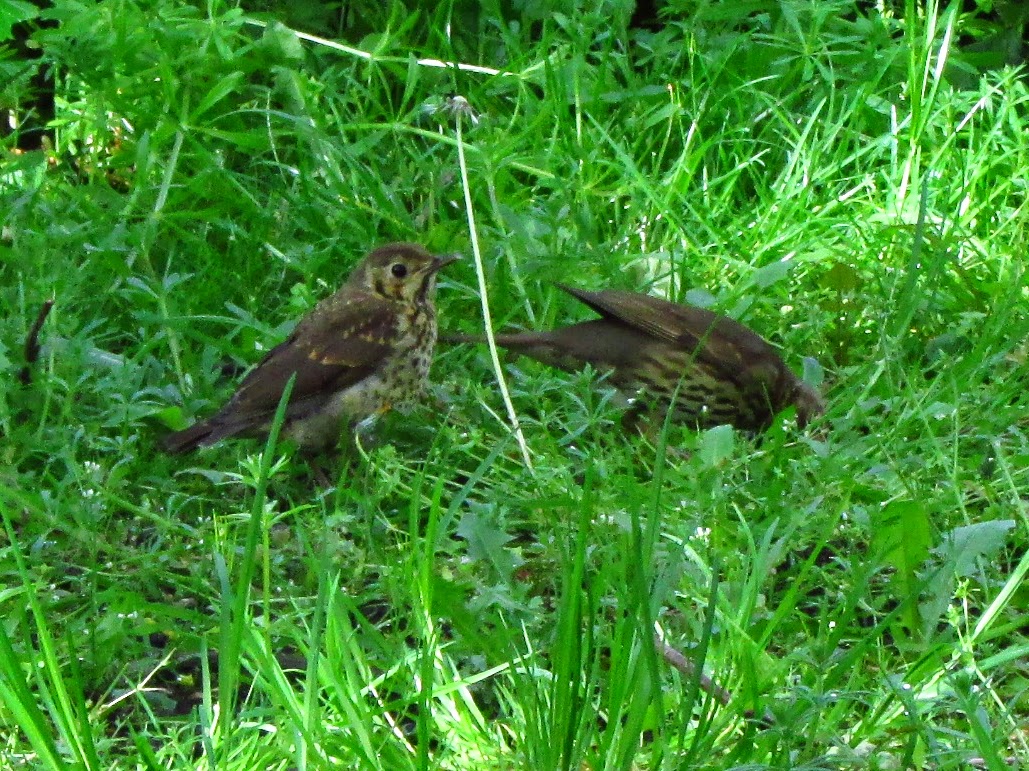
Young Song Thrush fledgling and busy parent.

A Magpie in search of nests or young birds in the undergrowth.

A Herring gull in the park having mallard for breakfast this morning.
Sunday, 1 July 2012
Blackbird cleaning slug

Friday, 27 April 2012
The crows have frog for dinner

The pair of crows on our street has been late building its nest. After a lot of territorial fights with their neighbours, they only started last week, on top of a lime tree, but the nest looks like it is now finished. One of the pair was sitting on the nest this afternoon, and kept calling softly, made me think of the way rooks caw. The other flew to the roof nearby carrying something floppy. I thought it would be a strip of bark, which they often use as lining material, but when the crow started pecking it hard and lifted it I saw it was a frog. The crow on the nest - presumably the female- was obviously very excited about this, flew close and started flapping her wings, calling pleadingly, while the first crow fed. I couldn't see if the frog changed hands (claws?) but in crows females incubate the eggs and the male is in charge of feeding her so it wouldn't surprise me if she also had frog for dinner.

The male feeds on the frog

The pleading crow
Monday, 5 March 2012
The Herring Gull pair at The Rock

Today, a gang of excited Mallard males were giving chase to a female and one of them started mating with her. This behaviour is common in Mallards and is known as forced copulation, where there is no display and the female is corralled by males who are not their partners and forced to mate. The gull, which was very close, saw this, walked to the mating pair, and pecked the male! Not just a gentle peck, no, she even got some feathers out of him. This was a bit too much for the drake, his passion was quickly dispelled, he dismounted the female immediately and walked away a bit ruffled while the other drakes watched. Everything happened fast and I only had time to take a shot of the last part of the scene (below).

Ouch!

The pair of Herring Gulls at the Rock
Some twenty minutes later I noticed the pair were calling noisily with their miaowing calls, they were feeding on something on the ground. An egg! By the look of it it was a duck's egg all cracked and its contents spilled on the path. When I went to check, it had all the looks of an infertile egg. Still, the seagulls took turns feeding on it.

One of the Herring Gulls feeding on the egg

The spilled egg
Subscribe to:
Posts (Atom)