Showing posts with label decision-making. Show all posts

Monday, 3 December 2018

Watching Waxwings

Yesterday, I got up early and had a short drive to a local supermarket to watch some Waxwings that had been reported. Waxwings are irregular winter visitors to the UK, especially to its eastern side, and are most likely to arrive to a supermarket car park near you. A lovely mild morning with sunny spells and a light wind, I walked around the quite empty car park checking the rowans, a couple of small ones still with berries. two Woodpigeons and a Blackbird were feeding on them, but no trace of Waxwings.
Woodpigeons.
Blackbird sitting on a rowan still laden with berries.

Suddenly, a flock of six Waxwings appeared silhouetted against the rising sun and landed on the tree in front of me.
The safe tree
Almost every time I've seen Waxwings, they alternate between bouts of frantic berry feeding and resting in a tree nearby. It's not just any tree, it is a particular tree. This tree attracts them like a magnet and they appear not to settle anywhere else. This time their safe tree was an ash, the tallest tree in a row on a rise by the road separating two supermarket car parks. The Waxwings spent a few seconds feeding on a yellow-berry rowan, and then they flew back to the top part of the ash tree, where they spend most of the time. Other times the flock would fly towards a rowan and return to the safety of their tree even before landing. They are extremely watchful, looking up nervously every now and then with bouts of preening, resting and calling.
Their quiff-life crests rise or flatten with their mood (compare the top shots taken a few seconds apart), sometimes becoming ruffled with the breeze. They are not particularly wary of people, some photographers assembled just underneath their tree, pointing at them with their cameras, walking right under them, and they paid no attention.

Birders and Waxwings on their safe tree.
Instead, they are watchful of predators. Being small birds, similar to starling in size, they would be easy prey for Sparrowhawks. Indeed, later on, when I go for a wander in the area, I see a Sparrowhawk flying past chased by a flock of starlings.
This is the only shot I got of the Waxwings in the rowan where they fed.
Decision making
When to go to feed? It was interesting to watch the individual Waxwings on the tree. At some point one of them appeared restless, and would fly from branch to branch around the others - which were preening or resting - or it would fly up and away from the tree a short distance, and if the others didn't follow, it would return. This individual appeared to be rallying the group to go and feed.
 Earlier in the week there had been nine Waxwings about, then the six yesterday. Today just two remained. Two Mistle Thrushes sat on a lamppost, guarding the rowans, so not sure the Waxwings will stay much longer. The two waxwings sat close in the tree and billed each other briefly, maybe passing some food?
Early arrival of Waxwings indicate an irruption year, so I do hope there's more opportunities this winter to catch up with them.

Friday, 21 November 2014

In the wrong flock

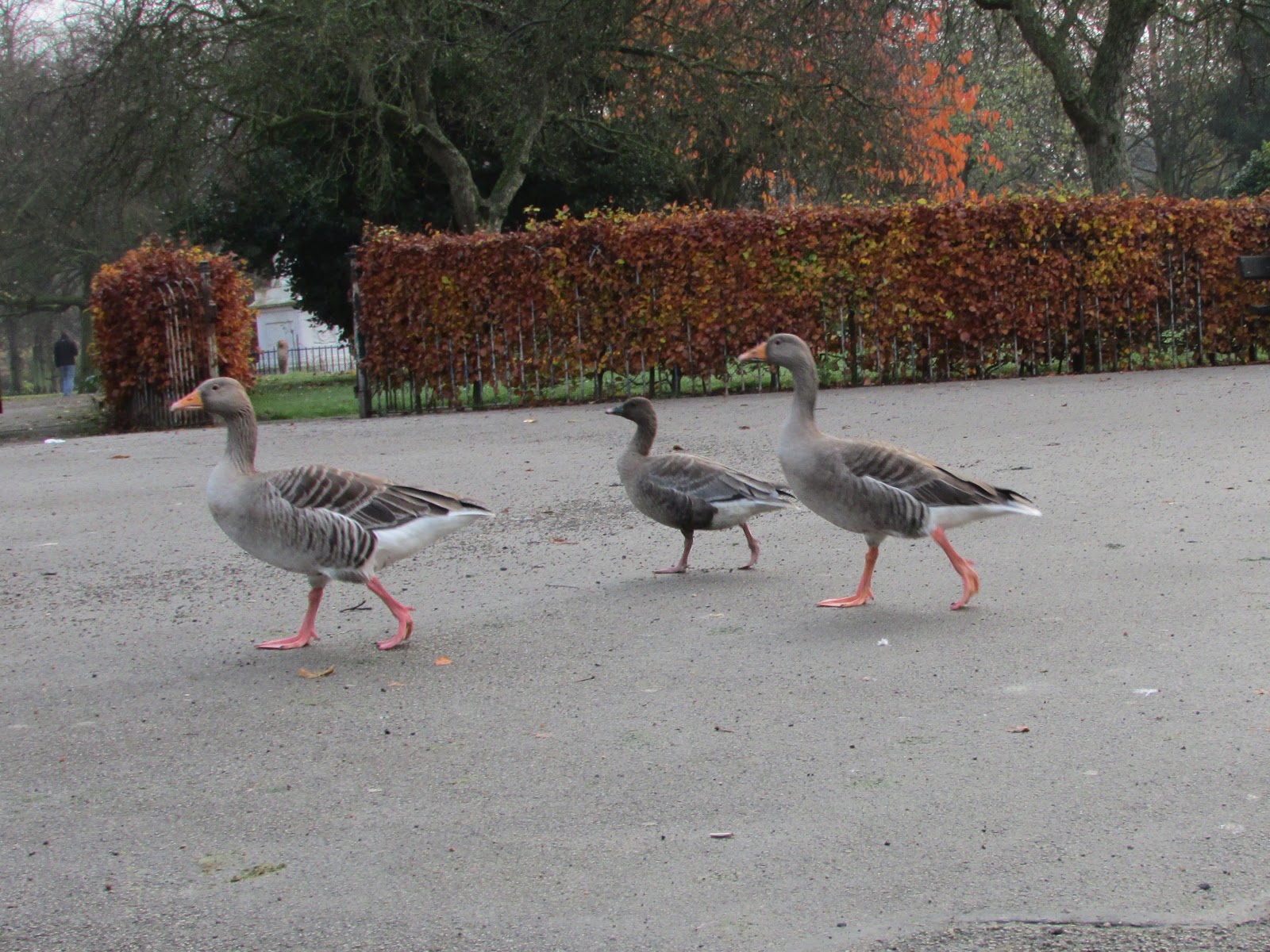
Although I wouldn't consider Pink-footed Goose (also known as Pinkfoot) to be an urban bird, it is a species that I regularly see. Skeins of this migratory geese, announced by a chorus of high pitched calls, regularly fly over the city in October and March, on their way to and from their breeding headquarters in Iceland and Greenland. Occasionally, however, a straggler will turns up with Greylags in local parks, allowing a closer look.
  On my way to work, walking through the park, a flock of Canada Geese and another of Greylag geese were about. While counting them I noticed a much smaller goose, a Pinkfoot, amongst the greylags. They have small bills, marked with pink, much darker head, contrasting with the slaty back. I think this individual was a young bird born this past summer, as you can see two types of feathers in its flanks and back, as the larger adult feathers, with a pale edge, have started to grow. The furrows that adorn the neck of adult geese are not yet sharply defined. The goose wasn't welcome and was often lunged at by the Greylags. Surprisingly, it was quite relaxed in the park, despite proximity to people, and it got very close to me as it followed the other geese across the lake and then to the grass to feed.
 I other occasions when had previously seen other Pinkfoot with greylags, it was also young birds. I wonder if leaving with your own species as the flock departs takes some learning. Geese need to reach a consensus before leaving as a flock, a decision that takes place by increasingly noisy vocalisations and movements of the birds of the flock when they are ready to leave. If a young bird misses the cues, it will fail to take off might miss the flock altogether, becoming stranded possibly with another geese species. Geese have long lives and move about, so most likely, while following the greylag flock in its travels, it will eventually meet a Pinkfoot flock and the young bird will be reunited with other members of its species.
A Greylag drives the pinkfoot away from its partner

Walking towards the grass. The difference in size between both species is evident here.

Wednesday, 2 October 2013

Canada Geese taking off decisions

ResearchBlogging.orgThis morning, the 60 strong flock of Canada Geese that seemed to have roosted in the park were restless. There were continuous loud grunts and honks and, after a crescendo in which more and more individuals joined in the calling, part of the flock took off in a coordinated way. The vocalising geese were making a decision, with individuals deciding to join or not a party leading the departure, maybe to quieter feeding grounds. It is unclear if the individuals felt hungry or if the several dog walkers had made then nervous (or both!).
  Flocking birds have to travel together to stay in a group to search for new feeding or roosting patches, to avoid predation or to migrate. When the individuals differ in their motivations to move away (some might be hungrier than others, for example), there might be a period in which an a consensus is reached about leaving or staying involving communication of the individuals intentions. An individual that is not hungry might change its mind and join in if most of the flock appear willing to move, so as not to become isolated.
  Dennis Raveling, in a paper in 1969, reported on the behaviour before flock taking off in Canada Geese. He observed a large flock in their natural range, in which 77 geese had been marked and radio tracked, including 10 families. Flock departure was preceded by a ceremony, with the neck stretched, there are quick head tossing movements with the bill pointing up and repeatedly, and the white head patch conspicuously displayed - communicating an intention to fly. Geese often spread and flap their wings and start to walk in the intended direction of flight for a few steps (this video illustrate this behavior). Ganders (adult male geese) were more successful at recruiting his family than any other family members, as a shorted time elapsed from his initiation of head-tossing until the family took flight, although all family members initiated head tossing at some point. In a couple of occasions when an excited immature took flight but the rest of the family did not follow, it flew in a circle and returned with the family shortly.
 Other than the cohesive function of the head-toss ceremony for family members, group vocalisations and wing flapping serves to synchronise the whole flock. The coordination of the flock during take off included the presence of an invisible 'starting line': individuals run until they arrived at the same position at which the individual before them had just taken off (instead of taking off where they were). Raveling hypothesized that the contrast between the white tail coverts and the black tail served as a signal to optimise the position of individuals during flight, quite important in such large birds. Families tended to keep together during flight and their vocalisations then changed from grunting to a more trumpet-like honking.

More information

Dennis G. Raveling (1969). Preflight and Flight Behavior of Canada Geese The Auk, 86, 671-681 DOI: 10.2307/4083454