Showing posts with label mobbing. Show all posts

Thursday, 19 April 2018

Gulls mobbing Buzzard

From my office I hear several Herring Gulls start calling plaintively, kyeoh! kyeoh! a loud, far carrying call that I associate to buzzards overhead. I looked through the window. The local Carrion Crows had assembled atop a large poplar, watching nervously, calling and displaying wing shuffling and tail fanning.
A dozen gulls soared and called - all the local Herring gulls - slowly assembling and ascending on the thermals. Then I see a Buzzard, soaring higher. The gulls didn't reach the buzzard's height and it eventually drifted away and the gull calls died off.
 Gulls often alert me to raptors. A couple of years back it was a Honey Buzzard, migrating over town. I pay a lot of attention to the gulls alarm call since then!
 Later, at home, the scene appears to repeat itself. Alarm calling gulls. I grab the camera and go out into the garden. Two Lesser Black-backed gulls are mobbing a Buzzard.
 This gull alarm call is persistent and sounds distressed, it is hard to ignore. It seems to attract other gulls too, who soar and chase the potential predator. I wonder if it is how young gulls learn to identify the predators they are likely to come across in their lives. Crowd knowledge of the enemies, initiated by older gulls with previous experience, who in turn learned it in their youth. Immature offspring of the gulls initiating the mobbing are likely to be around. The adults could be 'teaching' young about potential predators and the young are likely to benefit from this at some point in the future. This is a hypothesis called 'cultural transmission of mobbing' which was explored in some experiments by E. Curio and collaborators in 1978. They showed that exposure of a novel object to a 'naive' Blackbird at the same time a 'teacher' blackbird is mobbing results in learning to mob the new object (in one of their experiments a colourful bottle). This teaching could be passed through six rounds of learning in which the learner becomes the teacher of a new bird, and so on. The fact that enemies often have to be recognised culturally was put to a sad test when captive reared endangered Hawaii crows (or Alalā) were released into their natural habitat. The last wild Alalā had died in 2002. Two of six newly released birds were predated by native hawks, to which the captive reared birds were completely naive in the first week after release. The conservationist recaptured the surviving birds and started an intensive 'predator training' program in which the captive crows were exposed to hawks calls, hawks flying overhead and simulated hawk attacks. Hopefully the savvy crows will do better when they are released next.
This time of the year there seem to be a passage of migrating or dispersing Buzzards over the city. The gulls are breeding, probably incubating now, and a buzzard could be a predator likely not for them, but for eggs left unattended or young chicks. It makes sense that the gulls see off the potential predator.
I got this short clip from the garden:


More information
Curio, E., Ernst, U. and Vieth, W. Cultural transmission of enemy recognition: one function of mobbing. Science 202, 899–901 (1978).

Different gull calls: here.

A blog post including some great photos of Herring gulls mobbing a Buzzard

Thursday, 13 July 2017

Individual human recognition in crows

Corvid researchers have ample anecdotal evidence that crows recognise individual humans: crows are unusually alert and often direct mobbing calls to researchers that have previously ringed them, while ignoring other researchers. Other crows follow and harass individuals who feed them in order to obtain food, something that Ralph Hancock has described to me in comments to this blog (see previous post), and amply illustrated in his blog (Charley and Melissa are the pair of crows that often pester him for food). Unlike predators, who tend to be dangerous in general, people can be either very dangerous, mildly dangerous, neutral or good to crows. Some people, e.g. farmers who treat them as pests persecute and kill crows (see photo below) and crows might learn to be cautious when they see them and fly away before being shot. Other people are plain annoying, as bird ringers who trap them, and it may pay to learn who they are so that the trap is avoided next time. Yet others people are good to crows, such as people who feed them, and it may pay to be confiding and even harass them to get more food. It is not surprising that intelligent birds like crows pay attention and learn to discriminate between 'good' 'neutral' and 'bad' people and act accordingly.
Two Carrion Crow carcasses on the cows feeder of a local farm.

 John Marzluff, a researcher at the University of Washington has studied crows for many years, and part of his research has involved trapping and ringing crows in Seattle. Marzluff was aware of the crow's mobbing behaviour towards the specific researchers that had trapped and ringed them but he wanted formal proof. He incorporated ringing into an experiment to test if crows recognise individual humans. He worked with American crows, Corvus brachyrhynchos, a close relative of the Carrion Crow with a similar social organisation. The research included urban populations that included previously trapped and ringed individuals, and also 'naive' populations that had not been ringed before. Experiments included a single negative event: the setting a trap (a net launcher) to capture feeding crows in 5 different sites. The people activating the trap, capturing and ringing the birds wore specific masks and/or hats (a 'dangerous' mask). Masks were used so that they were interchangeable and effects due to inadvertent researcher behaviour, outfit or body size could be removed. During transects around the crow territories, researchers (wearing either the dangerous mask or a 'neutral' mask) assessed crow activity towards them before and after the trapping event. They in particular noted if crows displayed the 'scolding' response to them (defined as a harsh, alarm ‘kaw’ directed repeatedly at the observer, and accompanied by agitated wing and tail flicking) or were indifferent. The experiments were repeated by people unaware of the experimental design or objectives, which were asked to walk around the crows territories wearing or not the mask used during the trapping event or a different, neutral masks. This experiment removed any subjective bias by the experimenters themselves.
 The experiments show that crows rapidly learn to recognise the 'dangerous mask' used during the trapping in their local site, with more scolding in response to the dangerous mask than to neutral mask during and after the trapping event, but no differences before the trapping event. In addition, the percentage of local crows scolding the person wearing the dangerous mask increases from 26% steadily with time over 2.7 years to 66%, suggesting that the local crows learn from each other about the dangerous person. The masks used in one of the experiments were of ordinary people and the crows learned to mob the specific mask associated to the trapping and not similar masks.
The crows today calling and wing-flicking.

  Today I walked around the park today with my camera. Three crows at the end of the park, in the same area where they mobbed and followed me three weeks ago immediately flew to the top of a tree and cawed harshly looking in my direction, wing-flicking, then one of them flew towards the tree by which I was standing. I took a video that shows how it is scolding me and records the call. The top shot is a screen gan of the video. As I left the park they stopped cawing. I seem to have become the not so good people to the local crows, maybe I will wear a mask next time.

Cawing 
And flying towards me


More information
Marzluff, J. M., Walls, J., Cornell, H. N., Withey, J. C. and Craig, D. P. Lasting Recognition of Threatening People by Wild American Crows. 699–707 (2009).

Monday, 19 June 2017

Mobbed by crows

In my way to work as I crossed the park I saw a pair of crows with a fledgling. The young one hopped to one adult and was fed. I took my camera out and started taking photos, but all feeding and begging stopped. The young one started looking around for tidbits on the grass. One of the adults, after eyeing me (the one in the background above), flew to the top of the tree under which I was standing, and cawed loudly and repeatedly. The other adult followed. I didn't think much about this until I carried on with my walk and the crows flew from tree to tree above me, calling all the way, sounding pretty angry. It took that for me to realise that I was being mobbed! I thought about the episode by Konrad Lorenz when his tame jackdaws apparently mistook his wet swimming trucks, which he was holding, by a dead jackdaw and actually attacked his hand, drawing blood. I saw my black camera with dangling cap and immediately put it away. I do hope the crows don't remember me tomorrow!
 Curiously, but not surprisingly, this call is completely different to the mobbing call uttered when chasing sparrowhawks or gulls away (the call that gave name to this blog), which is a dry rattling. Instead is a long, harsh caw. I found a video of a crow attacking a fox and using the same call.
The adult, on the right, eyeing me. 
The young crow stops feeding, as the adults caw above me. 
The young crow is taking everything in, looking at the parents reaction.

Wednesday, 5 April 2017

Blackbird mob

Returning home in the light evening today I noticed Blackbirds 'chinking'. This is a very persistent call, often by several individuals, that I usually associate to summer evenings. The blackbirds, up to four of them, were in the tree where the Tawny Owl nest box is. The owls are indeed in occupation, although they were nowhere to be seen from the ground. They have been calling at dusk, and every few days I have been able to watch one of them as it called, sat on the box for a few minutes and then left to go hunting. Often, later at night, one calls with a lovely gurgling sound from inside the nest. Two of the blackbirds got close to the entrance, calling non stop, if there was an owl in the nest, they might be able to see it. At some point they calmed and left, but then one returned, started calling and the others joined him in the tree.
I wondered that the 'chinking' is not a roosting call, but a mobbing call to an owl, which is more likely to be encountered active as nights become lighter in the summertime. In a couple of weeks, the leaves would obscure the view and although a blackbird calling is evident, a quiet owl sitting inside a tree is not. This is a lovely clip of blackbirds mobbing a Tawny Owl demonstrating the call and also how fearless they are towards the owl.

UPDATE 7 April 2017. From the living room at 20:05, I heard a Blackbird suddenly starting to 'chink' and I looked at the nest box. The round silhouette of a Tawny was sitting atop the nest. It was light enough to get a low resolution photo.

Saturday, 12 March 2016

Great Tit grammar

Winter is tough for small birds. The bare trees and the need to spend more time finding food to compensate for higher energy demands in cold weather means that they might be more exposed to a range of predators. They often join other birds in mixed flocks which might afford them more protection, as more eyes keep an eye for Sparrowhawks or cats. Birds have another card up their wings: alarm calls. Alarm calls can be very diverse and research has shown that they can be specific to each predator: responding appropriately is crucial, therefore alarm calls have meaning: flying away might be good if a cat is about, but staying still or hiding in a bush might be a better response to an aerial predator. Tits are highly vocal and have a broad repertoire of calls, which they repeat in different combinations. Some calls are used to beckon other tits when food is found, others to mob predators, yet others as contact calls. They are also very responsive and inquisitive and will approach to you if you imitate them.
 A research team from Japan, Germany and Sweden, led by Toshitaka Suzuki, has been investigating communication in Japanese Great Tits, Parus minor, a close relative of the European species that used to be considered a subspecies (the photo above is of the European Great Tit). Using playback experiments of natural and artificially manipulated calls they show that Great Tits responded very differently to different calls. One call, which they named D call (also called the 'jar' call), is used by birds that are alone, and their partner is more likely to join them after hearing the call, a 'come and join me' call. When researchers played this call on a loudspeaker, great tits approached the loudspeaker. Another call, ABC calls, also called 'chicka calls' are used in an anti-predator context, and playback calls elicit scanning behaviour like the tits are looking for potential danger, 'watch out'. Often tits combine different calls are combined in different sequences, as we combine words in a sentence, for example they add their D call to the ABC call, e.g. ABC-D: upon hearing this, the birds watch left and right as it searching for a predator in their surroundings, but they also approach the loudspeaker, so that both calls combine the separate meanings into a 'sentence', which is used in a mobbing context.
This video shows the sounds separate and in combination, and illustrate how similar the Japanese Great tit calls are to European great tits.
 The researchers wondered if the order of the call matters, that is, there is syntax in the vocalisations. If order is important, then the birds should respond to the ABC-D but not to an artificially generated D-ABC call. They played both calls to 34 wild Japanese Great Tits individually in the winter and counted the number of scans and if the birds approached the loudspeakers. These were their results:
Responses of Japanese great tits to playbacks of ABC–D and D–ABC calls (a) Number of horizontal scans made by tits in 90 s (b) Percentage of trials in which tits approached within 2 m of the loudspeaker. From Suzuki et al 2016. This Creative Commons Attribution 4.0 International License.
The birds scanned and approached the loudspeaker much more when the natural ABC-D call was used, strongly suggesting that the meaning of the vocalisation is lost when the natural order is altered, and that, indeed, birds use grammar. The combination of calls in the context of grammar enriches the possibilities of meaning of a limited number of calls, making bird language much more fascinating and complex that we could have anticipated.

More information
Toshitaka, S. N., Wheatcroft, D. & Griesser, M. Experimental evidence for compositional syntax in bird calls. Nature Communications (2016). doi:10.1038/ncomms10986

Tuesday, 21 April 2015

The female Sparrowhawk and the 'missile' thrushes

There is a breeding pair of Mistle Thrushes in the park. Last week, one was busy finding earthworms on the lawn and carrying them neatly folded in its bill. This means they must be feeding young.  Today I heard the rattling call of annoyed Mistle thrushes. They use this call when they guard their berry trees in the winter, against Blackbirds and even much smaller birds like Chaffinches. The pair of them called and called from a tree. I tried to spot them and saw that a female Sparrowhawk was sitting on a branch. The Mistle Thrushes rattled and swooped over the hawk, the hawk ducked every time they dive-bombed her, although they didn't actually touch her.
 The female Sparrowhawk is an impressive raptor compared to the almost cute, much smaller, male. She is as large as a Woodpigeon, with broad chest and piercing yellow eyes. She can actually bring down Woodpigeons. Although the thrushes appeared fearless, they always stayed over the hawk, not underneath. The hawk moved onto an ash tree nearby, and although higher up, there were fewer leaves in the way, and after some trying I found a clear line of view and managed to take some photos and a video of the 'missile' thrushes dive bombing her. This behaviour, known as 'mobbing' involves potential prey individuals harassing or sometimes actually attacking predators when they are encountered. Mobbing is at its most intense during the breeding season. It is a behaviour that is not completely understood. One explanation, the 'move-along' hypothesis, is that mobbing diverts the predator attention from places where there are nests or young. When the Sparrowhawk's young hatches, they will be fed almost exclusively on fledglings, so harassing the predators might encourage them to move on, and hunt somewhere else.
Mistle thrush with worms in bill (14/4/2015)

The 'missile thrush' was my photo management software autocorrection, but I think it is actually quite fitting! This is an initially very shaky clip (no tree nearby to hold on). Watch out at 11 seconds.

Tuesday, 24 March 2015

An encounter with the male Sparrowhawk

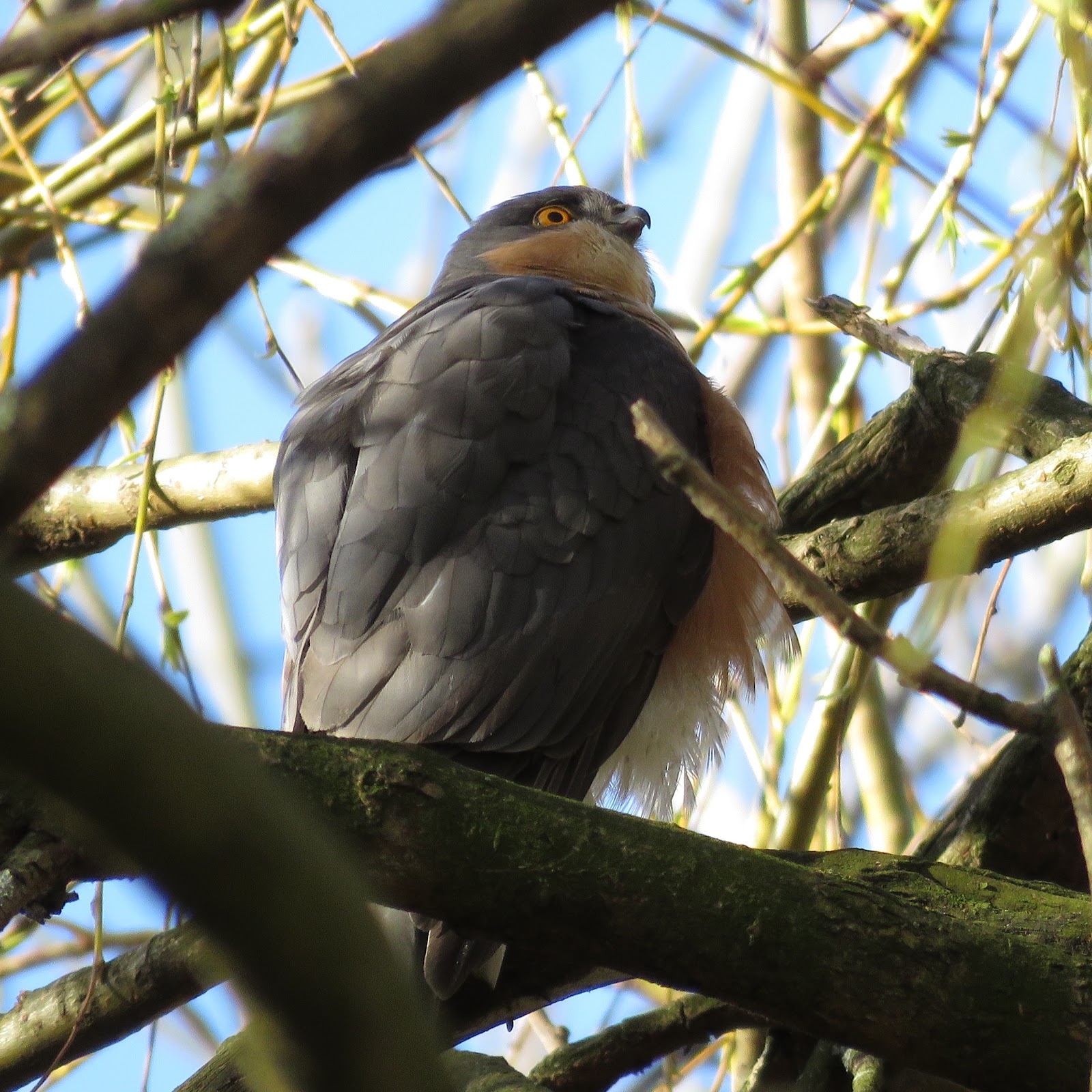
This morning a lively chorus of Blue Tits and Chaffinches alerted me to a hunting Sparrowhawk in the park. It flew over and landed on a branch of a Horse Chestnut nearby. Luckily, there was a clear line of sight between the still leafless branches from where I was standing. Its russet underside and small size revealed it was a male. It only sat there for a couple of minutes, scratched its chin, and flew across the road to a willow where I've seen Sparrowhawks sitting before. As it flew, the small birds started calling nervously again. I approached, and managed to find an angle where I could get a clear view. He didn't notice me, instead, he was interested in the birds mobbing him from a safe distance over him, and looked intently.

In the willow, under the cover of its curtain of branches the hawk appeared relaxed. It turned to the sun, raised its feathers and shook them leaving them fluffed out, an action called 'to rouse' amongst falconers (photo below). I was impressed by his long chest and flank heathers, thinly lined with white. Sparrowhawks also have long white undertail coverts, which they fluff out when they display over their territory.
The male turned its back to me again. Every time it changed position, the birds called echoing his movements.
This was the last photo I took from the five minute encounter. Followed by the alarm calls of the small birds, the Sparrowhawk flew away, probably trying to surprise some prey still not alerted to its presence.

Sunday, 3 February 2013

Sparrowhawk aerobatic displays

Since the start of the year, specially on sunny days, I have had the chance of watching Sparrowhawks displaying. Surprisingly, it is the larger female who takes the lead in these open air flight manoeuvres. They fly high over their territory, flapping their wings in a slow, deliberate way as they climb up, only to dive down, stooping with wings folded back, and repeating the procedure again. Their partner can follow them in their flight path, but often only one individual is visible. This way they advertise ownership of their nesting territory in preparation for the breeding season, although aerial displays are also part of courtship.
This flying in the open behaviour is much unlike the skulking, darting hunting flights of this species, which often just offer a glimpse of the bird. It is when they are displaying that Sparrowhawks - being more visible - are likely to be spotted by Carrion Crows (below) and seagulls and have then to endure being mobbed.

Saturday, 20 March 2010

Uneasy neighbours: Carrion crows and Kestrels

A kestrel has taken residence in the neighbourhood, I have seen it flying almost every other day. The resident pair of crows does not seem happy about this. A couple of weeks ago I saw them mobbing the kestrel while regularly uttering their characteristic 'krrr' call high over the garden. The same happened yesterday. In both occasions, by the time I had taken the camera out they were already quite distant. As I wanted to write a post about mobbing, I decided to take out my Wacom Bamboo tablet and sketch the behaviour. Mobbing is found in many bird species and often is a communal affair by which potential prey call and harass a predator. Mobbing is a costly behaviour, it takes a lot energy to chase and call and dive bomb the predator. The crows can spot the kestrel in the distance and go out of its way to mob it. Once a kestrel was gliding quite high, and I watch a crow laboriously gaining hight in broad circles in order to mob it. During the actual mobbing, the crow flies slightly over the kestrel - a safe way to do it - and chases it, occasionally taking dives at it, while the kestrel avoids each dive, and occasionally turns to the crow. In rare occasions, the mobber can turn into a meal for the mobbed, but I am not sure this can happen in crows, which are quite robust and bigger than kestrels. Why do birds mob? what do they gain from this behaviour? There are many hypothesis and it is likely that a combination of some of them is the reason. One of them is that mobbing allows birds to transmit information on who the enemy is to the next generation (a form of cultural transmission). In some classic experiments with blackbirds, birds watching a harmless, novel bird being mobbed by another blackbird started to mob the new bird themselves. Mobbing can have also direct benefits for the mobbing individual, it could be showing off is good condition, a form of advertising that if wont be easy prey. Mobbing could confuse or distract a potential nest predator from their nest seeking behaviour. When the predator is chased and engaged it cannot pay attention to the local territory and gather information on the nest location, for example. In seagull colonies, mobbing on crows - yes, crows can be mobbers or mobbed themselves - decreased the chances of egg predation and colonially nesting gulls enjoy lower rates of nest predation than solitary nesting gulls. In addition, mobbing tends to intensify during the breeding season in solitary nesting birds.

This crow is gathering nest material, soft bark from the lime nearby. The photos were taken trough glass.
Crows are indeed nest building now. Yesterday and this morning we watched the pair gathering nest lining material, stripping pieces of lime bark dextrously using their feet and beaks. Their zealous harassing of the kestrel might well reflect the fact that they would rather not have him as neighbour when their vulnerable offspring hatches.