Showing posts with label Greylag Goose. Show all posts

Monday, 2 May 2016

Greylag nursery

 Many Greylag geese pairs in our large local park have now young goslings. Although geese can be quite intolerant of each other at the start of the breeding season, now the families join together in an area of grass by the lake forming a large nursery. These behaviour might allow them to better detect and defend young from predators. Goslings are precocial and once dry after hatching they can feed by themselves straight away. In the few hours that the goslings spend on their own with their parents they imprint on them and will follow them everywhere. Both parents tend their young by fiercely protecting them from potential predators, hissing or chasing them away, while the goslings feed or rest quite oblivious to their parent's nervousness.
Goslings seek warmth under their mother's wing. Only females are in charge of brooding the goslings in their first few weeks, when they are still unable to regulate their body temperature.
 Despite geese being quite accustomed to people in the park, they still fiercely hiss even as they are being fed. We noticed that pairs differed on how nervous they were. In one of the pairs, the female, instead of hissing, uttered contented calls while she fed and the male didn't hiss at all, despite their goslings being very close to us.
Two families with females brooding young (on the left) and males stand guard.
A group of five goslings follows parents.
Two very nervous parents defending their only young.

Wednesday, 25 March 2015

Snooze time for a Greylag pair

The large wintering Greylag flock in my local park has now disintegrated into pairs, which have moved onto their breeding areas. The last few times the flock was around there were many fights as males started to become very aggressive towards other males. There are now just up to three pairs remaining, sometimes just the one. Yesterday, they were resting with the resident Canada Pair in the lake island where they are less disturbed by dogs and people.
 This pair, is easily recognisable by the male's black bill tip. In ducks, swans and geese the thickened tip of the bill is called a nail. In grey geese, juveniles have a dark nail, while in adults the nail is pale (so I have named this unusual male Black Nail). They are illustrating that paired geese tend to stay close together and do the same things at the same time: rest together, travel together, feed together. Research on the semi-tame Greylag flock established by Konrad Lorenz in Austria, showed that bonded pairs also carry out complementary behaviours, for example males are vigilant while females are foraging or resting. Pairs that had successfully reared offspring together differed from unsuccessful pairs in that they showed more reciprocation: females are vigilant when male feeds more often than in unsuccessful pairs.
  Unlike corvids or parrots, in which mutual grooming is important to keep the pair bond, geese never groom each other, in fact, I don't think I have even seen a pair of geese in actual physical contact (e.g. roosting against each other like pigeons or crows do). Instead, they are social allies, they rely on each other's support against rivals or intruders, and carrying out ritualised triumph ceremonies afterwards. In the Konrad Lorenz flock, although successful and unsuccessful pairs had a similar within-pair distances (keeping within one meter of each other), when previously successful pairs failed a breeding attempt, they remained closer together, showing a tighter social bond.
Eyes open
Eyes half close
In this video you can see an aggressive male chasing away other geese in the flock (taken 27th February 2015).


More information
Scheiber, I. B., Kotrschal, K., Hemetsberger, J., & Weiß, B. M. (Eds.). (2013). The Social Life of Greylag Geese. Cambridge University Press.

Wednesday, 3 December 2014

Gritting greylag geese

Birds that feed on fibrous or hard food of vegetable origin often swallow sand or small stones ('grit'). Grit accumulates in the gizzard or crop, and together with the muscular action of the crop it helps macerate their food facilitating digestion and increasing food processing rate. The limited size of the gizzard means that herbivorous birds need to spend time just processing food, waiting until the gizzard empties, before another foraging bout. Grit can be ingested accidentally with the food or purposefully, by visiting places where it is easy to find. Wintering flocks of Greylag goose in Doñana National Park (Spain) visit sand dunes to ingest sand, and their crop can hold up to 10 g of sand.  Birds can adjust the amount of grit to their diet and in turn, crops containing more grit become more muscular, flexibly responding to the demands of different coarseness or amount of fibre in the diet.
 While watching the flock of wintering geese in my local park, I noticed them stopping in a bare area. First I thought they were feeding on the small tufts of grass there, but when I looked closer I realised they were ingesting grit. They spent a few minutes doing this, and then moved onto the grass to feed. The distinctive individual with a white head (above) serves as an identifier for this flock. I have seen him or her both at East Park and Pearson Park.
A pair gritting together.
Here is a short video of the behaviour:


More information
Amat, J. A., & Varo, N. (2008). Grit ingestion and size-related consumption of tubers by Graylag Geese. Waterbirds, 31(1), 133-137. here.

VerCauteren, K. C., Lavelle, M. J., & Shively, K. J. (2003). Characteristics of grit in Canada goose gizzards. Wildlife Society Bulletin, 265-269. Here.

Friday, 21 November 2014

In the wrong flock

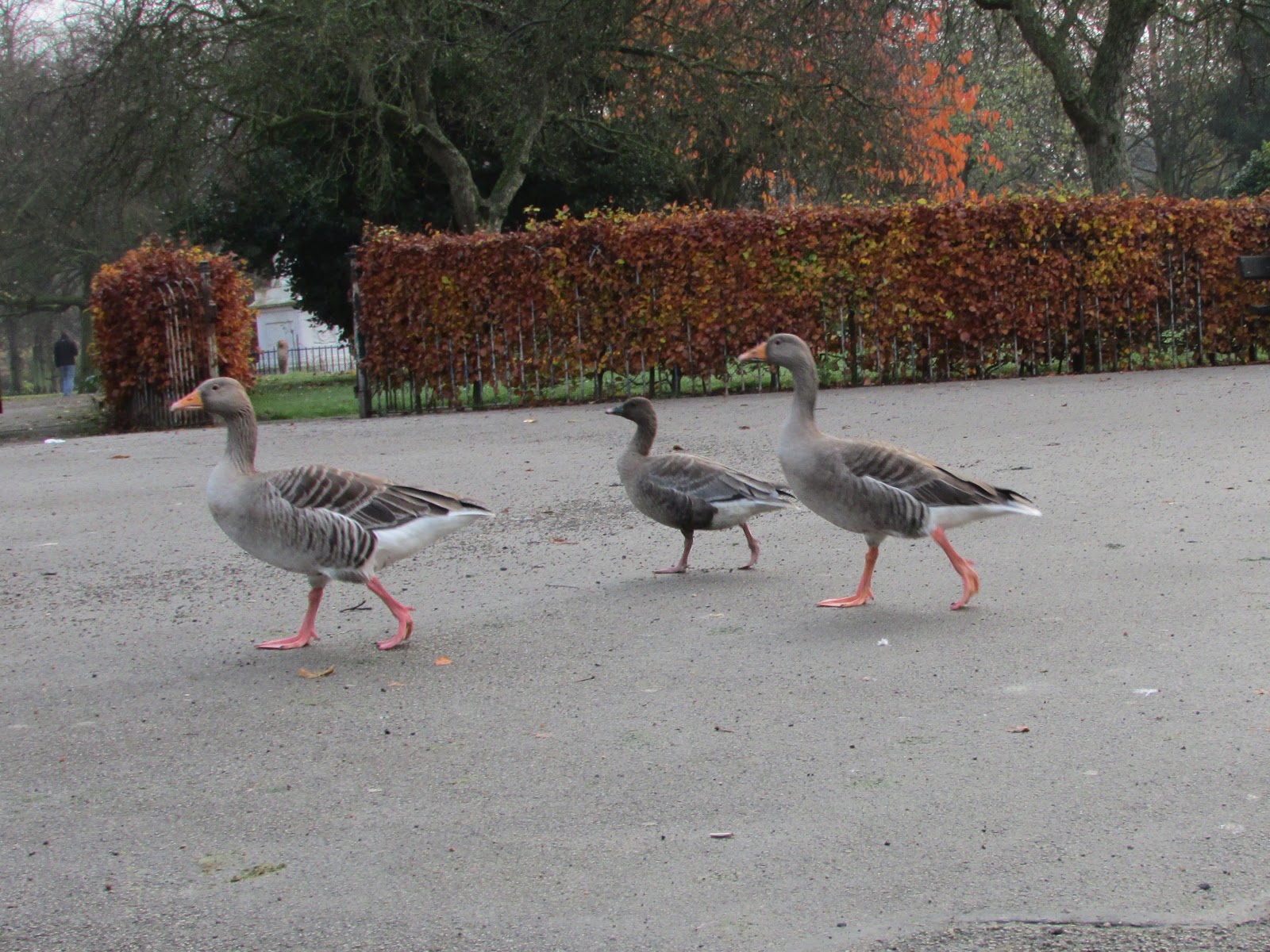
Although I wouldn't consider Pink-footed Goose (also known as Pinkfoot) to be an urban bird, it is a species that I regularly see. Skeins of this migratory geese, announced by a chorus of high pitched calls, regularly fly over the city in October and March, on their way to and from their breeding headquarters in Iceland and Greenland. Occasionally, however, a straggler will turns up with Greylags in local parks, allowing a closer look.
  On my way to work, walking through the park, a flock of Canada Geese and another of Greylag geese were about. While counting them I noticed a much smaller goose, a Pinkfoot, amongst the greylags. They have small bills, marked with pink, much darker head, contrasting with the slaty back. I think this individual was a young bird born this past summer, as you can see two types of feathers in its flanks and back, as the larger adult feathers, with a pale edge, have started to grow. The furrows that adorn the neck of adult geese are not yet sharply defined. The goose wasn't welcome and was often lunged at by the Greylags. Surprisingly, it was quite relaxed in the park, despite proximity to people, and it got very close to me as it followed the other geese across the lake and then to the grass to feed.
 I other occasions when had previously seen other Pinkfoot with greylags, it was also young birds. I wonder if leaving with your own species as the flock departs takes some learning. Geese need to reach a consensus before leaving as a flock, a decision that takes place by increasingly noisy vocalisations and movements of the birds of the flock when they are ready to leave. If a young bird misses the cues, it will fail to take off might miss the flock altogether, becoming stranded possibly with another geese species. Geese have long lives and move about, so most likely, while following the greylag flock in its travels, it will eventually meet a Pinkfoot flock and the young bird will be reunited with other members of its species.
A Greylag drives the pinkfoot away from its partner

Walking towards the grass. The difference in size between both species is evident here.

Tuesday, 6 May 2014

Fledglings

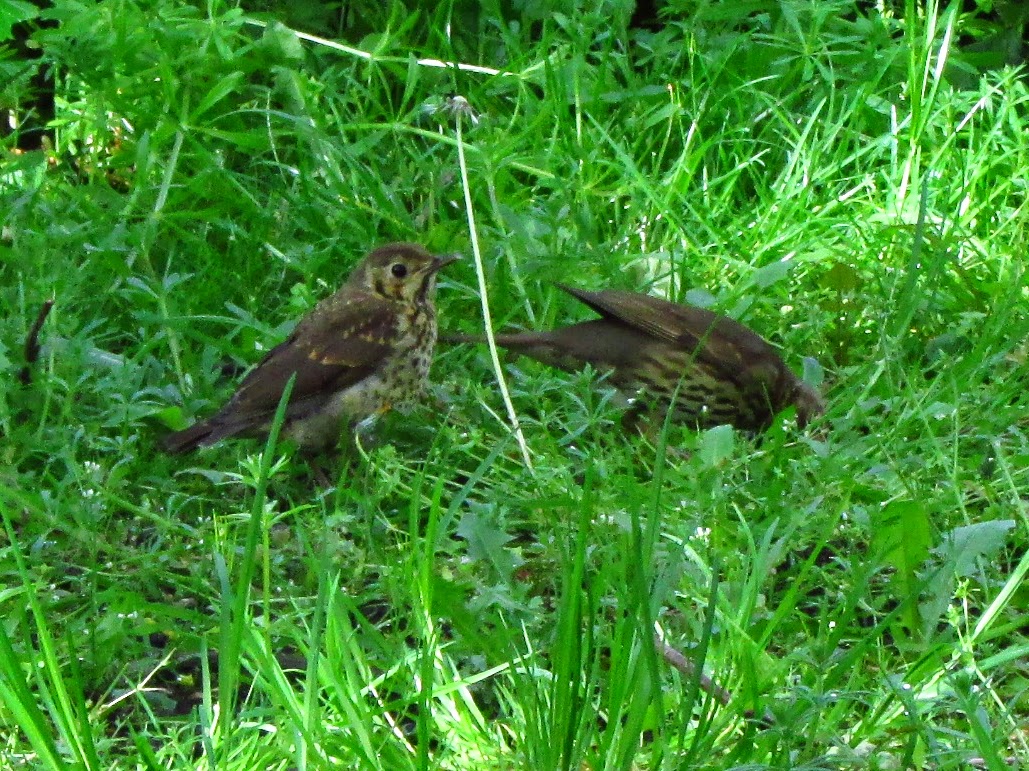
In the last couple of days I've come across a number of resident species with fledglings. Blackbirds were first, a short-tailed adventurous chick calling for food in the park, last week (below) and today (above) a Robin yesterday and a Song Thrush and Dunnock today. As the youngsters jump from the nest, they have to face a steep learning curve, they are more or less naive to predators, so in these days between fledgling and independence from parents they need to learn about them and also perfect their foraging skills, usually while they follow their parents, begging.
 Magpies and Carrion Crows start showing an interest on trees and bushes, listening for calling chicks, so the alarm calls of the adults, associated to the different predators are part of the learning process. The first mallard brood in the park has already disappeared, probably due to predation by Herring and Lesser-black backed gulls.
Blackbird fledgling, 29/04/2014, from the same brood as the top photo, today.
These goslings from a local park already show a great interest in people, usual food providers here.
Young Robin
A sleepy Dunnock fledgling
A song thrush finding food for its youngster...
Young Song Thrush fledgling and busy parent.
A Magpie in search of nests or young birds in the undergrowth.
A Herring gull in the park having mallard for breakfast this morning.


Thursday, 21 February 2013

The beak of a grazer

This male Greylag approached me nervously in the park today. It hissed regularly while walking towards me, probably expecting handouts. I crouched down and tried to get a close shot of its beak as it hissed. Geese - and the duck family, Anatidae, in general - have very distinctive beaks with a rounded, 'nail' at the top tip (young Greylags have a black nail) and serrated edges alongside both sides of the upper and lower bill. In the case of the geese, these are quite hard and sharp, remarkably teeth-like (they can draw blood if they get to bite your finger). When looking at the photo I noticed even the tongue has serrated projections. In geese, these help cut grass and plant material when they are grazing. In some ducks these edges have wafer-thin lamellar forming something akin to a whale's baleens, helping them filter out small planktonic organisms from the water.

Tuesday, 20 November 2012

Greylag portrait

I took this photo last monday in a local park. I can't stop myself photographing Greylags, definitely a top bird for me, and I feel lucky that these geese are so approachable, most if not all of them of feral origin. The flock was watchful for dogs, and took off shortly after, but this handsome individual looked straight to the camera while posing nicely.

Tuesday, 17 January 2012

The hybrid goose in the park

ResearchBlogging.orgI have known this goose since 2005. It is a hybrid between Canada Goose and possibly Greylag, and it turns up every winter in my local park. Today, it behaved gallantly, chasing away other geese and ducks while its partner, a Canada goose, fed.
The hybrid goose holds the pair of Canada away from the food source, allowing his partner to feed unmolested.
This goose is a large bird, with a mixture of features from both species (see photos of Greylag and Canada below), with the white patch on the face of the Canada, the pink legs of the Greylag and a beak half, black half pink.
A Canada goose
 A Greylag
 I think the hybrid is a male. He is paired with a female Canada and travels with a Canada flock. Hybridisation is a fascinating issue. In a puritanical view of species - which were created, would not change and could be nicely put into separate drawers - hybrids, were viewed as oddities: unnatural, often sterile, hard to put away in a neat drawer. This view has changed a lot lately. Recent genome sequencing data have shown that we humans seem to be a melange of different hominid isolates that mixed when they met; polar bears and brown bears have been shown to have often interbred during the Pleistocene; Carrion Crows and Hooded Crows do it; Willow Grouse and Rock Ptarmigan do it as well. There are many more examples. Natural climatic changes, such as during ice ages, often brings species together facilitating hybridization. Human introductions, placing species that previously didn't come together in the same areas can also promote hybridisation. Hybridisation is not only more frequent in nature than previously thought, but can also fuel species diversification and adaptation.
 Geese hybridisation is interesting as, when young, goslings undergo a phenomenon called imprinting. After hatching, goslings have a sensitive period during which they attach themselves socially to any moving stimulus, and follow it. This usually happen to be their parents, but they will eagerly follow people when goslings are hatced in an incubator. Even their mating preferences are determined to some point early in life, as goslings imprint on the adults that rear them - this is called sexual imprinting - and, when adults, will try and find a mate of the same species of the individuals that reared them. In nature, errors can happen. For example when individuals practice egg parasitism - laying eggs on another species' nest - or a brood from another species is adopted or brood amalgamation, when goslings from  different species pool together and the adults of one of the species take care of them.
 What happens to the fostered brood when they grow up? They imprint on their foster parents, which rear them as if they were their offspring, but they still look like their biological parents. Eric Fabricius carried out an experiment in the wild to examine the effects of sexual imprinting on hybridisation in geese. He swapped all eggs from two nests of Canada geese by Greylag eggs. The cross-fostered Greylags migrated with their Canada parents and upon returning to the breeding ground the following spring they paired up:
Of 35 returning birds, all 16 females paired with greylag goose males (100%) whereas of 19 males 5 paired with Canada goose females (14%) and the remaining 14 with greylag goose females (74%). The pair bonds generally persisted as long as both birds were present, but after loss of a partner, the remaining bird usually re-mated. Even when this happened several times during the lifetime of a male, the new mate was always a Canada goose female, showing that the males were sexually imprinted to this species. The Canada goose females which had mated with the greylag ganders also remated when widowed, but their new mate could be either a Canada goose or a greylag goose.
All cross-fostered females paired with Greylags. They looked like greylags, so they weren't courted by Canada males, just Greylag males. The pattern in the males is interesting, as they probably actively courted Canada females - and some accepted them-  but they were also found attractive by greylag females and they ended up pairing with them. Only the category of cross-fostered males pairing with Canada are likely to father hybrid offspring. What happens to the hybrid offspring is interesting as they do look intermediate between species. If is still unclear if hybrid CanadaxGreylags are fertile. The hybrid in the park then probably had a cross-fostered dad. He appears to have no trouble keeping a mate, and if he is always as considerate in his behaviour as today, she might as well keep him.

References
Fabricius, E. (2010). Interspecific Mate Choice Following Cross-fostering in a Mixed Colony of Greylag Geese (Anser anser) and Canada Geese (Branta canadensis). A Study on Development and Persistence of Species Preferences1 Ethology, 88 (4), 287-296 DOI: 10.1111/j.1439-0310.1991.tb00283.x


Edwards, C., Suchard, M., Lemey, P., Welch, J., Barnes, I., Fulton, T., Barnett, R., O'Connell, T., Coxon, P., Monaghan, N., Valdiosera, C., Lorenzen, E., Willerslev, E., Baryshnikov, G., Rambaut, A., Thomas, M., Bradley, D., & Shapiro, B. (2011). Ancient Hybridization and an Irish Origin for the Modern Polar Bear Matriline Current Biology, 21 (15), 1251-1258 DOI: 10.1016/j.cub.2011.05.058


Quintela, M., Thulin, C., & Höglund, J. (2010). Detecting hybridization between willow grouse (Lagopus lagopus) and rock ptarmigan (L. muta) in Central Sweden through Bayesian admixture analyses and mtDNA screening Conservation Genetics, 11 (2), 557-569 DOI: 10.1007/s10592-009-0040-9

Saturday, 13 February 2010

Greylag Geese watching

 In the last couple of weeks, a small flock of a dozen greylag geese has started to come to the local Park. Greylags are one of the most interesting local birds to watch. Once they land, the orderly formation breaks and pairs separate and noisily settle scores before starting their feeding with ritualized neck posturing. Despite being in a flock, pairs are usually quite easy to spot, they follow each other and the gander is slightly larger than the goose. When showing aggressiveness, one of the pair members lowers its neck and shows the beak to its opponent, with the partner following close. On quiet times, where no people are feeding the ducks, greylags head up to the large grass spaces of the park to feed. These are no wild geese, if you show some interest in them, they are likely to come closer to check if you have scraps, or even come right to you to demand some depending on their personalities. To watch them doing what if comes naturally to them you need to feign indifference. Today I watch six of them grazing.
Konrad Lorenz, the Nobel prize, carried out long term behavioural studies on hand-reared greylag geese to allow close approximation. His geese - which were individually named - lived free but did not migrate, so he could study them year round. Lorenz describes geese behaviour in detail in his book 'Here I am - where are you?' Lorenz first discovered the phenomenon of imprinting on geese, by which newborn birds attach themselves to the first moving object they see after hatching. The description of his first, serendipitous, realisation of imprinting is quite moving: 
'After the first gosling had hatched and dried, I was unable to resist the temptation of removing the delightful creature from under the foster mother and taking a closer look. As I did so, it gazed at me and soon began to utter its single syllable lost calls [...] I answered with a few comforting sounds. [...] Eventually, however, I had enough of this babysitting and placed the gosling back under the wings of the brooding domestic goose and started to leave. I should have known better.' 
The gosling started making distress calls and when Lorenz starts moving away, it follows him. Lorenz did a lot of babysitting from then on! 

The Greylag goose triumph ceremony (from one of Lorenz's papers on the behaviour of the Greylag geese).