Showing posts with label urban birds. Show all posts

Sunday, 18 October 2020

Pink-footed geese commute


One of the highlights of my bird year is to first hear and then see the wavy skeins of Pink-footed Geese flying over from their summer breeding quarters in Iceland and East Greenland.

This morning, I headed to my local park to carry out the Wetland Bird Survey. I counted the Greylag and Canada geese flock, the Common Gull flock, all recently arrived, and the resident Mallards and Moorhens. But al through, there was a beautiful background noise of calling Pink-footed geese. Flock after flock flew over, their arrival preceded by their echoing calls. Most were going north, 1500 of them.

You might be puzzled to see these geese flocks flying north or east early in the morning, how can it be that they are not going south? The reason is these birds are wintering or staging their migration in the Humber Estuary. What we are watching is their daily commute, in fact, their morning rush hour! Every night, the flocks gather to roost Read's Island and Whitton Island in the upper Humber estuary, where they are safe from disturbance and predation. At day rise, the birds fly to fields on Holderness or the wolds to feed, favouring fallow fields, or the spilt grain in those fields still to be planted, and also left-over potatoes! A similar movement happens towards Lincolnshire.

The Pink-footed geese population suffered strong declines in the 20th century, but it has been steadily increasing in the last couple of decades. The increase was followed by a renewed use of the Humber Estuary for wintering and also as a staging post on the way to Norfolk. UK coasts and estuaries now hold a sizeable amount of the total wintering population of this geese species, estimated to be about half a million birds.

With the constant daily movement, it is unavoidable that a few stragglers will separate from the flock. They call pitifully when trying to catch up. Many will eventually find the flock. Some others, which could mainly be young birds which haven't learned the route, may be disoriented and join a Greylag flock, as has happened several times in our local parks. 

More information

A Humber Goose spectacular. RSPB Blog by Pete Short.

Mapping the Pink-footed Geese.

WeBs survey results.

Monday, 3 December 2018

Watching Waxwings

Yesterday, I got up early and had a short drive to a local supermarket to watch some Waxwings that had been reported. Waxwings are irregular winter visitors to the UK, especially to its eastern side, and are most likely to arrive to a supermarket car park near you. A lovely mild morning with sunny spells and a light wind, I walked around the quite empty car park checking the rowans, a couple of small ones still with berries. two Woodpigeons and a Blackbird were feeding on them, but no trace of Waxwings.
Woodpigeons.
Blackbird sitting on a rowan still laden with berries.

Suddenly, a flock of six Waxwings appeared silhouetted against the rising sun and landed on the tree in front of me.
The safe tree
Almost every time I've seen Waxwings, they alternate between bouts of frantic berry feeding and resting in a tree nearby. It's not just any tree, it is a particular tree. This tree attracts them like a magnet and they appear not to settle anywhere else. This time their safe tree was an ash, the tallest tree in a row on a rise by the road separating two supermarket car parks. The Waxwings spent a few seconds feeding on a yellow-berry rowan, and then they flew back to the top part of the ash tree, where they spend most of the time. Other times the flock would fly towards a rowan and return to the safety of their tree even before landing. They are extremely watchful, looking up nervously every now and then with bouts of preening, resting and calling.
Their quiff-life crests rise or flatten with their mood (compare the top shots taken a few seconds apart), sometimes becoming ruffled with the breeze. They are not particularly wary of people, some photographers assembled just underneath their tree, pointing at them with their cameras, walking right under them, and they paid no attention.

Birders and Waxwings on their safe tree.
Instead, they are watchful of predators. Being small birds, similar to starling in size, they would be easy prey for Sparrowhawks. Indeed, later on, when I go for a wander in the area, I see a Sparrowhawk flying past chased by a flock of starlings.
This is the only shot I got of the Waxwings in the rowan where they fed.
Decision making
When to go to feed? It was interesting to watch the individual Waxwings on the tree. At some point one of them appeared restless, and would fly from branch to branch around the others - which were preening or resting - or it would fly up and away from the tree a short distance, and if the others didn't follow, it would return. This individual appeared to be rallying the group to go and feed.
 Earlier in the week there had been nine Waxwings about, then the six yesterday. Today just two remained. Two Mistle Thrushes sat on a lamppost, guarding the rowans, so not sure the Waxwings will stay much longer. The two waxwings sat close in the tree and billed each other briefly, maybe passing some food?
Early arrival of Waxwings indicate an irruption year, so I do hope there's more opportunities this winter to catch up with them.

Wednesday, 13 December 2017

Singing starlings

Starlings sing all year round. True that in spring they spend more time atop vantage points near their nest, throat feathers fluffed, wings fluttering, emphasising their phrases. Even in December though, they find time to sing. They include calls from other birds, often copied to perfection: pied wagtails, sparrows, swift are some that have misled me when I realised it was a starling singing. I was tidying up the photos of the year when I found this photo from May, which captures the enthusiasm of a starling singing.

Thursday, 7 February 2013

City scavengers

We humans can make a mess. Bins left open or toppled over, the remains of takeaways eaten on the street thrown to the pavement. It is not a pretty sight, but it means extra feeding opportunities for some. Birds take advantage of their surroundings: they eat the berries, buds, and flowers of the trees we plant in our gardens, they do reward our love for them feeding on delicacies on the bird table, but they will also eat our rubbish. Today, a Carrion Crow (top shot) searched for tidbits under a rubbish bag using that lovely crow technique of delicately picking 'things' and moving them aside. They do the same when feeding on leaf litter,  and it is quite different to the energetic, almost full body technique for the same effect used by Blackbirds. The Carrion Crows and Blackbirds often feed at the back of a row of flats, where bins are often left open and bin bags on the ground. My favourite sighting of a scavenging crow was one strutting on a pavement with a large sausage held across its bill, a pity I was driving at the time! Seagulls are supreme city scavengers too, with their bouncy, manoeuvrable flight, Black-headed Gulls are able to avoid the passing traffic - as they will avoid waves out at sea - to deftly dip in the middle of the road to pick items from in between cars.

Snow bonanza for a male blackbird...
...and a female too
Even Robins enjoy takeaway pizza
Black-Headed Gull on the lookout for feeding opportunities

Tuesday, 5 June 2012

Urban Kittiwakes

Some urban birds used to be cliff nesters before towns and cities existed: House Martins and Swallows, Swifts, Barn Owls, and some seagulls. Kittiwakes are birds of the open seas. They do not use rubbish tips to feed, like other gulls, and they are only brought inland when gales or storms push them out of their preferred habitat. They only come to land to breed and cliffs are great magnets for them: they will perch their nests made of grass, mud and seaweed in small ledges. In the cliffs where they nest their constant calls contribute to create a wonderful atmosphere in the breeding season. 
Buildings on seaside towns offer them artificial cliffs, safe from predators. We watched the large Kittiwake colony in Scarborough. Some nest in luxury, single occupation ridges on the ornate walls of the Grand Hotel. 
Others cram in apartment buildings, having to share their window ledges with two other pairs. These were making such a rattle I couldn't imagine the human occupants of the building would get much sleep.

The lower kittiwake classes have to content themselves with a nest under the bridge. One adult fed little fish to the adult on the nest in the middle.

Friday, 1 June 2012

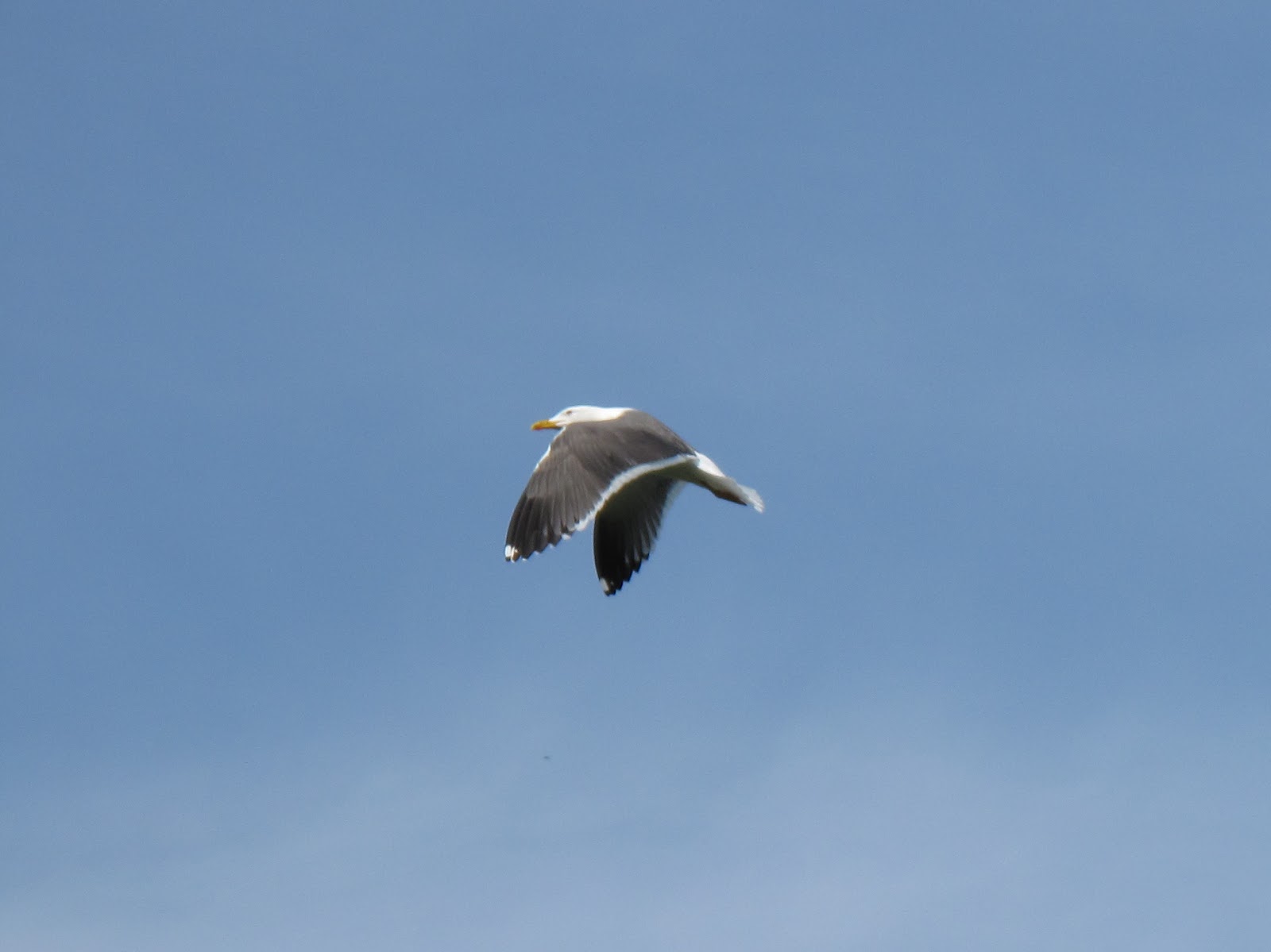
Urban Lesser black-backed Gulls

I have seen Lesser Black Back Gulls, Larus fuscus, regularly this year in the city. They are beautiful seagulls, similar to the Herring Gull, to which they are closely related, but with dark grey mantle, and yellow legs. During May I have seen them practically every day. Recently, I watched a flock in a local park, over ten birds, all adults, eating bread from the lake. They surely must be breeding in town.
The Lesser Black-backed gull is an Amber species, with some conservation concerns, however, they appear to be on the increase. Although shy, in the last few decades they have followed the Herring Gull in becoming an urban bird. A report by Monaghan and Coulson indicates that pairs have taken to nest on rooftops, with industrial and modern town centre buildings favoured as nesting locations. The first reports of roof nesting in this species are from 1969, and populations nesting in buildings are on the increase in the British Isles.


More information
Patricia Monaghan & Dr. J. C. Coulson (1977) Status of Large Gulls Nesting on Buildings, Bird Study, 24:2, 89-104. pdf here.