Showing posts with label Sparrowhawk. Show all posts

Wednesday, 5 April 2017

Encounters of the Sparrowhawk kind

I treasure encounters with Sparrowhawks as they are quite secretive and alert birds which don't like being seen. Today I managed some sightings of a pair in my local park. First I heard a call 'kikikikiki!' and I saw a female landing on a tree. The view was quite obstructed and unfortunately, she flew off as I tried to get a better view. 
Then, a while later, in the same area I spotted the male. Not sure how, possibly a blue tit alarm call alerted me. He had some prey, what looked like a small bird, and was plucking it.
 He flew off, carrying the prey in his talons, and I wandered after him towards some big trees where he had disappeared. Then I saw the pair together, high up the crown of one of the largest trees in the park, a poplar (top shot). Fortunately the beautiful light made up for the distance to take some photos. The male started preening. I couldn't see if the female had the prey now. Male Sparrowhawks hunt for the female while she incubates.
The male at the top, smaller and with reddish tones in his plumage. The female at the bottom, all alert. Soon tree foliage will completely obscure views of these birds from the ground.
 On my way back from work I looked longingly at the poplar. No Sparrowhawks to be seen there. But then, beyond the tree, high in the sky, the pair was circling together, playfully chasing and soaring.


Tuesday, 21 April 2015

The female Sparrowhawk and the 'missile' thrushes

There is a breeding pair of Mistle Thrushes in the park. Last week, one was busy finding earthworms on the lawn and carrying them neatly folded in its bill. This means they must be feeding young.  Today I heard the rattling call of annoyed Mistle thrushes. They use this call when they guard their berry trees in the winter, against Blackbirds and even much smaller birds like Chaffinches. The pair of them called and called from a tree. I tried to spot them and saw that a female Sparrowhawk was sitting on a branch. The Mistle Thrushes rattled and swooped over the hawk, the hawk ducked every time they dive-bombed her, although they didn't actually touch her.
 The female Sparrowhawk is an impressive raptor compared to the almost cute, much smaller, male. She is as large as a Woodpigeon, with broad chest and piercing yellow eyes. She can actually bring down Woodpigeons. Although the thrushes appeared fearless, they always stayed over the hawk, not underneath. The hawk moved onto an ash tree nearby, and although higher up, there were fewer leaves in the way, and after some trying I found a clear line of view and managed to take some photos and a video of the 'missile' thrushes dive bombing her. This behaviour, known as 'mobbing' involves potential prey individuals harassing or sometimes actually attacking predators when they are encountered. Mobbing is at its most intense during the breeding season. It is a behaviour that is not completely understood. One explanation, the 'move-along' hypothesis, is that mobbing diverts the predator attention from places where there are nests or young. When the Sparrowhawk's young hatches, they will be fed almost exclusively on fledglings, so harassing the predators might encourage them to move on, and hunt somewhere else.
Mistle thrush with worms in bill (14/4/2015)

The 'missile thrush' was my photo management software autocorrection, but I think it is actually quite fitting! This is an initially very shaky clip (no tree nearby to hold on). Watch out at 11 seconds.

Tuesday, 24 March 2015

An encounter with the male Sparrowhawk

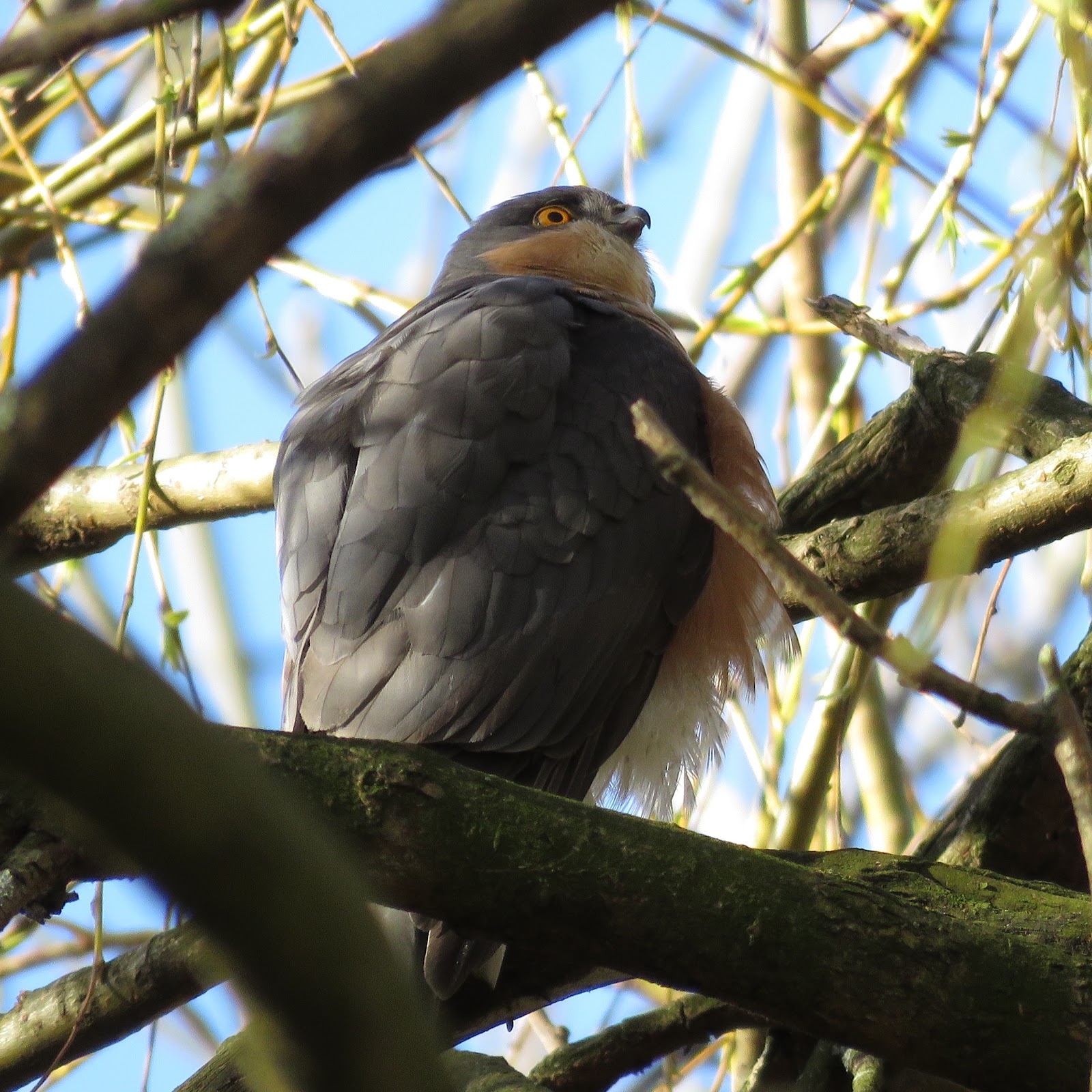
This morning a lively chorus of Blue Tits and Chaffinches alerted me to a hunting Sparrowhawk in the park. It flew over and landed on a branch of a Horse Chestnut nearby. Luckily, there was a clear line of sight between the still leafless branches from where I was standing. Its russet underside and small size revealed it was a male. It only sat there for a couple of minutes, scratched its chin, and flew across the road to a willow where I've seen Sparrowhawks sitting before. As it flew, the small birds started calling nervously again. I approached, and managed to find an angle where I could get a clear view. He didn't notice me, instead, he was interested in the birds mobbing him from a safe distance over him, and looked intently.

In the willow, under the cover of its curtain of branches the hawk appeared relaxed. It turned to the sun, raised its feathers and shook them leaving them fluffed out, an action called 'to rouse' amongst falconers (photo below). I was impressed by his long chest and flank heathers, thinly lined with white. Sparrowhawks also have long white undertail coverts, which they fluff out when they display over their territory.
The male turned its back to me again. Every time it changed position, the birds called echoing his movements.
This was the last photo I took from the five minute encounter. Followed by the alarm calls of the small birds, the Sparrowhawk flew away, probably trying to surprise some prey still not alerted to its presence.

Thursday, 19 March 2015

The Sparrowhawk silence

There are three ways I spot Sparrowhawks. First, during their spring soaring flights, high over their territory, when they are very apparent then, though a bit distant. The second is when Carrion Crows alert me to their presence, when they are mobbing them, chasing them mercilessly while uttering the call that gives the name to this blog: a call that I directly translate in my mind as 'sparrowhawk!'. The third one I have got to call 'the Sparrowhawk silence'. It is an eerie silence just after the synchronic clap of many pairs of wings - Feral pigeons, Gulls - that replaces alarm calls in these birds, and the alarmed calls of Blue Tits or Blackbirds: no gull squabbles, no cooing, no chitchat. If I look up during the 'silence', I am bound to see the brown silent shadow of the hawk, flying low across the trees in the park. I have witnessed this a couple of times this week. Today, when the silence happened I was photographing a Mistle Thrush. It was feeding on a small, but exposed grassy area, but it didn't fly off. It just froze, for maybe two eternal minutes, tense, its tail pressed against the ground, just watching. Afterwards, it relaxed and carried on hunting worms as normal.

Wednesday, 5 November 2014

Spotting the Sparrowhawk

The pigeon flock in the park took off all of a sudden, like a loud clap. In the silence that followed, I looked up: The male Sparrowhawk flew into the tree tops, I managed to see where it landed, high up in a sycamore. The leaves made it tricky to have a clear view, but I managed a few shots. When I find a predator by interpreting the behaviour of their prey I get a satisfying 'Dr. Dolittle moment'. The rattling call of the crow that gives this blog its name, or the alarm call of the blue tit have pointed me to many a Sparrowhawk. The Feral Pigeons are probably safer in flight than sitting on the cafe roof when a Sparrowhawk is out hunting, so they take off as soon as they see the raptor in flight.

Sunday, 3 February 2013

Sparrowhawk aerobatic displays

Since the start of the year, specially on sunny days, I have had the chance of watching Sparrowhawks displaying. Surprisingly, it is the larger female who takes the lead in these open air flight manoeuvres. They fly high over their territory, flapping their wings in a slow, deliberate way as they climb up, only to dive down, stooping with wings folded back, and repeating the procedure again. Their partner can follow them in their flight path, but often only one individual is visible. This way they advertise ownership of their nesting territory in preparation for the breeding season, although aerial displays are also part of courtship.
This flying in the open behaviour is much unlike the skulking, darting hunting flights of this species, which often just offer a glimpse of the bird. It is when they are displaying that Sparrowhawks - being more visible - are likely to be spotted by Carrion Crows (below) and seagulls and have then to endure being mobbed.