Showing posts with label urban trees. Show all posts

Friday, 24 March 2023

Siskins Galore


There is something about birdwatching that I find so rewarding: learning a simple thing, like a species contact call, opens a new world. Although they are regular wintering birds, I don't think Siskins are becoming more common around Hull. It is just that once I learned the beautiful soft, sad 'pew! call, then I am seeing them everywhere, and this year I have really enjoyed watching Siskins. 

Siskin feeding on Italian Alder this afternoon.

In the depths of the winter, when days are gloomy and cold, Siskin flocks rove around the city looking for Alders. They feed on both Common and Italian Alders, clinging from the cones sometimes upside down, deftly extracting seeds with their pointy bills. In quiet areas they might come down and feed on seeds on the ground.

In the last few weeks, the chattering singing chorus of Siskins have alerted me to flocks feeding in Lombardy Poplars in three different locations around the city, possibly as the seeds in Alders are becoming depleted. I was intrigued as I thought these catkins were pollen catkins. Lombardy Poplars are male clones, which produce red pollen catkins. Being wind pollinated I didn't think they had nectar (which would be odd for a finch to eat anyway), but I've never heard of a bird feeding on pollen. What are they feeding on then? Insects, possibly aphids, is a possibility, but it appears unlikely so early in the year.

Male Siskin feeding on Lombardy poplar catkins.

So, a bit like the Goldfinches feeding on lichen covered branches, I don't have an answer to what Siskins are feeding on, but Lombardy Poplars are plentiful around the city parks and playing fields, where they are planted as wind breakers, so hopefully they will stay around a little longer.

Please do let me know in the comments if you know the answer to the mystery!

Tuesday, 8 December 2020

Carrion Crows feeding on Plane Tree fruits

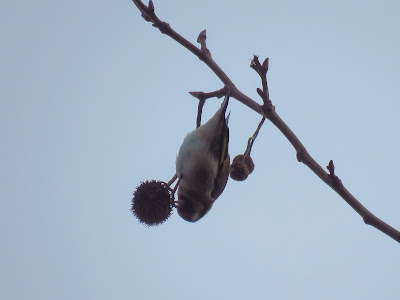
This morning I took a walk near a local park. On a square lined with Plane Trees, some pollarded, a flock of Goldfinches fed on the bauble-like fruits, often hanging from them acrobatically, as they often do.


Then I noticed the crows. They flew to the tip of the branches, where the plane tree fruits clustered, once they gained their balance they moved to the tip of the branch, and picked on the fruits, pulling at their stem. Then they purposefully hanged down from their legs, then only one leg while holding the fruit on the other and attempting to break the stem. What complex thing to do! Some of the fruits had frayed stems, like they had been chewed a few times. If a crow breaks the stem but drops the fruit, the other crows will be quick to go and steal the price. I didn't see this, but I did see chases and close guarding of the fruit by the owner crow, often flying to a safer place holding onto it.

All three crows did this, often the three of them hanging from branches at the same time. At least twice I saw they were successful, and then they flew with the fruit on their bill, once transferring it to their feet before landing and starting breaking the fruit open for their seeds. I'm always amazed at crows, I have covered how they crack mussels and periwinkles at the beach.

Today's behaviour, however, really topped it up. Were they copying the Goldfinches? Crows are always to the alert, they must have noticed the Goldfinches feeding on these fruits and had a go at getting them!

This is a video made with three clips I took from them


And a few photos of the behaviour.

Hanging from one leg, holding onto the fruit with the other.


Crow with its prize.
The pink gape suggests this is a young crow, feeding on the plane fruit. I wonder if this is a family, with the young copying the adults in learning this skill.
I'll be very interested to head from anyone that have seen this behaviour in their local crows!

Sunday, 8 December 2019

What are goldfinches doing on tree branches?

At this time of year I often see Goldfinches appearing to feed high on tree branches, often sycamores. It is hard to see what exactly they are doing, but definitely there are no seeds involved, it looks like they are pecking the bark or possibly lichens. I checked and they were not holding seeds under their feet (as they often do) or wiping their bills clean. They appear to peck the surface of the branch. I managed to photograph one that appears to lift and hold a bit of bark with lichen on top (top shot).

I am very curious to know what they are doing. During the breeding season Goldfinches use lichen to camouflage their nests, I only see this behaviour during winter. Has anyone seen this? Please comment! Some more photos of the behaviour follow.
3/12/2017.
25/01/2018
25/01/2018. This individual stayed pecking the end of this branch for quite a while.
16/11/2016

UPDATE 11/1/20
I found out a chorusing Goldfinch flock in a local park today. Several of them were feeding on branches in two lime trees. I managed a couple of videos showing how they target areas at the end of broken branches and deftly peel bark and wood, discarding bits. If they are feeding on the bark or wood itself or on some invertebrates living in it is unclear.


Monday, 3 December 2018

Watching Waxwings

Yesterday, I got up early and had a short drive to a local supermarket to watch some Waxwings that had been reported. Waxwings are irregular winter visitors to the UK, especially to its eastern side, and are most likely to arrive to a supermarket car park near you. A lovely mild morning with sunny spells and a light wind, I walked around the quite empty car park checking the rowans, a couple of small ones still with berries. two Woodpigeons and a Blackbird were feeding on them, but no trace of Waxwings.
Woodpigeons.
Blackbird sitting on a rowan still laden with berries.

Suddenly, a flock of six Waxwings appeared silhouetted against the rising sun and landed on the tree in front of me.
The safe tree
Almost every time I've seen Waxwings, they alternate between bouts of frantic berry feeding and resting in a tree nearby. It's not just any tree, it is a particular tree. This tree attracts them like a magnet and they appear not to settle anywhere else. This time their safe tree was an ash, the tallest tree in a row on a rise by the road separating two supermarket car parks. The Waxwings spent a few seconds feeding on a yellow-berry rowan, and then they flew back to the top part of the ash tree, where they spend most of the time. Other times the flock would fly towards a rowan and return to the safety of their tree even before landing. They are extremely watchful, looking up nervously every now and then with bouts of preening, resting and calling.
Their quiff-life crests rise or flatten with their mood (compare the top shots taken a few seconds apart), sometimes becoming ruffled with the breeze. They are not particularly wary of people, some photographers assembled just underneath their tree, pointing at them with their cameras, walking right under them, and they paid no attention.

Birders and Waxwings on their safe tree.
Instead, they are watchful of predators. Being small birds, similar to starling in size, they would be easy prey for Sparrowhawks. Indeed, later on, when I go for a wander in the area, I see a Sparrowhawk flying past chased by a flock of starlings.
This is the only shot I got of the Waxwings in the rowan where they fed.
Decision making
When to go to feed? It was interesting to watch the individual Waxwings on the tree. At some point one of them appeared restless, and would fly from branch to branch around the others - which were preening or resting - or it would fly up and away from the tree a short distance, and if the others didn't follow, it would return. This individual appeared to be rallying the group to go and feed.
 Earlier in the week there had been nine Waxwings about, then the six yesterday. Today just two remained. Two Mistle Thrushes sat on a lamppost, guarding the rowans, so not sure the Waxwings will stay much longer. The two waxwings sat close in the tree and billed each other briefly, maybe passing some food?
Early arrival of Waxwings indicate an irruption year, so I do hope there's more opportunities this winter to catch up with them.

Saturday, 30 April 2016

The summer Blackcaps

At the end of April, the arrival of migrant Blackcaps is marked by their beautiful fluty song. Males arrive a few days earlier than females and settle in their breeding territories. I heard the first one in the park on the 19th of April. Blackcaps usually sing from cover in trees and bushes, and the rapidly sprouting leaves will make it more difficult to spot them singing as the spring avances. Today I found a female in the territory where the male had been singing. She was very busy in a tall Sycamore tree, Acer pseudoplatanus, picking aphids from under the leaves, stretching and balancing on the fine branches. The male wasn't far, singing and feeding on aphids like her.
The female feeding.
Note the two aphids on the main veins of the leaf near the male's bill and...
...a few seconds later they are gone.
A short clip of the male feeding.

Thursday, 16 January 2014

Goldfinches feeding on ash keys


I had never seen any Ash seed predators, until today I spied a charm of Goldfinches atop a weeping ash tree in the park. The Goldfinches were sitting on bunches of keys chomping away at them. I was so surprised I checked sure they were eating the seeds and not the buds or just loitering on the tree. But, yes, they were manipulating the seeds with their bill (bottom photo). I could only find a photo of goldfinches feeding on ash keys (here). The coat of the ash seeds seems quite tough and leathery so that shows how versatile goldfinch bills are, not only extracting tiny seeds like teasel, birch or alder from their pods, but also dealing with these.


UPDATE 18/01/2014
I watched another flock in a different Ash tree today. I photographed an individual using its foot to hold the whole seed while it pecked it with its bill. Photos follow.


Saturday, 27 April 2013

Nectar feeding Blackcap


ResearchBlogging.orgYesterday I heard a male Blackcap singing on my way to work. Although it was high on a tree, luckily, I had a small pair of binoculars with me and I found him on a Sycamore in bloom. While I watched it, the Blackcap alternated singing and clearly drinking from the Sycamore flowers, in one occasion clinging upside down from a branch like a tit to reach them. It is well documented that several European birds, especially warblers, regularly drink nectar (I have posted on Blue Tits feeding on Mahonia nectar before in this blog). I could only take some distant shots of this behaviour, and when I got back, I did some research on the nectar feeding habits of the Blackcap.
 The Blackcap is actually one of the most nectarivorous European warblers. Nectar feeding in warblers is most common during spring migration, and has been documented in many stopover sites. Blackcaps often have stained faces due to their flower feeding habits (you can see some examples here and here. This can result on the formation of a 'pollen horn' a matted mass of nectar, pollen and feathers around their bills. Given that their long, thin bill leaves flowers intact after feeding, that they visit many flowers and the presence of pollen on their faces indicating regular contact with the flower's anthers, it is not surprising that Blackcaps can also act as pollinators.
 Experiments on birds trapped during migration indicates that migrating warblers seem to prefer nectar to mealworms when both are offered simultaneously. Nectar feeding is not a last food resort for emaciated birds, but a valuable source of easily digested carbohydrates when birds have reduced digestive systems and high energy demands.
 Blackcaps feed on nectar from a large diversity of flowers, both native and introduced. From the references below, I have compiled the following list of visited plants, which also includes some Mediterranean plants that they encounter during migration, and the Sycamore too. I note the native status in the UK.

  1. Goat Willow, Salix capraea. Native.
  2. Sycamore, Acer pseudoplatanus. Native.
  3. Oregon Grape. Mahonia sp. Ornamental.
  4. Citrus trees, Citrus. Mediterranean.
  5. Hawthorn. Native
  6. Damsons. Here. Native.
  7. Almond blossom. here. Mediterranean.
  8. Scrophularia. Here. Four large flowered species. Mediterranean, Canaries.
  9. Aloe arborescens This female has so much orange pollen on its chest that almost looks like a robin. South African plant widely introduced in the Mediterranean.
  10. Anagyris foetida. The only documented native European plant that is exclusively pollinated by birds. Mediterranean.
  11. Giant fennel Ferula communis. Mediterranean.
  12. Brassica oleracea-group.


More information

Ortega-Olivencia, A., Rodríguez-Riaño, T., Valtueña, F., López, J., & Devesa, J. (2005). First confirmation of a native bird-pollinated plant in Europe Oikos, 110 (3), 578-590 DOI: 10.1111/j.0030-1299.2005.13877.x

Ford, H. (1985). Nectarivory and Pollination by Birds in Southern Australia and Europe Oikos, 44 (1) DOI: 10.2307/3544053

Schwilch, R., Mantovani, R., Spina, F., & Jenni, L. (2001). Nectar consumption of warblers after long-distance flights during spring migration Ibis, 143 (1), 24-32 DOI: 10.1111/j.1474-919X.2001.tb04166.x

Jacopo G.Cecere, Costanza Matricardi, Beatrice Frank, Simona Imperio, Fernando Spina, Gabriel Gargallo, Christos Barboutis & Luigi Boitani. (2010). Nectar exploitation by songbirds at Mediterranean stopover sites. Ardeola, 57(1), 143-157.

Ortega-Olivencia, A., Rodriguez-Riano, T., Perez-Bote, J., Lopez, J., Mayo, C., Valtuena, F., & Navarro-Perez, M. (2011). Insects, birds and lizards as pollinators of the largest-flowered Scrophularia of Europe and Macaronesia Annals of Botany, 109 (1), 153-167 DOI: 10.1093/aob/mcr255

Monday, 21 January 2013

Siskin winter flocks

ResearchBlogging.orgI have come across a flock of Siskins in my street a couple of times this week. Today, about 20 birds were quietly feeding on seeds of a large Italian Alder (Alnus cordata), a widely planted tree along avenues. They were easily disturbed by car door slamming or a passing dog and tweeted while they flew to a higher tree. Given that my photos are quite distant, I decided to draw a male feeding on alder catkins (above).
Siskins - like Waxwings - are nomadic birds that follow unpredictable resources: tree seeds, with conifers, alder and birch being favourites. In the winter, substantial numbers of Scandinavian Siskins join the British breeding population and disperse more widely. In Scotland, Siskins appear in gardens in higher abundance in years with poor spruce cone crops, indicating more nomadic behaviour in these years and search for alternative food sources. Conversely, they barely come into gardens when their conifer seeds are found in abundance. Sitka Spruce, one of the most widely planted comercial conifer in the UK, has good crops every 3-5 years and this seems to be synchronised across large areas. The large plantations of this tree appear to have benefited Crossbills, Coal Tits and Siskins, which feed on the small seed of the tree. According to the BTO, nesting Siskin populations have increased by 77% since 2004 as the trees in plantations reached maturity and started producing seeds. But Siskins have also altered their behaviour outside their nesting grounds, increasingly using garden feeders - especially peanuts and niger seed - on poor crop years. I wonder if Italian Alder planting in streets might also make easier that we come across this lively little bird.

More information

AILSA J. MCKENZIE, STEVE J. PETTY, MIKE P. TOMS, and ROBERT W. FURNESS (2007). Importance of Sitka Spruce Picea sitchensis seed and garden bird-feeders for Siskins Carduelis spinus and Coal Tits Periparus ater Bird Study, 54, 236-247 : 10.1080/00063650709461480

Sunday, 11 November 2012

Wandering Waxwings

ResearchBlogging.orgI have litte interest in watching birds swept away from their native grounds by a tropical storm, or inexplicably lost and found far away from their usual migratory routes. Waxwings are different, and I have been wanting to see them for years. They might be rare, or not present in great numbers every year, but the UK is part of their distribution range. The last couple of days, I have been popping in a local supermarket carpark to watch a large flock of these amazing birds. Bohemian Waxwings, Bombycilla garrulus, as other boreal bird species - like Crosbills, Siskins and Redpolls - do not fit into a regular migratory pattern, they are instead irruptive migrants. It is thought that the species common name, Bohemian, comes from these wandering habits. In irruption years, many thousands of individuals flock and wander well south of their summer grounds in the the Russian and northern Scandinavian taiga making it to the UK. Flocks then move nomadically in search of food, as it is not cold winters what prompts their movement, but unpredictable food resources. Irruption years in Waxwings correlate with poor crops on fruit and berries in their northern grounds following a good fruiting year. Waxwings are highly frugivorous birds, their exclusive diet in the winter consists of berries and fruits: Rowan, Hawthorn, Cotoneaster, Mistletoe, Rose Hips and many others both wild and cultivated. The main resource, Rowan berries, fluctuates erratically across years in their summer grounds, as Rowan is a masting species, as fruit production is synchronised in the population and totally fails some years. During these poor fruit years, Waxwings initiate their movements earlier in the year, and therefore earlier arrivals of waxwings indicate that it will be an irruption year.
 During irruptions, waxwings carry on moving through the winter as they deplete their food resources locally, and they are wanderers all year round, with little chance that they will return to the same areas where they were born in the following summer. This winter is going to be one of those irruption years, and the Waxwing invasion is well underway.
 Waxwings are surprisingly small birds, similar in size to Starlings, to which they also resemble in flight, as they flock and have pointy, triangular wings. At close range there is no mistaking them, with their soft plumage, characteristic crest and 'zorro' mask. At even closer range, you might get to see the striking bright scarlet waxy drops and yellow streaks adorning their wings. They do look smart.
 As most fruit eaters, Waxwings need to eat a large number of berries to survive - an estimation was double their body weight in berries. A flock can quickly strip down a tree. When not feeding, they like to sit atop trees, preening and just looking around, while constantly chattering, a pleasing cricket-like and jingly call.

A large flock of Waxwings resting and preening.
The top of this Rowan has already been stripped, but there are still plenty of berries at the bottom of the tree, which are harder to reach 
A circling flock of Waxwings deciding where to stop
 These three were looking up nervously, might well have been keeping an eye on the Sparrowhawk soaring above them.
The flock I was watching was resting on a Rowan tree and the birds were not quite daring to do to the bottom of the tree to start eating. They increased the rhythm of they calls like they were agreeing on something, and took to the wing. I am so pleased I finally managed to catch up with them. Bon voyage!

More information

Barbara and David Snow (1988) Birds and Berries. T & AD Poyser. 268 pp.

Ian Newton (2006) Advances in the study of irruptive migration. Ardea 94, 433-460.

Koenig, W., & Knops, J. (2001). Seed-crop size and eruptions of North American boreal seed-eating birds Journal of Animal Ecology, 70 (4), 609-620 DOI: 10.1046/j.1365-2656.2001.00516.x