Showing posts with label Robin. Show all posts

Tuesday, 6 May 2014

Fledglings

In the last couple of days I've come across a number of resident species with fledglings. Blackbirds were first, a short-tailed adventurous chick calling for food in the park, last week (below) and today (above) a Robin yesterday and a Song Thrush and Dunnock today. As the youngsters jump from the nest, they have to face a steep learning curve, they are more or less naive to predators, so in these days between fledgling and independence from parents they need to learn about them and also perfect their foraging skills, usually while they follow their parents, begging.
 Magpies and Carrion Crows start showing an interest on trees and bushes, listening for calling chicks, so the alarm calls of the adults, associated to the different predators are part of the learning process. The first mallard brood in the park has already disappeared, probably due to predation by Herring and Lesser-black backed gulls.
Blackbird fledgling, 29/04/2014, from the same brood as the top photo, today.
These goslings from a local park already show a great interest in people, usual food providers here.
Young Robin
A sleepy Dunnock fledgling
A song thrush finding food for its youngster...
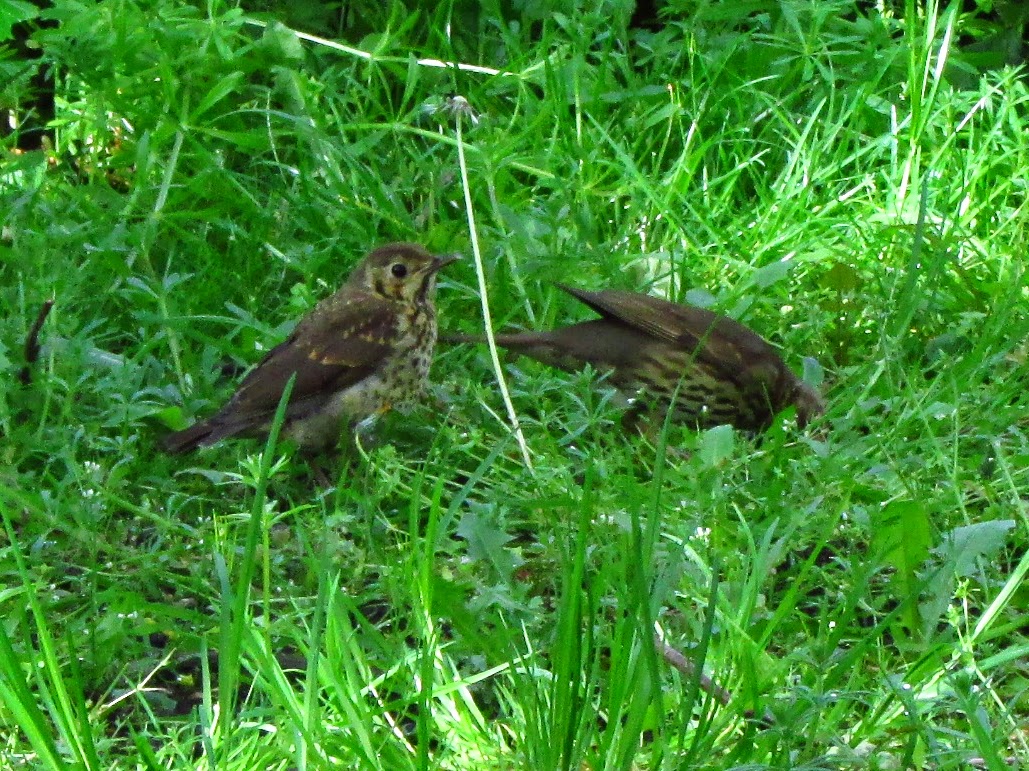
Young Song Thrush fledgling and busy parent.
A Magpie in search of nests or young birds in the undergrowth.
A Herring gull in the park having mallard for breakfast this morning.


Thursday, 7 November 2013

Autumn songs

Despite the days becoming shorter and darker, a few birds are still singing. Robins, both males and females claim their winter territories with their heartfelt, melancholic song, Wrens can be prompted to go on their outburst of song all year round, often by other bird calls and Starlings, donning their brightly spotty winter plumage call enthusiastically from chimneys and aerials.

Tuesday, 12 March 2013

There is more to the eyes of the Robin

ResearchBlogging.orgWe are used to see Robins all year round, and indeed, although is a large resident population in the UK, they are migratory birds in much of their range, with northern European birds migrating every winter to Southern Europe and North Africa. Many of these migratory Robins pass through or winter in the UK. Robins migrate at night, and much research has been devoted to find out how they manage to navigate during migration. Human navigation uses a 'map and compass' system, to find out where we are and what direction to go. Recent discoveries on bird navigation have shown that they rely on an internal magnetic sense. Indeed, although many migratory birds are known to have a magnetic sense, the first demonstration of a magnetic sense in animals came from experiments on caged Robins. Experiments to document migration orientation usually involve using what is called an Emlen funnel, a round cage in the shape of a funnel covered on blotting paper on the sides, a clear top, with an inkpad at the bottom, something like this:
Emlen funnel 

 Caged migrant birds become restless at night during the migration season and jump more often in the direction where they intend to migrate, making little ink prints on the paper. Caged robins changed their heading accordingly when the magnetic field was artificially altered using strong magnets. Migratory birds magnetic sense is extraordinary as it relies on light as detected by the eyes - in particular the right eye -, which is interpreted in a magnetic way. Photons exciting a particular molecule (called 'cryptochrome') in the retinal cells form radical pairs sensitive to the magnetic field. The information reaches the brain through the optic nerve and the bird is able to form a map of intensity of the magnetic field overimposed to their visual field. The intensity of the magnetic field is region specific, helping the bird to navigate even in low light conditions. Recently, Katrin Stapput and collaborators found out that this magnetic sense depends of the bird having a clear image on their right eye as Robins that had their left eye covered with a frosted goggle - which prevents them from forming a clear image -could navigate, while if the right eye did not form a clear image they got disorientated (see their result below).
Robin wearing goggles (from Stapput et al 2010)
Orientation of European Robins during Spring Migration with the Local Geomagnetic Field as the Only Cue. (A) In the binocular control tests without goggles (Bi), the birds preferred their normal northerly migratory direction. (B) Birds tested binocularly in a radio frequency field (BiRF) were disoriented, indicating that the orientation was based on radical pair processes. (C) When the right eye was covered with a clear foil and the left eye covered with a frosted one (Rclear), the birds were oriented in their normal migratory direction. (D) When the left eye was covered with a clear foil and the right eye covered with a frosted one (Lclear), the birds were no longer oriented. The triangles at the periphery of the circles indicate mean headings calculated from three tests of the individual birds; the arrows originating from the center represent the grand mean vector drawn proportional to the radius of the circle = 1. The two inner circles are the 5% (dashed circle) and 1% (solid circle) significance borders of the Rayleigh test. (From Stapput et al 2010).  
 Next time you see the lovely bright eyes of the Robin spare a thought for the amazing things they can do with them.

More information
Wiltschko, R., & Wiltschko, W. (2006). Magnetoreception BioEssays, 28 (2), 157-168 DOI: 10.1002/bies.20363
Stapput, K., Güntürkün, O., Hoffmann, K., Wiltschko, R., & Wiltschko, W. (2010). Magnetoreception of Directional Information in Birds Requires Nondegraded Vision Current Biology, 20 (14), 1259-1262 DOI: 10.1016/j.cub.2010.05.070

Thursday, 7 February 2013

City scavengers

We humans can make a mess. Bins left open or toppled over, the remains of takeaways eaten on the street thrown to the pavement. It is not a pretty sight, but it means extra feeding opportunities for some. Birds take advantage of their surroundings: they eat the berries, buds, and flowers of the trees we plant in our gardens, they do reward our love for them feeding on delicacies on the bird table, but they will also eat our rubbish. Today, a Carrion Crow (top shot) searched for tidbits under a rubbish bag using that lovely crow technique of delicately picking 'things' and moving them aside. They do the same when feeding on leaf litter,  and it is quite different to the energetic, almost full body technique for the same effect used by Blackbirds. The Carrion Crows and Blackbirds often feed at the back of a row of flats, where bins are often left open and bin bags on the ground. My favourite sighting of a scavenging crow was one strutting on a pavement with a large sausage held across its bill, a pity I was driving at the time! Seagulls are supreme city scavengers too, with their bouncy, manoeuvrable flight, Black-headed Gulls are able to avoid the passing traffic - as they will avoid waves out at sea - to deftly dip in the middle of the road to pick items from in between cars.

Snow bonanza for a male blackbird...
...and a female too
Even Robins enjoy takeaway pizza
Black-Headed Gull on the lookout for feeding opportunities

Tuesday, 15 May 2012

Fledglings galore

The resident birds seem to have synchronised their breeding to such extent that I saw/heard seven different species of fledglings or chicks in my way to work. A Blackbird (#1) fledgling gave a try to hunt for itself, its parents out of sight. It was hilarious to watch it picking up a dried berry and dropping it and listening for worms.

A lovely fluffy Robin (#2) fledgling by the university parking lot, still very naive, let me get quite close (top photo), a pair of Greenfinches landed next to it and had me confused for a while!
Then a pair of noisy rook (#3) youngsters by the university woodland area demanded to be fed, I could only get a poor shot.

The family of Wrens (#4) I pictured a couple of posts ago were still around, the young giving their calls from a bed of nettles and docks opposite the Wilberforce building.
In my way back from work, a lovely family of Long Tailed Tits (#5) 'see-see-seeing', but the young ones shun me and only gave me their tails to photograph.

In my kids school, the Blue Tit (#6) eggs have finally hatched and I watched the live footage, with one of the parents sitting on very hungry and bare chicks
Near home, the Starling (#7) adults and youngsters in the nest have starting calling to each other with their 'churrr' calls which mean that they are almost ready to leave their nests.

Thursday, 9 February 2012

Snowy birds


It has been cold and snowy in the last few days. Berries that a couple of weeks ago were plentiful - are now in short supply, as the Blackbirds, Woodpigeons and thrushes have dug in. Flocks of thrushes are moving south to avoid the cold temperatures and entering parks and gardens. Birds used to feed on the ground have the added disadvantage of having their food under a layer of snow, and the ground hard and frosty. Blackbirds and Carrion Crows will persist if the snow is not too thick. They push the snow aside with their beaks to uncover their hidden morsels. The robin on the photo above looked a bit perplexed though.
Carrion crows searching on the snowy grass
This blackbird has dug himself a hole

Friday, 29 January 2010

January Chorus

There are a surprisingly high number of bird species that start singing in January. A handful of species can pretty much sing all through the winter: Robins, Collared Doves, Woodpigeons and, surprisingly, Great Tits and Blue Tits. Some mild winters the Song Thrush will join them. Although the days are still cold and short, light levels are increasing by the day and this set birds into 'get ready for breeding' mood. One after the other birds join the chorus.
 In the last two weeks, Coal Tits, Song Thrushes, Stock Doves, Starlings (above), Dunnocks, Goldfinches and Chaffinches have, ones boldly, others more tentatively, taken positions and started to practice their singing. Even Sparrows sitting under the eaves have been doing their chirping.
Robin singing
Song Thrush