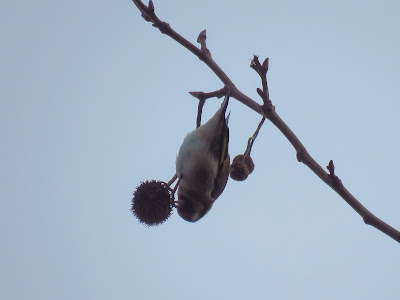
I'm used to finding Lesser Redpolls in the coldest days of winter, when small groups feed quietly on birch catkins. Learning their cheerful 'chi-chip' call, sharper and less liquid than Greenfinches, has helped me detecting them as they move around the city. I was surprised to hear their flight calls amongst a flock of roving Goldfinches at my local cemetery, a misty but mild morning. I trained my binoculars high up on the Sycamores and spotted them, apparently gorging on the last fat sweet aphids still under the Sycamore leaves, together with the Goldfinches. Some Chaffinches and Blue and Great tits were also on the sycamores, but I'm more used to these species feeding on insects. The distance and the poor light didn't make for great photos, but I was pleased to record a behaviour I had never seen before for both Redpolls and Goldfinches.
Monday, 28 October 2024
Redpolls and Goldfinches feeding on Sycamore aphids
Tuesday, 8 December 2020
Carrion Crows feeding on Plane Tree fruits
This morning I took a walk near a local park. On a square lined with Plane Trees, some pollarded, a flock of Goldfinches fed on the bauble-like fruits, often hanging from them acrobatically, as they often do.
Then I noticed the crows. They flew to the tip of the branches, where the plane tree fruits clustered, once they gained their balance they moved to the tip of the branch, and picked on the fruits, pulling at their stem. Then they purposefully hanged down from their legs, then only one leg while holding the fruit on the other and attempting to break the stem. What complex thing to do! Some of the fruits had frayed stems, like they had been chewed a few times. If a crow breaks the stem but drops the fruit, the other crows will be quick to go and steal the price. I didn't see this, but I did see chases and close guarding of the fruit by the owner crow, often flying to a safer place holding onto it.
All three crows did this, often the three of them hanging from branches at the same time. At least twice I saw they were successful, and then they flew with the fruit on their bill, once transferring it to their feet before landing and starting breaking the fruit open for their seeds. I'm always amazed at crows, I have covered how they crack mussels and periwinkles at the beach.
Today's behaviour, however, really topped it up. Were they copying the Goldfinches? Crows are always to the alert, they must have noticed the Goldfinches feeding on these fruits and had a go at getting them!
This is a video made with three clips I took from them
Sunday, 8 December 2019
What are goldfinches doing on tree branches?
I am very curious to know what they are doing. During the breeding season Goldfinches use lichen to camouflage their nests, I only see this behaviour during winter. Has anyone seen this? Please comment! Some more photos of the behaviour follow.
I found out a chorusing Goldfinch flock in a local park today. Several of them were feeding on branches in two lime trees. I managed a couple of videos showing how they target areas at the end of broken branches and deftly peel bark and wood, discarding bits. If they are feeding on the bark or wood itself or on some invertebrates living in it is unclear.
Monday, 21 December 2015
Goldfinch Chorus
Friday, 28 March 2014
Problem solving Goldfinches
It happens that Goldfinch manipulation abilities have been known for a long time (Plinius and Gesner mention it). Golfinches used to feature in animal shows, as seen in this old British Pathe film demonstrating the string pulling ability of a Goldfinch. The bird alternatively pulls and holds a string to reach a container with water or food.
Something the experiment highlighted was the remarkable behavioural plasticity of Goldfinches and Siskins as shown by the diverse repertoire of behaviours the birds used to solve the problem (getting the food in the thimble):
Several individuals of both species hovered in flight near the thimble. They never succeeded in taking food, but still tried to reach food this way when they were already able to eat via string pulling and holding. A few goldfinches and siskins stretched from the cage fence towards the thimble but without successfully touching it. Two siskins and one goldfinch reached the thimble while hanging down from the perch head down like bats. Several siskins climbed down the string and ate from the thimble. Three other siskins shed some food from the thimble by heavily shaking the string and pecked the grain from the floor. (Goldfinches never moved to the cage floor.) Eight goldfinches and seven siskins invented a special method to flick the string around the perch, thus lifting the thimble indirectly. Some individuals used several of these techniques.In addition, some individuals showed a preference for one or the other foot to hold the string.
Additional experiments tested the effect of being reared with access to branchlets. These seemed to facilitate success, but they were not necessary in several individuals. Similarly, the presence of a model facilitates success for a large proportion of the birds (the 'imitators'). Finally, the presence of food in the thimble was also necessary for the goldfinches to lift the string.
Bird species which instinctively used their feet to clamp food or branches while foraging - like the Goldfinch - should be able to solve the test, but the experiments show that birds still vary in their predisposition to experiment with the string and in their success. What proportion of wild Goldfinches use foot-bill coordination when foraging is hard to assess, but one would expect that given that natural conditions this would be higher than in the experiments. The wild birds are exposed to a much richer rearing environment, as they have very diverse diets and have to extract seeds from an array of plants from small perennials with soft pliable stems to trees with variably flexible branchlets (dandelion, teasel, lavender birch, ash, alder, rowan to give some examples). In addition, Goldfinches are highly social birds that feed together in flocks, so the learning opportunities would be plentiful.
Seibt, U., & Wickler, W. (2006). Individuality in Problem Solving: String Pulling in Two Carduelis Species (Aves: Passeriformes) Ethology, 112 (5), 493-502 DOI: 10.1111/j.1439-0310.2005.01172.x . Here.
Monday, 17 February 2014
Swinging goldfinch
The pivoting display is also used in aggressive contexts, and maybe the goldfinch was becoming impatient waiting by the feeder. I shall keep an eye on my visiting goldfinches and see if I can record this behaviour. I found a little video showing the behaviour in a charm of goldfinches. Check the individual at the bottom of the image from s 36.
And a great video of a pair of captive goldfinches courting.
Thursday, 16 January 2014
Goldfinches feeding on ash keys

UPDATE 18/01/2014
I watched another flock in a different Ash tree today. I photographed an individual using its foot to hold the whole seed while it pecked it with its bill. Photos follow.
Sunday, 17 November 2013
Charming seed predators
There was no mention of Goldfinches in the authoritative 'Birds and Berries' by Snow and Snow. I found a wonderful, if lone, photo on Flickr here and a line in a novel that suggested that this behaviour had been noticed before:
They went down the track through a wood where a flock of goldfinches was feeding on the rowanberries [...]
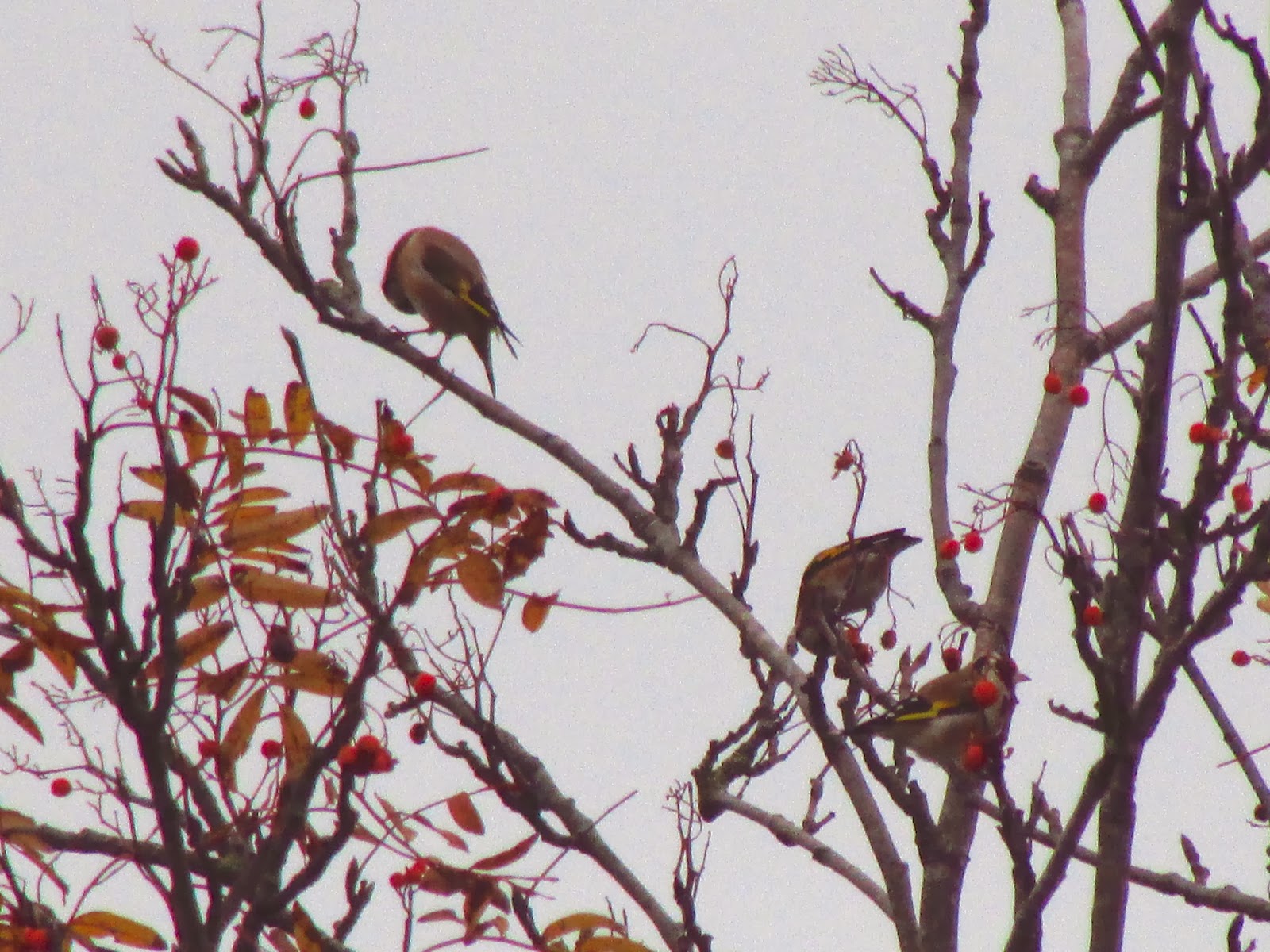
Today on a walk in the park, I noticed a rowan on a garden and had a look. A charm of goldfinches looked busy on it. I wouldn't have normally had a closer look, but I did. They were feeding on the berries, hanging from the bunches like tits, not one, not two, but the whole flock seemed to be enjoying the berry seeds. The photos from today (below) are atrocious, as it was late and the light very poor, but a record nonetheless. After a while, something spooked the birds, a Sparrowhawk perhaps, and the Goldfinches went quiet and took to the air with a group of starlings and feral pigeons. I glimpsed what I think was a woodcock before if flew behind a roof, powerful wings and long bill, but just for a second. A Blackbird called: 'seee!' from a bush, their air predator alarm call.
Indeed, a range of finches - including Goldfinches - are reported to feed on rowan seeds occasionally: Greenfinch, Crossbill, Brambling, Chaffinch, Hawfinch, Goldfinch, Redpoll and Siskin. Indeed, for some finches, particularly Bullfinch and Pine Grosbeak rowan seed in autumn can be their staple food. But rowan is a masting tree, where crop is very variable across years, with bumper crop, the 'masting years' interspeded with poor or failed crops in some. In the winter of 2004-2005, simultaneous irruptions of boreal Waxwing, Pine Grosbeak and northern Bullfinch occurred, all three birds liking rowan berries. Bullfinch local movements and irruptions in western and southern Europe have been linked to the strength of rowanberry fruiting crop.
A couple of weeks ago I spotted a juvenile Common Rosefinch, a rare visitor to these shores, feeding on rowan berries
Some finches might use rowan depending on local availability. As this year rowan berries are plentiful and the thrushes have barely made a dent on the crop, Goldfinches and other birds may take advantage of this resource opportunistically.
References
Pennington, Mike G., and Eric R. Meek. (2006). The ‘Northern Bullfinch’ invasion of autumn 2004. British Birds 99: 2-24.
Snow, B. K., and Snow, D. (2011). Birds and berries. A&C Black.