Showing posts with label portrait. Show all posts

Saturday, 18 November 2017

Ringed Common Gull

The Common Gulls at the local park have been back for a few weeks, slowly building up in numbers to about a hundred today. I searched for ringed ones and found JV47, which I first saw on its first winter in January 2015. It is a fully adult gull now and trusting enough to allow me to take a close up.
Another shot from today.
JV47 as a 1st winter immature in typical chick 'hunchback' posture (23/1/2015). He was ringed  the previous October at Bergen, Norway.
Click here to find out about other ringed common gulls at Pearson Park. If you find a ringed gull and you can read the ring, you can report it to Euring, the European Ringing scheme.

Wednesday, 14 June 2017

Carrion crow fledgling

The Carrion Crow pair in the local park have fledged two young. One of them sat on a carpet of poplar fluff, looking sleepy, and unable to fly very high. It looked like it had flown the nest a bit early. It was very tame, and allowed me to crouch by it and take his portrait. You can see that the chest and head feathers lack the metallic lustre of the adult plumage and the young's eyes are blue. The wing feathers are more metallic. A parent was nearby, furiously chasing a squirrel away. The sibling was much more active, and was intrigued by water, it opened it's bill to the water, like it was testing it or finding out what the best way of drinking was.
The inquisitive sibling. 

Friday, 13 January 2017

A lucky front shot of a male Mute Swan on a local park. He was with his polish variety partner, and ringed and approached me as I walked around the lake.

Sunday, 11 December 2016

Standing pretty

In the low winter sun, this magpie was tree-topping, displaying her contrasting black and white plumage, a typical territory-owner behaviour. They will 'tree-top' on aerials and buildings alike in towns. This one also regularly 'tail-flirted': a quick bow and tail flick, which is very noticeable and draws attention. Magpie's apparently black plumage has structural iridescent colours, blue sheen in the wings and green and purple in the tail tip - as shown in this tail feather - which are shown during displays and aggressive encounters. Breeding, territory-owner magpies have the brighter and greener iridescent hues than non-breeders. Plumage brightness in birds especially in body parts that are displayed during territory defence or during fights, reflects the owner's health and attractiveness, so their display advertises not only territory ownership, but its good body condition, so that potential challengers can assess it, and potentially avoid fights that they might be likely to lose.

Wednesday, 9 November 2016

Chok, chock, chock!

I've been wanting to take a photo of a Blackbird in this posture for a long time. Blackbirds do often cock their tails. When they alight they do that tail-cocking so as to keep their balance - in a similar way to Woodpigeons - they often do a jerky tail-cocking action when they do one of their various alarm calls 'chok, chok, chok' at the same time than they flap their wings. On Sunday, a windy day, this Blackbird perched on the side of a drinking trough, the wind made it lose its balance a bit and it stayed, tail cocked, for that second longer for me to press the shutter. Got you!

Sunday, 20 March 2016

Collared dove fledgling


The other day I watched a Collared Dove attacking a Woodpigeon. I was a bit puzzled by this bit of seemingly random aggression, as the Woodpigeon was on its way to drink.

The following day in the same spot, a Collared Dove sat on a branch, quite low and I thought that the Collared Dove's puzzling behaviour might have to do with it's nest being nearby.
 This morning I thought that the Collared Dove was sitting in the same spot, but when I approached I noticed the fuzzy fluff and less pink plumage of a fledgling. Completely unafraid of me, it looked curious as I took its portrait.
This is the third pigeon species that I have seen fledglings this year, the first one was a Feral Pigeon, then a Woodpigeon last week. Not wasting any time!

Tuesday, 9 June 2015

Fledgling crow

As I took the kids to school this morning, I noticed a couple of crows on the grass on the school grounds. One of them was hunched up and I thought it looked like a young one. As I was leaving I went to check. Still looking like it would be more comfortable sitting in its cosy nest, it looked curious as I approached, and it didn't flee. It's first encounter with a camera, taking things in. As human babies, Carrion Crows young ones have dark blue eyes, which will darken to rich brown as adults. The blue eyes, pink mouth and brownish feathers help tell young from adults, but the general attitude is different too, as young crows tend to be much tamer than the adults.

Friday, 8 May 2015

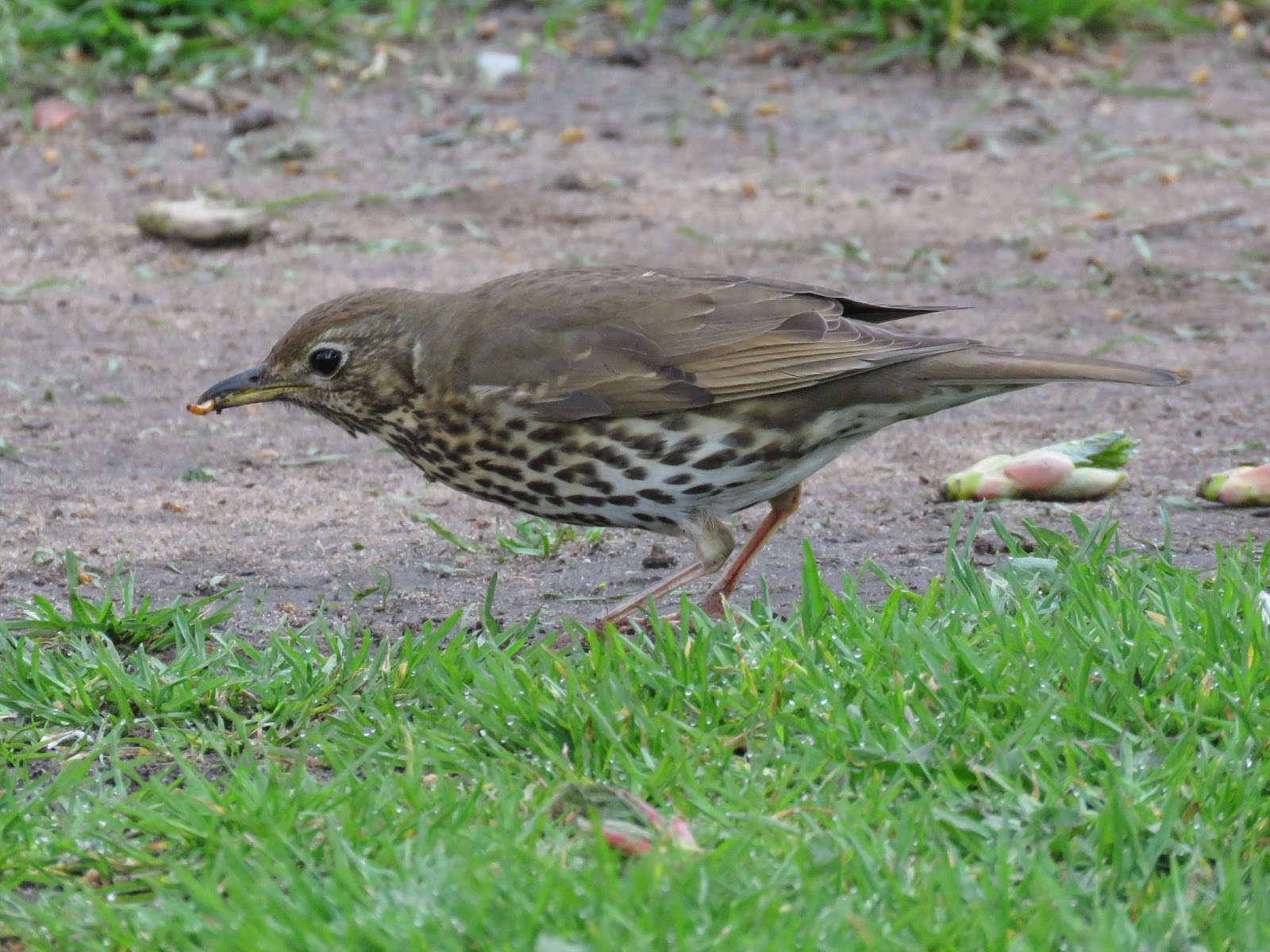
Song thrush portrait

The thrushes are now feeding chicks, and there is a sense of urgency when they look for food. They would be shy when not breeding, but now they feed just by you, oblivious to their surroundings. This Song Thrush stood and run, alternatively, on the grass near me, when feeding.
Standing proud
And catching what it looks like a ground beetle larvae.

Tuesday, 24 March 2015

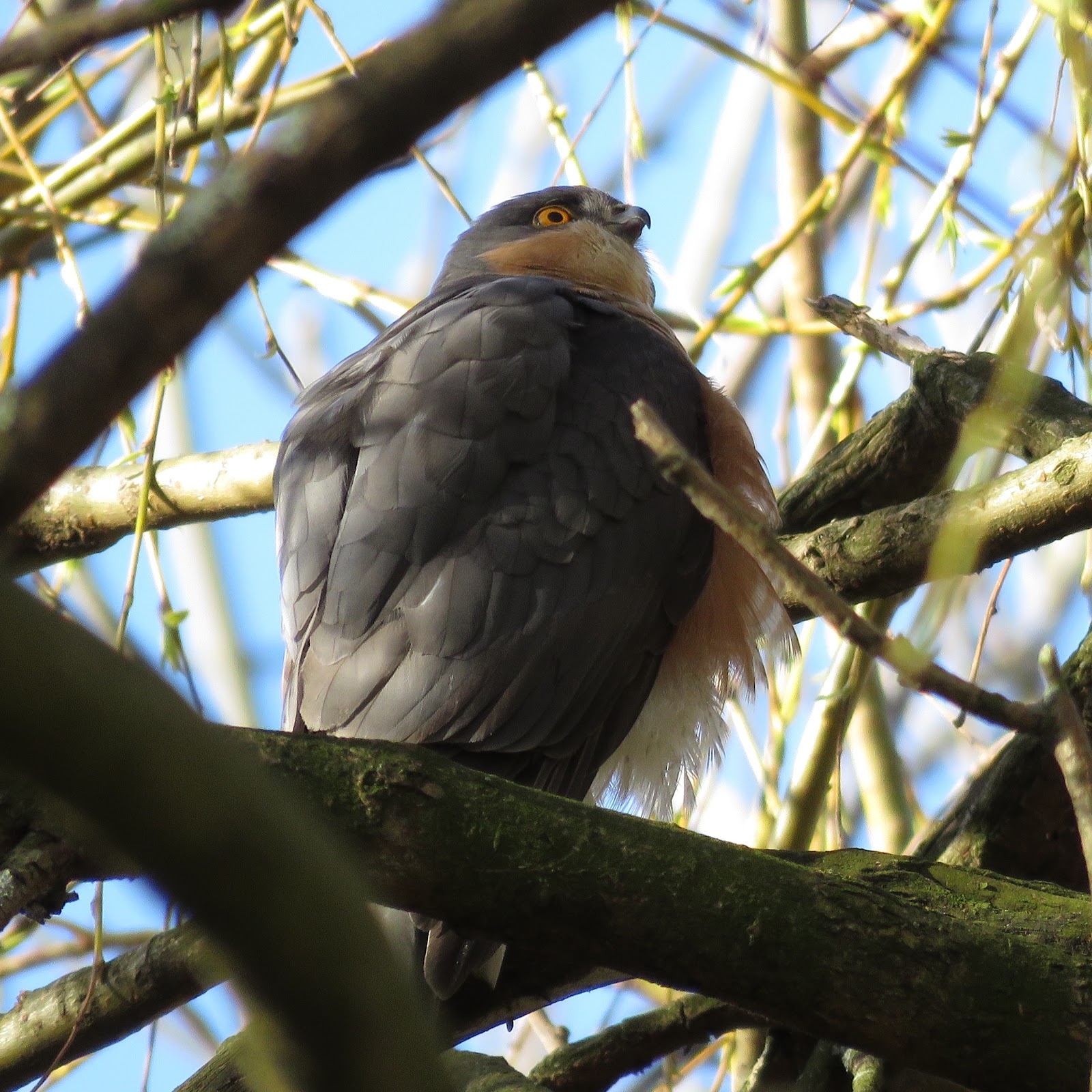
An encounter with the male Sparrowhawk

This morning a lively chorus of Blue Tits and Chaffinches alerted me to a hunting Sparrowhawk in the park. It flew over and landed on a branch of a Horse Chestnut nearby. Luckily, there was a clear line of sight between the still leafless branches from where I was standing. Its russet underside and small size revealed it was a male. It only sat there for a couple of minutes, scratched its chin, and flew across the road to a willow where I've seen Sparrowhawks sitting before. As it flew, the small birds started calling nervously again. I approached, and managed to find an angle where I could get a clear view. He didn't notice me, instead, he was interested in the birds mobbing him from a safe distance over him, and looked intently.

In the willow, under the cover of its curtain of branches the hawk appeared relaxed. It turned to the sun, raised its feathers and shook them leaving them fluffed out, an action called 'to rouse' amongst falconers (photo below). I was impressed by his long chest and flank heathers, thinly lined with white. Sparrowhawks also have long white undertail coverts, which they fluff out when they display over their territory.
The male turned its back to me again. Every time it changed position, the birds called echoing his movements.
This was the last photo I took from the five minute encounter. Followed by the alarm calls of the small birds, the Sparrowhawk flew away, probably trying to surprise some prey still not alerted to its presence.

Monday, 23 March 2015

The soul thrush

This young male blackbird (recognisable for its brownish wings and black smudges on its bill) sung its beautiful song in front of my house yesterday. Were not for the fact that the blackbird song is so familiar we would herald the blackbird as one of the most pleasant songsters. The song thrush gets the name, but in comparison it's just an apprentice compared to the musical delivery of the blackbird. When I first moved to the UK, my garden's blackbird sung the first notes of Ella Fitzgerald 'Fascinating Rhythm', one of the blackbirds a couple of year back sung 'La Cucaracha' chorus really well. It really deserves the name of the soul thrush.

Sunday, 22 March 2015

Coot diving

We have a visiting Coot in our local park. It is quite used to people and a good photographic subject. Coots dive for a few seconds - they appear to be very buoyant - and lift pieces of vegetation from the bottom, to feed on the surface.

A front view of the coot.
Here is a short video of the coot diving for food.

Wednesday, 18 March 2015

The Viking gulls

A flock of about 100 common gulls winters in the park, they arrive at the end of September/October and are around most of the time until the end of March. They are very excitable and their squeals provide the background noise of the park in winter, especially when visitors empty their bags of bread by the side of the pond. A cacophony of calls and chases ensues while the gulls pick the bounty fast, before the ducks and geese have the chance to react.
 Is not only bread though for the park gulls, there are very quiet times, especially during the middle of the week, and the gulls will move onto the grass, looking for worms and other invertebrates, watching the ground intently as they walk.
 In wet days they can be seen 'dancing' (foot-paddling) to entice the worm to the surface of the soil. Like so.

Then they spend some time just flying in circles over the park, in a flock, I am not sure if in preparation to roost, although I am not sure where they spend the night.
A quiet moment in the flock, with preening, snoozing and yawning by the pond.
This is an adult one on winter plumage. Note the yellow bill with faint dark ring near the tip and the yellow legs, and spotty head.
on the 3rd of February this adult looked very nice on the snow, still in winter plumage.
On the 20th of February this adult had an almost white head and a thin red eye ring.
A close up of an adult's head showing mainly yellow bill, red ring. Note the scruffy back of the head, showing the ongoing moult towards a completely white head plumage.

I find them endlessly fascinating and can't stop myself from photographing them, and they are often co-operative, as they are so used to people. When I noted that the flock disappeared each year, one day in March or April I wondered where they would go in the summer, to breed. I need wonder no longer, these gulls come from Bergen, in Norway.
While watching them one day in January I found a couple of Common Gulls with plastic colour rings. I spent some time looking at the legs of many gulls since that day, but I didn't spot any other ringed ones. I managed to get photos where I could read the code and submitted the samples to Euring. I got an e-mail the same day from Morten Helberg with details of their ringing and recoveries. Since then, I have seen the ringed gulls a few times, and managed to get their portraits.
This is J2EX, sex unknown ringed its first autumn (1st calendar year in 2013) which means now should be in its 3rd calendar year (almost adult), although the bill and legs are still grey/bluish and doesn't have a red eye ring or prominent wing 'mirrors'. This is its ringing/recovery history:

15.09 2013 Byparken, Bergen, Hordaland, Norway
17.09 2013 Tveitevannet, Bergen, Hordaland, Norway
20.09 2013 Tveitevannet, Bergen, Hordaland, Norway
21.09 2013 Byparken, Bergen, Hordaland, Norway
14.06 2014 Kilnsea, Humberside, Great Britain
14.01 2015 Pearson park Hull, Humberside, Great Britain (the photo above is from yesterday, also observed 22/01/2015)
This is JV47, Sex male age, 1 cy when ringed last October, so it's in his first winter. He still called like a gull chick when feeding, and adopted this hunched chick posture. Legs and bill base pinkish.
This is it's ringing/recovering history:
05.10 2014 Tveitevannet, Bergen, Hordaland, Norway
(in the month after it was ringed the flock came back to Pearson Park)
14.01 2015 Pearson park Hull, Humberside, Great Britain 

Looking at photos yesterday, I found another ringed common gull, from the 20th of February. It looks like a first winter bird. The code reads JR20. I will update the post when I hear back from Euring.
It is very nice to know where these gulls spend the summer, but something equally rewarding is to know them as individuals. The rings have allowed me to recognised them in my visits to the park. I will look forward to them coming back in years to come, as gulls can be long lived. A typical Common Gull lives for 10 years (the record is 27).

Wednesday, 4 March 2015

The Greenfinch song

Few sounds are more evocative to me than the song of the Greenfinch. It brings back memories of trying to work out bird songs from scratch when, as a young teenager I started to watch birds in my local park. The Greenfinch's loud, distinctive cicada-like song carries longer than the beautiful, canary-like warbling notes that alternate with it. It took me attempts to finally find the source of the song, high on the canopy of a pine trees they used as song post. Later I also watched their display flight, with slow-motion butterfly-like wingbeats high over the trees, as they sing.
 Greenfinches have started to sing in the last couple of weeks and as I realised there is no Greenfinch post in the blog, today is the first step to amend that. I took the top shot today on my way to work, as I heard the finch calling. Listen to its song in this Xenocanto recording.
Aerial song
From a Hawthorn
A pair in an Ash tree with male singing.


Sunday, 9 November 2014

Walton Street crows

We went to Walton Street market and car boot sale this morning and I couldn't help but notice the crowds of Carrion Crows. At least 50 individuals were about, on van and car roofs, atop flood lights,
 and walking amongst the huge puddles left by yesterday's rain.
Some patrolled just over the paths, elaborately flying slowly, sometimes almost hovering - in black-headed gull style - scouring the ground.
Soon it became apparent what they were after. No, they weren't hunting for antique bargains, but taking advantage from the fast food bonanza that inevitably follows human crowds.
Crow on roof van. 
A starling passed too close and made him jump
I missed the wing tip in the phot, but I like the shadow of the crow
I watched as one individual landed on the roof of a van, triumphantly holding half a hot dog sausage in its bill.
The remainder of the hot dog was being dealt with a few other crows: a dominant one pushed another aside...
...and quickly picked up the other half of the sausage in its bill, before flying away
while the other, less fortunate crows contented themselves with bread smeared on ketchup.
We associate scavenging behaviour with dirt, rotten food and germs, but I doubt the hot dog had been on the ground longer than the five-second rule allows, before it was cleared up, taken away by the crows.
But, occasionally, the bin man gets there first. Crows watched him picking a paper bag...
...but leaving some food behind, which was quickly dispatched
There were many gulls and starlings about, but I didn't see them take advantage of the market food. Crows appeared bolder, and cheekier than in other places, maybe they are all locals used to take advantage of the markets - and Hull Fair - and are used to people. This one spent some time checking itself out in the wing mirror of a car.
The it jumped to the roof and spent some time watching from this vantage point.It allowed me to approach close enough for a portrait (top shot)
 After filling their tummies, some crows took turns in the puddles for a bath.