Showing posts with label Lesser Black Backed gull. Show all posts

Sunday, 22 March 2015

Gulls playing helter skelter?

Do birds play? You have probably seen videos of crows sliding down snow and rolling down on car windscreens, or heard of the Australian black swans that enjoy surfing. These cases, and many others documented for a long time, are hard to explain in utilitarian terms (no feeding, or mating or predator avoidance is involved), it appears purposeless, and seem most fitting to actual play. Play behaviour, often solitary, some times involving objects, but also social, has been described in ten orders of birds including corvids, raptors and parrots amongst others. Some of this behaviour involve play flying, or flying in aerobatic ways. This afternoon, in the first mild sunny day of spring, thermals developed over the park, and a large mixed flock of gulls - Herring, Common, Lesser Black backed and at least a black-headed, later joined by a Carrion Crow - started to soar higher and higher, I could barely see them as they circled. My camera decided to run out of battery run out just at the same time (the photo above is the flock flying high this mid February).
 Then I noticed some gulls tumbling down. Not just gliding, but actually flipping over and going on their backs as they descended. Two of them seemed to be flying together, making a downward double spiral, opposite each other, occasionally tumbling. The Carrion Crow also dropped height by closing its wings as if enjoying the feeling of being kept up by the thermal. It was an exhilarating spectacle to watch, and the gulls gave the impression to be having a good time.

Thursday, 17 April 2014

A flock of Lesser Black-backed gulls

It is unusual to have more than a pair of Lesser Black-backed gulls in my local park. Today, I counted six circling over the pond in the morning to feed on scraps. They shared the pond with a few young of last year and and adult Herring gulls and a single common gull. After eating some bread, two individuals went to the water to drink.
 These are really beautiful gulls, with the most stern looks due to their deeply seated yellow eyes circled by a red eye ring. The individual at the top was particularly stunning, its red spot was really bright and extended extending to the top side of the bill, like some badly applied lipstick.
 Here, Lesser Black-backed gulls are summer birds, from March to August, and presumably breed atop buildings locally.
Four of the Lesser black-backed gulls
Lesser Black back gull on the water
A pair by the water. Note the darkish ring on the top of the bill, indicating these have recently adquired their adult plumage (about 5 yr old). Note also the different tone of the yellow legs.

Friday, 13 September 2013

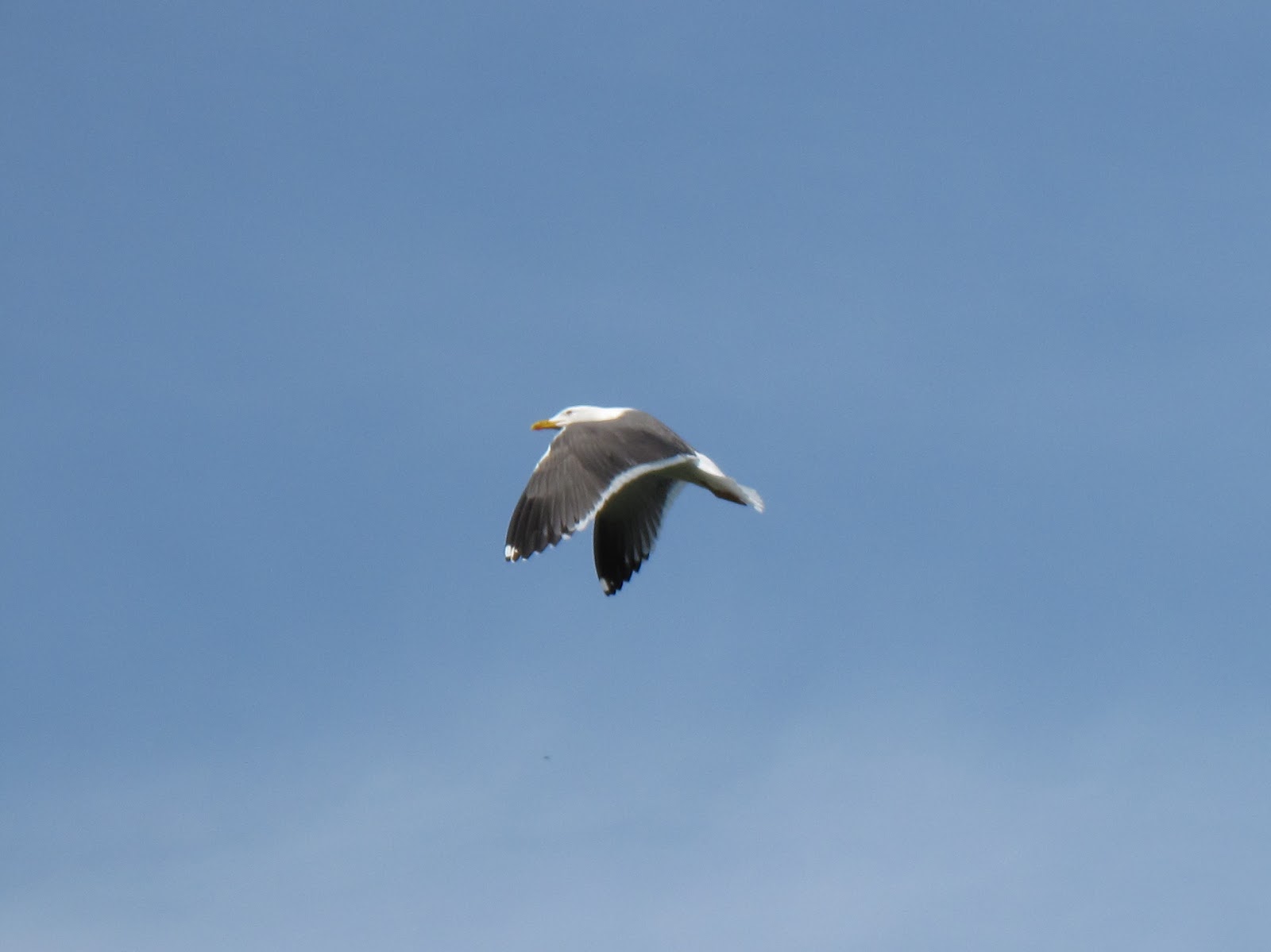
Lesser Black Backed gull

Three different gull individuals, a Herring Gull, a Lesser Black Back, and a Common Gull arrived at the park and flew in circles around the pond, their keen eyes looking for food. Several people come early in the morning and leave bread and scraps on the side. After finally landing, before coming to the food, this Lesser Black Backed gull had a good look around, a bit nervous. Once the other two gulls landed, they all went in with the feral pigeons to eat.

Friday, 1 June 2012

Urban Lesser black-backed Gulls

I have seen Lesser Black Back Gulls, Larus fuscus, regularly this year in the city. They are beautiful seagulls, similar to the Herring Gull, to which they are closely related, but with dark grey mantle, and yellow legs. During May I have seen them practically every day. Recently, I watched a flock in a local park, over ten birds, all adults, eating bread from the lake. They surely must be breeding in town.
The Lesser Black-backed gull is an Amber species, with some conservation concerns, however, they appear to be on the increase. Although shy, in the last few decades they have followed the Herring Gull in becoming an urban bird. A report by Monaghan and Coulson indicates that pairs have taken to nest on rooftops, with industrial and modern town centre buildings favoured as nesting locations. The first reports of roof nesting in this species are from 1969, and populations nesting in buildings are on the increase in the British Isles.


More information
Patricia Monaghan & Dr. J. C. Coulson (1977) Status of Large Gulls Nesting on Buildings, Bird Study, 24:2, 89-104. pdf here.