Showing posts with label foot use. Show all posts

Tuesday, 8 December 2020

Carrion Crows feeding on Plane Tree fruits

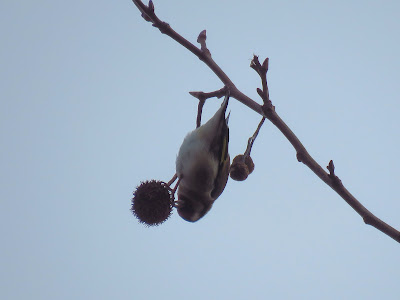
This morning I took a walk near a local park. On a square lined with Plane Trees, some pollarded, a flock of Goldfinches fed on the bauble-like fruits, often hanging from them acrobatically, as they often do.


Then I noticed the crows. They flew to the tip of the branches, where the plane tree fruits clustered, once they gained their balance they moved to the tip of the branch, and picked on the fruits, pulling at their stem. Then they purposefully hanged down from their legs, then only one leg while holding the fruit on the other and attempting to break the stem. What complex thing to do! Some of the fruits had frayed stems, like they had been chewed a few times. If a crow breaks the stem but drops the fruit, the other crows will be quick to go and steal the price. I didn't see this, but I did see chases and close guarding of the fruit by the owner crow, often flying to a safer place holding onto it.

All three crows did this, often the three of them hanging from branches at the same time. At least twice I saw they were successful, and then they flew with the fruit on their bill, once transferring it to their feet before landing and starting breaking the fruit open for their seeds. I'm always amazed at crows, I have covered how they crack mussels and periwinkles at the beach.

Today's behaviour, however, really topped it up. Were they copying the Goldfinches? Crows are always to the alert, they must have noticed the Goldfinches feeding on these fruits and had a go at getting them!

This is a video made with three clips I took from them


And a few photos of the behaviour.

Hanging from one leg, holding onto the fruit with the other.


Crow with its prize.
The pink gape suggests this is a young crow, feeding on the plane fruit. I wonder if this is a family, with the young copying the adults in learning this skill.
I'll be very interested to head from anyone that have seen this behaviour in their local crows!

Thursday, 6 February 2020

Long-tailed tits hanging and feeding

Just a quick field note on foot use. I wasn't aware on Long-tailed tit foot use before, so I was very pleased to watch this behaviour. Sun flower hearts had been placed atop posts on a nature reserve and a flock of Long tailed tits was feeding on them. Individuals will pick a sunflower seed and jump to a branch to hang from it with one foot while holding the seed on the other food to feed on it. Other tits hold seeds between their feet while they feed, perching on a branch. Is it that Long-tailed tits are not able to balance on a branch while bending down on their feet, maybe because of their long tail? I saw the behaviour repeatedly, and I should have taken a video, but I just got this shot from behind that shows the foot holding onto the branch and the other with the seed on it. What call my attention was the fact that they had to jump to a branch to hang from in a premeditated way so that they could feed. The Two in the Bush blog also describes this behaviour, with much better photos. Hanging from one leg poses no issue for these tiny acrobatic birds!

Saturday, 1 October 2016

Great tits feeding on horse-chestnut leaf miner

In a walk around the local park, a pair of Great Tits called my attention. They were calling and foraging in a horse chestnut. I watched how dexterously they grabbed the large leaves with their bills, pulled them towards them, and held them with one foot while feeding (top shot). They were looking for larvae or pupae of the horse chestnut leaf miner, Cameraria ohridella, a micromoth that has expanded its range throughout Europe from its native Balkans. The moth's larvae feed inside the leaves of the horse chestnut, leaving them speckled. Blue tits also feed on this leaf-miner (as do Marsh Tits), and I've seen them feeding on them before, but as they are lighter than Great Tits, they are able to just hang from the leaves themselves.

A short clip demonstrating this behaviour.


More information
Grabenweger, G., Kehrli, P., Schlick‐Steiner, B., Steiner, F., Stolz, M., & Bacher, S. (2005). Predator complex of the horse chestnut leafminer Cameraria ohridella: identification and impact assessment. Journal of Applied Entomology, 129(7), 353-362.

Friday, 1 January 2016

The variable Redpoll

Redpolls are small finches with a tiny bill, a crimson spot on the forehead and a little black bib and mask giving them slanted-looking eyes. Their plumage is so dense that on their faces it can partially hide their bill, giving them a flat face. They are found from the Arctic (where they are resident), to subarctic and temperate open forest and scrub and specialise on small seeds, mainly from birch, but also alder, willow, spruce, larch (above) and pine cones. They will also feed on various wildflower seeds near the ground.
 Redpolls are very entertaining to watch as they feed, as they reach catkins and cones using acrobatic, agile movements, reminiscent of tits. In addition, they can use one foot to hold onto a stem, a bunch of seeds or catkin to reach the seeds more easily, like goldfinches. They can apparently store up to 2 g of seeds in a expandable pouch in their throat, to eat later in less exposed conditions. Redpolls have been seen 'bathing' and burrowing tunnels in the snow. These tunnels have unclear function, as they don't appear to use them to shelter from low temperatures, rather, they appear to fulfill a social role, or just be a form of play.
  Redpoll flocks have erratic, nomadic, movements in winter in search of seeds, often travelling in the company of Siskins. They also have 'irruption years', following failures on the seed crops on which they rely, or high population densities after a good crop year, often spurred by cold weather. One of the largest irruption years were in the winter of 1995-96, where Arctic and Common Redpolls arrived in the UK in good numbers.
 The taxonomy of Redpolls has been very fluid, with three species, Arctic, Common and Lesser -each with various described geographic subspecies- recognised, but at some point six were described. The browner, small and very streaked 'Lesser Redpoll' breeds in the UK. Diagnosis was based on the lightness and amount of streaking in the plumage and also bill shape and size and overall size. However identification is often difficult, as there is a lot of variation, and many individuals would fall in between the 'classic' species descriptions, resulting 'in much collective head-scratching' in the words of Riddington and colleagues.
  A recent study by Nicholas Mason and Scott Taylor from Cornell University, sampled 77 Redpolls from around their distribution range and looked at the diversity across their genomes, niche differentiation, morphological diversity and gene expression patterns. Surprisingly, all Redpolls were extremely similar genetically, with barely any genomic differentiation between 'species'. The different colour patterns and bill shape can be explained by different gene expression patterns (e.g in response to temperature), but the authors did not find a clear-cut morphological differentiation between species, as many individuals were intermediate. Although recent adaptation to particular local conditions, for example the dominant available seeds) might have happened, it is likely that the nomadic migratory movements of Redpolls result in a lot of dispersal and gene flow between populations and incipient regional varieties, preventing differentiation and subsequent speciation. Perhaps we should just enjoy Redpolls as a delightful bird on its own, and worry less about tidying individuals away into imaginary boxes.

More information
The Cornell Lab of Ornithology Cool Redpoll Facts.

Riddington, R., Votier, S. C., & Steele, J. (2000). The influx of redpolls into Western Europe, 1995/96. British Birds, 93: 59-67. Pdf here.

Gustave Axelson (2015) From Many, One: How Many Species Of Redpolls Are There? Commentary on Mason and Taylor paper on the The Cornell Lab of Ornithology blog.

Mason, N.A. and Taylor, S.A., 2015. Differentially expressed genes match bill morphology and plumage despite largely undifferentiated genomes in a Holarctic songbird. Molecular ecology, 24: 3009–3025. Here.

Collins, J. E., & Peterson, J. M. (2003). Snow burrowing by Common Redpolls (Carduelis flammea). The Kingbird, 53, 13-22. Here.

A male Redpoll feeding on Alder catkins
A Redpoll feeding on Rosebay Willowherb.

A male Redpoll on Alder
An individual on Alder, illustrating their ability to hang upside down from thin branches.

Monday, 14 April 2014

Great tit holding seed

A Great tit holds a seed that just fetched from a bird table. Tits in general are dextrous birds, and often manipulate seeds or fruits before consumption. There are many passerine birds that hold food with their feet, from a total of 20 families in a revision on the topic by George Clark. Other examples include Carrion Crow, Rook, Siskin, Goldfinch and Crossbill.

More information

Clark, G. A. (1973). Holding food with the feet in passerines. Bird-Banding, 91-99. here.

Friday, 28 March 2014

Problem solving Goldfinches

ResearchBlogging.orgI realised only recently that Goldfinch manipulation abilities are superb. They hold large seeds with one foot while manoeuvring them into position to feed, or fold stems back to hold berries or seeds securely, or hand upside down to reach the thinnest branches. Yesterday I watched a small flock feeding on the catkins of a silver birch. The closest bird to me held a catkin while feeding from it and even changed the foot it used to hold it.
 It happens that Goldfinch manipulation abilities have been known for a long time (Plinius and Gesner mention it). Golfinches used to feature in animal shows, as seen in this old British Pathe film demonstrating the string pulling ability of a Goldfinch. The bird alternatively pulls and holds a string to reach a container with water or food.


String pulling is a common experimental setup to investigate the problem solving ability in birds. Parrots, corvids parids and finches can pass the test. In a series of experiments on captive-reared Goldfinches and Siskins, Uta Seibt and Wolfgang Wickler set to explore the problem-solving abilities of individual birds and what factors influence success. The birds were reared in cages with no access to material with which they could experiment their manipulative abilities and were tested when less than 5 months old using a 7-cm string holding a thimble with food at the end.
The researchers found that there were three groups of bird. 'Inventors' (23% of goldfinches and 62% of siskins) solved the string-pulling test by themselves, some times in the first experimental session, whereas ‘imitators’ (25% of goldfinches; 10% of siskins) were successful after watching conspecifics solving the problem. The remaining birds failed the test even when exposed to an experimented model.
 Something the experiment highlighted was the remarkable behavioural plasticity of Goldfinches and Siskins as shown by the diverse repertoire of behaviours the birds used to solve the problem (getting the food in the thimble):
Several individuals of both species hovered in flight near the thimble. They never succeeded in taking food, but still tried to reach food this way when they were already able to eat via string pulling and holding. A few goldfinches and siskins stretched from the cage fence towards the thimble but without successfully touching it. Two siskins and one goldfinch reached the thimble while hanging down from the perch head down like bats. Several siskins climbed down the string and ate from the thimble. Three other siskins shed some food from the thimble by heavily shaking the string and pecked the grain from the floor. (Goldfinches never moved to the cage floor.) Eight goldfinches and seven siskins invented a special method to flick the string around the perch, thus lifting the thimble indirectly. Some individuals used several of these techniques.
In addition, some individuals showed a preference for one or the other foot to hold the string.
Additional experiments tested the effect of being reared with access to branchlets. These seemed to facilitate success, but they were not necessary in several individuals. Similarly, the presence of a model facilitates success for a large proportion of the birds (the 'imitators'). Finally, the presence of food in the thimble was also necessary for the goldfinches to lift the string.
Bird species which instinctively used their feet to clamp food or branches while foraging - like the Goldfinch - should be able to solve the test, but the experiments show that birds still vary in their predisposition to experiment with the string and in their success. What proportion of wild Goldfinches use foot-bill coordination when foraging is hard to assess, but one would expect that given that natural conditions this would be higher than in the experiments. The wild birds are exposed to a much richer rearing environment, as they have very diverse diets and have to extract seeds from an array of plants from small perennials with soft pliable stems to trees with variably flexible branchlets (dandelion, teasel, lavender birch, ash, alder, rowan to give some examples). In addition, Goldfinches are highly social birds that feed together in flocks, so the learning opportunities would be plentiful.
Goldfinch holding birch catkin with left foot. Note that the catkin is still attached to the branch and the foot helps immobilise it, facilitating food retrieval.
More information
Seibt, U., & Wickler, W. (2006). Individuality in Problem Solving: String Pulling in Two Carduelis Species (Aves: Passeriformes) Ethology, 112 (5), 493-502 DOI: 10.1111/j.1439-0310.2005.01172.x . Here.