Showing posts with label calls. Show all posts

Sunday, 8 November 2020

Herring Gull pair long call duetting

You have probably seen Gibbon pairs duetting in nature documentaries or videos. It is a territory display that shows how the pair is well bonded, and the turn-taking of the duetting is amazingly precise, the pair alternating calls to produce a single 'song' that advertises their presence and ownership of a territory. But you don't need to travel to distant tropical jungles to witness pairs duetting animals. Herring Gulls do it all the time. Because their long call is so familiar we tend not to pay much attention to it, but I was made to stop a couple of days ago when a pair landed on a chimney stack opposite my house (above). One of the pair seemed intent on long calling, and started to call, followed each time by its partner. Long calls become commonplace during the breeding season, when pairs defend territories or food, as it appears to have an aggressive function. Here is a sonogram of it. The gull starts calling with the neck pointing down, the calls well spaced, then the calling becomes faster in a staccato and the gull stretches its neck and points up and then the call dies in intensity. In 'The Herring Gull world, Tinbergen describes the call, saying that 'The voice of the herring gull is wonderfully melodious’‘There are few sounds as evocative, as stirring as the profound, plaintive beauty of their calls.' However, he missed the fact that it often occurs in pairs, there the pair message is not to each other, but to other gulls. The duetting has also been described in other gulls, like in the Western Gull.

A pair of Herring Gulls with their two young duet on a roof in Filey.

Often, one of the pair starts the call, and the other joins in and they end the long call together, necks stretched, bills pointing up.
Why do gulls long call? They seem to do it when they have asserted their ownership of something (food, for example) or finish a squabble, or sometimes the whole Herring Gull colony calls and pairs joins together. I'm surprised I've found so little about this amazing behaviour other than anecdotal references to it, but this is a wonderful photo of a pair duetting.

More information
An article on long calls in various gull species. Earbirding.

Saturday, 9 November 2019

Mute Swan acoustic communication

I've said it before, Mute Swans are not really mute, they have a repertoire of calls and sounds. They also use movements of their head and neck to communicate. There is a quick head bowing movement, and a courting movement in which the feathers at the top half of the neck are ruffled, while those at the bottom are not, while the swan bows his head alternatively to left and right; and the aggressive 'busking stance' of the territorial male. In this post I focus on sound communication. I have trawled through Xenocanto, an encyclopaedic website with thousands of bird calls, to compile the following selection of Mute Swan sounds. I was prompted to write the post after listening to an odd distant call, which I didn't recognise to start with, and I was surprised to find out that it was a mute swan's. I heard the call again today, young swans calling to a swan flying overhead. It is not straightforward to distill the 'meaning' of a call, but the context can helps.

1. Snort

A short grunt or snort, often uttered when the swans are relaxed, and appears as a contact call while feeding, between members of a family, but also a greeting call. A lone young swan snorted when I walked by a lake near him.


2. Begging call

A soft repeated whistle typical call of young. Mute Swans don't 'feed' their young by putting food in their bills, but they help the young to obtain their food by paddling with their feet to  disturb the sediments or by pulling underwater plants. Even fully grown immature swans carry on whistling.

  3. Wing-beat Sound

This loud sound produced by the mute swan's wing-beats is really eery, especially when it takes you unawares until you realise that is coming from a swan. It carries very well and appears to replace the trumpeting contact calls of other swans.


4. Hissing

An aggressive sound, usually uttered by the female she has small young and a danger (human, dog) approaches. The bill is open and the swan adopts an upright stance towards the danger source.


5. Contact all

A two-note contact call reminiscent of other swan's flight call. I heard this call when a pair was separated, maybe during landing (one ended up in the river, the other one in a lake). Also when a Mute Swan flew over a family, the juveniles used this distance call.


6. Courtship calls

A range of snorts and grunts during courtship.


 Have I missed any? Let me know in the comments.

Wednesday, 5 April 2017

Blackbird mob

Returning home in the light evening today I noticed Blackbirds 'chinking'. This is a very persistent call, often by several individuals, that I usually associate to summer evenings. The blackbirds, up to four of them, were in the tree where the Tawny Owl nest box is. The owls are indeed in occupation, although they were nowhere to be seen from the ground. They have been calling at dusk, and every few days I have been able to watch one of them as it called, sat on the box for a few minutes and then left to go hunting. Often, later at night, one calls with a lovely gurgling sound from inside the nest. Two of the blackbirds got close to the entrance, calling non stop, if there was an owl in the nest, they might be able to see it. At some point they calmed and left, but then one returned, started calling and the others joined him in the tree.
I wondered that the 'chinking' is not a roosting call, but a mobbing call to an owl, which is more likely to be encountered active as nights become lighter in the summertime. In a couple of weeks, the leaves would obscure the view and although a blackbird calling is evident, a quiet owl sitting inside a tree is not. This is a lovely clip of blackbirds mobbing a Tawny Owl demonstrating the call and also how fearless they are towards the owl.

UPDATE 7 April 2017. From the living room at 20:05, I heard a Blackbird suddenly starting to 'chink' and I looked at the nest box. The round silhouette of a Tawny was sitting atop the nest. It was light enough to get a low resolution photo.

Monday, 27 March 2017

Woodpigeons calls and displays

Although the woodpigeon is the bird I come across most often and the one I record the most, it is still one of my favourite birds, the species that made me a birdwatcher. I find them truly stunning and very resourceful, feeling at ease in gardens, parks and woodland alike. Despite their reputation as grain guzzlers their diet includes leaves, nuts (acorns and beech mast), buds, flowers and berries, including rowan, ivy, holly, cotoneaster and alder, which they often reach with great acrobatics. Although Woodpigeons have featured often in this blog, here I am compiling and documenting their calls and displays, especially those related to reproductive behaviour. Although in his article on woodpigeon behaviour Cramp says that 'they mark their ownership of a territory primarily by just being there' as indeed 'a Woodpigeon perched in a tree bare of leaves is a large and conspicuous object' Woodpigeons have a simple, but interesting behavioural repertoire.

Advertisement call. A deep, repeated 5 note phrase that serves as a territorial song. This is the well know Woodpigeon song, often heard early in the morning.

Display flight. This is another territorial display most frequent in February and March. The male flies around the territory rising in a broad arc, and then gliding down with wings held stiffly horizontal advertising ownership. They can do the rising and falling a few times before alighting. Although mainly a visual advertising display, as the bird does not call, sometimes the bird will make a clapping noise with its wings at the apex of the arc.

The Bow display. It is a courtship display that territorial males perform when still unpaired and trying to attract a mate and also when the pair bond is becoming cemented. The male approaches the female and with his neck enlarged he calls a three note call as he alternatively stretches up and then lowers its head, displaying the white and iridescent neck markings, and fanning the tail when it's at its highest. Check out this wonderful photo by Richard Hawley showing the display when fanning is at its maximum. Females can display some aggressiveness to the courting male, move away or flee if they are not interested. This display often happens on trees, roofs or aerials, but occasionally on the ground. When on the ground the male will try and get closer and follow the female hopping to bow just in front of her, one of the few occasions that woodpigeons will hop instead of walking.

Allopreening, billing and mating. Feeding the mate, gentle preening and billing precedes mating. I documented this behaviour in a series of photos here.

Slightly opened wings is a threat posture.
Fighting. Woodpigeons have large chest muscles, which power their explosive take off and fast flight. They have small bills and legs, so they also use their wings as offensive weapons in their territorial fights. Males will fly towards intruders landing in their territory and land adopting an aggressive stance, with neck stretched, flattened plumage and semi-open wings, and often this is enough to drive the intruder away. Occasionally, this develops into a fight, which sometimes occur in the depths of a tree. The pigeons will land near each other, alight their bodies and flap trying to hit each other (above).      
                                         
Nest calling. This is a call by the male signalling to his partner a suitable nest site. I've covered this on other posts (here and here) and it is described in detail in the article by Cramp cited below. The call is harsh, and guttural composed of two notes, here is a recording of the call. I want to share here a video I took this morning, in which I got a good angle. You can see pecking or nodding movements to the nest floor in between calls:


More information
Cramp, S. Territorial and other Behaviour of the Woodpigeon. Bird Study 5, 55–66 (1958). here.

Tuesday, 10 March 2015

Stock doves courting

I was lucky this morning to watch a pair of Stock Doves courting from a good vantage point. They usually stick to high branches in the trees in the park, only rarely coming to the ground. Today I heard a male's booming call from the trees opposite the pond, and I climbed to a small hill on the other side. My new camera is heavy and I still need to get used to its weight, so I eventually leaned against a tree trunk to steady myself. The male crouched on a branch bowing parsimoniously at the same time that fanned its tail - very similar to woodpigeon's courtship -, facing the female. Its neck, inflated with air showed while cooing showed its green iridescent neck patch, which looks much larger than when the dove is at rest (bottom photo).
A side view of the male singing
The male looks at the female about to land
She greets her with this lovely display
She eventually lands next to him. This photo is not brilliant, but I like how the neck patch is actually ruffed, something I had not seen before.
More male bowing, fanning tail, showing its iridescent neck patch.
A stock dove at rest, from 27th Feb. Compare the size of the neck path.

Friday, 16 May 2014

Offspring recognition in Starlings

ResearchBlogging.org The first Starling fledglings joined their parents in the lawn of the park this morning, running behind their parents begging for food, with a cacophony of calls. Starlings are highly social birds, they like to feed together, so the chances are that the still dependent young will join unrelated young while still expecting to be fed by their parents. Furthermore, starlings in an area have synchronised egg laying so that many young will fledge on the same day. While the young are inside the nest, parents do not need to particularly recognise their offspring individually - they are likely to be their young. However, how can they make sure they recognise their offspring from others in the flock, so that they feed their own young after they fledge?
  Every year, a week or so before the fledglings leave the nest, adults start using a harsh call 'charr, charr!' (above, listen here) and the by then loud voices of the young can be heard replying from inside the nest. Why, I wondered, do they do this?
 Linda van Elsacker, Rianne Pinxten and Rudolf Frans Verheyen carried out experiments in nest box starling colonies in Antwerp (Belgium), either swapping broods of different ages for a day (Exchange experiment), or offering a choice between their chicks and alien chicks in nearby nests (Choice experiment), or swapping the nest by an empty one and relocating their nest containing young at a certain distance (Search experiment) at different chick ages.
In their choice experiments, carried out when young were 5, 11 and 16 days old, they showed that parents accepted and fed strange chicks until they were 16 days old, as shown by the weight gain of the chicks. In contrast, most parents were able to recognise their chicks when they reached 19 days, ignoring the strange ones completely, and this behaviour was found in all parents when chicks were 20 days old. So by this age adults were able to recognise their chicks.
In the search experiments they showed that the ability of parents to locate their offspring improves quickly and by the time chicks reach fledging age (20-22 days old) 97% of parents searched for and relocated the moved nest containing their young within an hour of the nest having been moved.
 The constant calling by parents and offspring in the days before fledgling might be a way of reinforcing this recognition. So, by the time the offspring are ready to fledge, and then mingle with other chicks, parents are able to recognise their offspring, presumably by their calls.

More information

Frans Verheyen, R., Van Elsacker, L., & Pinxten, R. (1988). Timing of Offspring Recognition in Adult Starlings. Behaviour, 107 (1), 122-130 DOI: 10.1163/156853988X00232

Chaiken, Marthaleah (1992) Individual recognition of nestling distress screams by European starlings (Sturnus vulgaris). Behaviour : 139-150.
Young starling looking for food this morning

...and chasing its parent begging.


Tuesday, 11 March 2014

Woodpigeon nest calling

This Woodpigeon was nest calling 'coo, crrroooo!' from a fork in a still bare ash tree atop a nest (possibly an old one). Male Woodpigeons sign like this to their mates pointing to a suitable nest site and apparently also stimulating ovulation. Read more about this calling behaviour in this post from The Rattling Crow archives.

Thursday, 27 February 2014

Honking Carrion Crow territory owners

My working morning has been enlivened by a pair of Carrion Crows advertising their territory ownership repeatedly from atop the building opposite my office. They use a peculiar call for this, which has a a honking horn quality, drawn out and without the 'r' sound present in many crow calls. It carries far, and is made while the bird carries out a self-advertising display, by bending forward exaggeratedly, with the tail fanned and, as they make the call they stretch forward and back on a graceful curve. I photographed the pair yesterday nearby (above), with one of them doing the advertising call. This is the call from a Xenocanto recording by Matthias Feuersenger.
More Carrion Crow calls from the blog 'Echoes from Nature" here.

Monday, 13 January 2014

Coo coo!

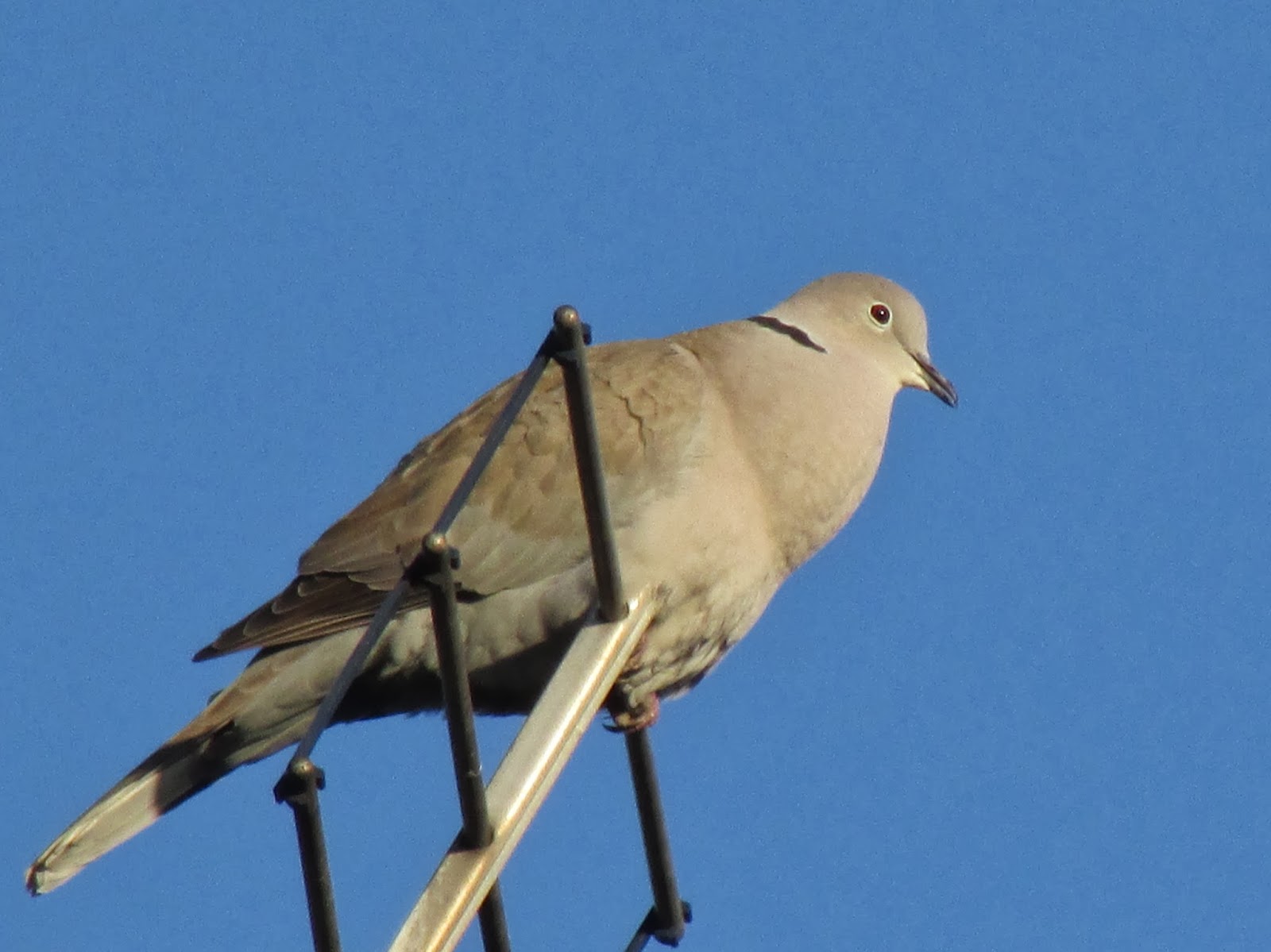
I have been wanting to get this shot for a while, and I managed it this afternoon. A singing Collared Dove, throat puffed out, with the low sun of the winter afternoon lighting it from underneath, doing its repeated, three-syllable coo from an aerial, their favourite singing perch.
 I photographed two cooing pigeons today, as the Stock Doves in my local park are also very vocal, although much more coy than the collared dove, I couldn't manage a nice shot, but like how the iridescent patch in the neck spreads out, making feather stripes which are not very visible on the resting bird.
The song of the Stock dove is also cooing, but lower, bisylabic and full of effort, and lacks the purring quality of the domestic pigeon. Given how shy and unobtrusive these doves are, learning to identify their call is the best way to spot them.
Here is a nice recording from Volker Arnold in Germany:

Wednesday, 2 October 2013

Canada Geese taking off decisions

ResearchBlogging.orgThis morning, the 60 strong flock of Canada Geese that seemed to have roosted in the park were restless. There were continuous loud grunts and honks and, after a crescendo in which more and more individuals joined in the calling, part of the flock took off in a coordinated way. The vocalising geese were making a decision, with individuals deciding to join or not a party leading the departure, maybe to quieter feeding grounds. It is unclear if the individuals felt hungry or if the several dog walkers had made then nervous (or both!).
  Flocking birds have to travel together to stay in a group to search for new feeding or roosting patches, to avoid predation or to migrate. When the individuals differ in their motivations to move away (some might be hungrier than others, for example), there might be a period in which an a consensus is reached about leaving or staying involving communication of the individuals intentions. An individual that is not hungry might change its mind and join in if most of the flock appear willing to move, so as not to become isolated.
  Dennis Raveling, in a paper in 1969, reported on the behaviour before flock taking off in Canada Geese. He observed a large flock in their natural range, in which 77 geese had been marked and radio tracked, including 10 families. Flock departure was preceded by a ceremony, with the neck stretched, there are quick head tossing movements with the bill pointing up and repeatedly, and the white head patch conspicuously displayed - communicating an intention to fly. Geese often spread and flap their wings and start to walk in the intended direction of flight for a few steps (this video illustrate this behavior). Ganders (adult male geese) were more successful at recruiting his family than any other family members, as a shorted time elapsed from his initiation of head-tossing until the family took flight, although all family members initiated head tossing at some point. In a couple of occasions when an excited immature took flight but the rest of the family did not follow, it flew in a circle and returned with the family shortly.
 Other than the cohesive function of the head-toss ceremony for family members, group vocalisations and wing flapping serves to synchronise the whole flock. The coordination of the flock during take off included the presence of an invisible 'starting line': individuals run until they arrived at the same position at which the individual before them had just taken off (instead of taking off where they were). Raveling hypothesized that the contrast between the white tail coverts and the black tail served as a signal to optimise the position of individuals during flight, quite important in such large birds. Families tended to keep together during flight and their vocalisations then changed from grunting to a more trumpet-like honking.

More information

Dennis G. Raveling (1969). Preflight and Flight Behavior of Canada Geese The Auk, 86, 671-681 DOI: 10.2307/4083454

Wednesday, 20 February 2013

Crow roost at the large poplar

For over 15 years, there has been a Carrion Crow roost at University. In winter, I used to leave work when the crows started to gather on a large poplar tree to spend the night. Each arrival being greeted with raucous calls. I found the atmosphere amazing as their vocal repertoire is so diverse: gurgling, croaking, trumpeting, beak drumming, almost quacking, compounded by the often different tone of voice of different individuals. Tonight, I happened to be by the roost at the right time again. At least 50 crows were already assembled on the top branches, leaving respectful spaces between them, members of pairs closer to each other, and, as I was approaching, pairs and bands of crows flew over me to settle on the tree.
 Crows can fly long distances to roost in their traditional trees (I have read up to 50 miles for American Crow). It can be well past sunset when they settle and they leave first light in the morning. When the nesting season starts, around March, territory holders stop roosting communally, while non breeding birds might carry on sleeping on the traditional roost.
I took this little video of tonights' crow night-time assembly.

Saturday, 1 May 2010

Nest Calling Woodpigeons

Woodpigeon pairs are already formed and nest building is underway. For quite a while I have become accustomed to an unusual song of the Woodpigeon. It starts like it is going to deliver the usual five-syllable song, but instead it stalls and it only delivers two long notes, 'coo, coooo' with the second note dragging on - it reminds me or a revving motorbike. After a minute or so, the two notes are repeated, and it can go on like that for quite a while. I have heard it mostly when the pigeon is concealed from view (inside a cypress) and in one occasion I saw it delivered by a pigeon sitting on its nest. A pair of Woodpigeons have made a nest on a fork in a large weeping willow and the pigeon in the photo was calling in such a way. This call has been named 'the nest calling' and is uttered by the male showing the female a nesting site. According to Murton and Isaakson:

Nest calling is a submissive display, mainly shown by the male and is used to attract the female to the nest or potential nest site. Caressing can occur at the same time as nest calling or away from the nest, and possibly evolved from the food begging movements of the nestling. It usually precedes courtship feeding. On the physical level the display is used to stimulate ovulation in the female, so that when used for long periods in the absence of courtship feeding it appears as a ritualized display.


And according to Cramp:

From early January, and often soon after the pair is definitely formed, the male begins to mark suitable nest sites by Nest Calling. He crouches on the proposed site (which may be a bare fork or branch, or an old nest) and makes short, sharp, downward pecking motions, 
accompanied by the special nest call—a deep, double note, `coo, coo'.
The male may `nest-call' at several sites, and I imagine that the female normally makes the final choice, for the nest is by no means always built on the site where her mate has `nest-called' most persistently. The first nests are seen normally towards the end of March, and the majority start to sit in April.

More information:
Cramp, S.(1958) 'Territorial and other Behaviour of the Woodpigeon', Bird Study, 5: 55-66.here.
Murton, R.K., A. J. Isaacson (1962) The functional basis of some behaviour in the Woodpigeon Columba palumbus. Ibis: 104: 503-521. here.

Wednesday, 10 February 2010

The timid dove

You can consider yourself lucky if you have watched Stock Doves (Columba oenas) around. Compared with the obvious Woodpigeons and Collared Doves, and the tame ever present feral pigeons, Stock Doves are shy and unobstrusive. Their general dove-like appearance makes them almost invisible despite being relatively frequent in towns and villages. Although dull-grey from a distance, this dove is quite delicate at close range. It is shorter tailed and smaller than the Woodpigeon, being similar in size to the feral pigeon, but its dark wing bars are thinner and shorter and its eyes are dark, giving it a gentle expression. It has got an iridescent neck patch, shining green or violet, and an orange and pink beak. Unlike its relatives, it breeds on holes and therefore tends to occur linked to mature trees in parks and tree lined avenues with large gardens, although it also uses nest boxes (a couple used the owl box in the tree outside our house a few years back).
 Today, a rapid, persistent almost hiccupy cooing (uh, cu-uc! uh, cu-uc!) of a Stock Dove came from the large cypresses next to the park conservatory and a bird alighted on top of a nest box, giving me a rare photo opportunity.

A bill clattering crow

A few days ago I was walking past a wooded area in University when I heard a drumming noise. I though it was a woodpecker, and I stopped and watched. Not at all! A Carrion Crow sitting on a branch made this mute, bill clattering noise - in the most pure Stork style. The mobbing rattle is vocal, but similar in tempo. I managed to take a short video on it, must get round to upload it to YouTube and post it here. When clattering, the crow stood up and fanned its tail. It kept repeating the noise every few seconds. I could see no obvious context - no predators to be seen or even other crows.
More reading on Crow vocalisations here.