Showing posts with label Pink-footed geese. Show all posts

Sunday, 18 October 2020

Pink-footed geese commute


One of the highlights of my bird year is to first hear and then see the wavy skeins of Pink-footed Geese flying over from their summer breeding quarters in Iceland and East Greenland.

This morning, I headed to my local park to carry out the Wetland Bird Survey. I counted the Greylag and Canada geese flock, the Common Gull flock, all recently arrived, and the resident Mallards and Moorhens. But al through, there was a beautiful background noise of calling Pink-footed geese. Flock after flock flew over, their arrival preceded by their echoing calls. Most were going north, 1500 of them.

You might be puzzled to see these geese flocks flying north or east early in the morning, how can it be that they are not going south? The reason is these birds are wintering or staging their migration in the Humber Estuary. What we are watching is their daily commute, in fact, their morning rush hour! Every night, the flocks gather to roost Read's Island and Whitton Island in the upper Humber estuary, where they are safe from disturbance and predation. At day rise, the birds fly to fields on Holderness or the wolds to feed, favouring fallow fields, or the spilt grain in those fields still to be planted, and also left-over potatoes! A similar movement happens towards Lincolnshire.

The Pink-footed geese population suffered strong declines in the 20th century, but it has been steadily increasing in the last couple of decades. The increase was followed by a renewed use of the Humber Estuary for wintering and also as a staging post on the way to Norfolk. UK coasts and estuaries now hold a sizeable amount of the total wintering population of this geese species, estimated to be about half a million birds.

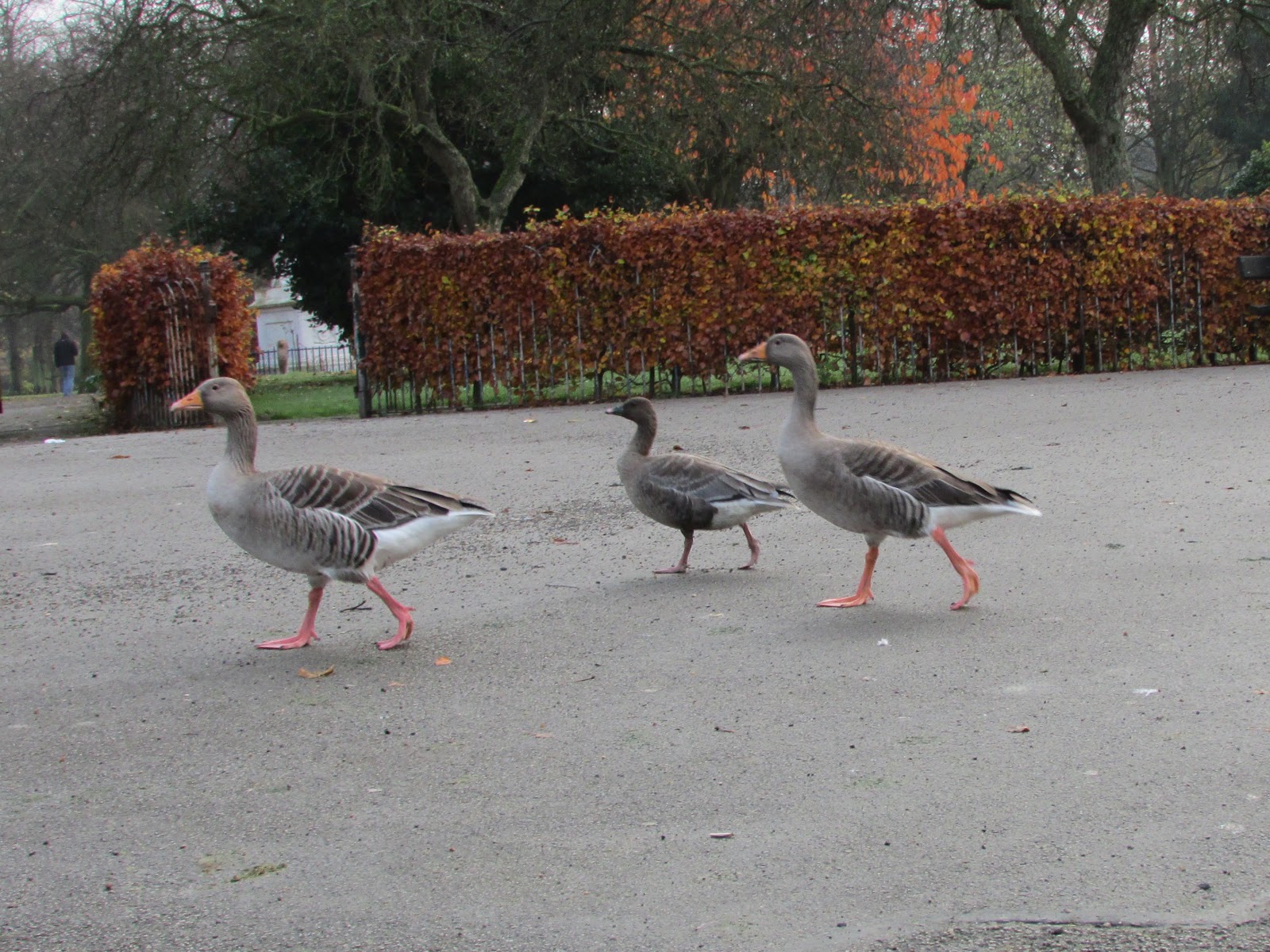
With the constant daily movement, it is unavoidable that a few stragglers will separate from the flock. They call pitifully when trying to catch up. Many will eventually find the flock. Some others, which could mainly be young birds which haven't learned the route, may be disoriented and join a Greylag flock, as has happened several times in our local parks. 

More information

A Humber Goose spectacular. RSPB Blog by Pete Short.

Mapping the Pink-footed Geese.

WeBs survey results.

Sunday, 11 January 2015

Pinkfeet together

At East Park this morning we came across a Greylag flock by the cafe lawns. I spotted the Pinkfoot, and then another, which surprised me. There has been a resident Pink-footed goose in East Park for a year now, a young bird flocking with Greylags. In November, I had spotted a different bird (and blogged about it, see here), also with Greylags at Pearson Park. Could these be these two birds that had got together?
 I looked carefully at my photos and saw that they have distinct bill markings, one with a very small mark close to the nail, the other with a larger U shape mark. The older bird, with the U shape mark (I'll call her Stripe) appears to the the East Park resident. The younger bird, still with tiny body feathers has a small bill patch and matches the bill marks - and tiny white feathers around its bill - of the one that was at Pearson Park. Despite being younger, this bird was bigger and has a larger head, with a Roman profile and a thicker neck and a heavier head, so it might be well a male. Since last saw both birds I was impressed how much more grown up they look. Their neck stripes are better delineated, their head shapes less gentle, and they have a more silvery backs as they have moulted their juvenile feathers. The Pinkfeet stayed near each other in the flock, but one lunged at the other when it got too close. At some point the flock got wary of a radio controlled car, and after a crescendo of cackles, they flew off.
'Dot' Pearson Park 20/11/2014
East Park, today. A male?
'Stripe' East Park 14/2/2014
East Park, today, a female?


Dot's juvenile feathers very noticeable in the flanks, with some adult feathers, darker and silvery just over his legs.
Stripe seems to have a full adult plumage now.

Friday, 21 November 2014

In the wrong flock

Although I wouldn't consider Pink-footed Goose (also known as Pinkfoot) to be an urban bird, it is a species that I regularly see. Skeins of this migratory geese, announced by a chorus of high pitched calls, regularly fly over the city in October and March, on their way to and from their breeding headquarters in Iceland and Greenland. Occasionally, however, a straggler will turns up with Greylags in local parks, allowing a closer look.
  On my way to work, walking through the park, a flock of Canada Geese and another of Greylag geese were about. While counting them I noticed a much smaller goose, a Pinkfoot, amongst the greylags. They have small bills, marked with pink, much darker head, contrasting with the slaty back. I think this individual was a young bird born this past summer, as you can see two types of feathers in its flanks and back, as the larger adult feathers, with a pale edge, have started to grow. The furrows that adorn the neck of adult geese are not yet sharply defined. The goose wasn't welcome and was often lunged at by the Greylags. Surprisingly, it was quite relaxed in the park, despite proximity to people, and it got very close to me as it followed the other geese across the lake and then to the grass to feed.
 I other occasions when had previously seen other Pinkfoot with greylags, it was also young birds. I wonder if leaving with your own species as the flock departs takes some learning. Geese need to reach a consensus before leaving as a flock, a decision that takes place by increasingly noisy vocalisations and movements of the birds of the flock when they are ready to leave. If a young bird misses the cues, it will fail to take off might miss the flock altogether, becoming stranded possibly with another geese species. Geese have long lives and move about, so most likely, while following the greylag flock in its travels, it will eventually meet a Pinkfoot flock and the young bird will be reunited with other members of its species.
A Greylag drives the pinkfoot away from its partner

Walking towards the grass. The difference in size between both species is evident here.