Showing posts with label migration. Show all posts

Sunday, 18 October 2020

Pink-footed geese commute


One of the highlights of my bird year is to first hear and then see the wavy skeins of Pink-footed Geese flying over from their summer breeding quarters in Iceland and East Greenland.

This morning, I headed to my local park to carry out the Wetland Bird Survey. I counted the Greylag and Canada geese flock, the Common Gull flock, all recently arrived, and the resident Mallards and Moorhens. But al through, there was a beautiful background noise of calling Pink-footed geese. Flock after flock flew over, their arrival preceded by their echoing calls. Most were going north, 1500 of them.

You might be puzzled to see these geese flocks flying north or east early in the morning, how can it be that they are not going south? The reason is these birds are wintering or staging their migration in the Humber Estuary. What we are watching is their daily commute, in fact, their morning rush hour! Every night, the flocks gather to roost Read's Island and Whitton Island in the upper Humber estuary, where they are safe from disturbance and predation. At day rise, the birds fly to fields on Holderness or the wolds to feed, favouring fallow fields, or the spilt grain in those fields still to be planted, and also left-over potatoes! A similar movement happens towards Lincolnshire.

The Pink-footed geese population suffered strong declines in the 20th century, but it has been steadily increasing in the last couple of decades. The increase was followed by a renewed use of the Humber Estuary for wintering and also as a staging post on the way to Norfolk. UK coasts and estuaries now hold a sizeable amount of the total wintering population of this geese species, estimated to be about half a million birds.

With the constant daily movement, it is unavoidable that a few stragglers will separate from the flock. They call pitifully when trying to catch up. Many will eventually find the flock. Some others, which could mainly be young birds which haven't learned the route, may be disoriented and join a Greylag flock, as has happened several times in our local parks. 

More information

A Humber Goose spectacular. RSPB Blog by Pete Short.

Mapping the Pink-footed Geese.

WeBs survey results.

Friday, 10 January 2020

Stonechat pairs in winter territories

Species like the Robin keep territories during the winter, with males and female individuals defending their own separate territories, while in the summer, territories are defended as a pair. There are some exceptions in which pairs defend winter territories, often in different areas that summer ones. One of these species is the Stonechat. In their wintering grounds on the coast and around the Humber estuary, it is frequent to encounter Stonechat pairs in the same area, feeding near each other and following each other, with no aggression (top shot, a pair at Alkborough, Lincolnshire, 11/12/2017). Of course, winter territory defence has nothing to do with reproduction, and often happens in areas that don't even hold breeding pairs in the summer. This unusual behaviour must offer some benefit to persist in the population, maybe allowing individuals to increase their chances of survival to predation or competition and to secure sufficient food resources.
A study of wintering Stonechats in the Negev desert (Israel), shed some light onto the behaviour. A total of 89 individuals were colour banded and followed through two wintering seasons. Their territorial behaviour was noted. The most surprising result of the study is that wintering Stonechat pairs are very fluid. Pairs often form after arrival to winter areas, and individuals rarely stay together all winter, instead pairs change frequently, with an average of just 4 weeks together per pair. In fact, none of the studied pairs stayed together all winter long and individuals arrived in the area and left at different times. This rules out that breeding pairs migrate together or settle on the same winter territory. Up to a third of individual are unpaired at any given time, but all associations are always between a male and a female. There were some aggressive interactions between members of a pair, which were commonly initiated by the male. Both males and females engaged in territory defence, with males more aggressive against intruders than females.
Male Stonechat at Kilnsea, 10/12/18.
Why pair in the winter?
If pairs are not stable, don't migrate together, or don't form in preparation for the winter season, what is the point in defending territories as a pair? Males and female stonechats feed on the same prey, therefore there may be a cost on sharing a territory during the winter, when food resources may be very scarce. A possible benefit outweighing the cost may be joint territory defence: two individuals are better spotting and chasing away conspecific intruders or detecting predators and defending the territory against individuals of other species with similar food resources. In this study, individuals spent a lot of time defending the territory against Mourning Wheatears, but there was no mention of differences when pairs or individual Stonechats were involved.
Another pair at Kilnsea (13/1/2020)

Why male/female pairs?
These results don't clarify why associations are not between two males or two females defending a territory. The authors speculate that as Stonechats are sexually dimorphic, even in the winter, there may be constraints that prevent two males from living peacefully in the same territory, and the increased male aggressiveness may mean two females may be unable to defend a territory against a male/female pair.

More information
Gwinner, E., Rödl, T. and Schwabl, H. Pair Territoriality of Wintering Stonechats: Behaviour, Function and Hormones. Behav. Ecol. Sociobiol. 34, 321–327 (1994).

Sunday, 15 December 2019

Wintering Chiffchaffs

In the last month, I've come across a couple of wintering Chiffchaffs. The last of them this Wednesday on my way to work, the calling bird revealed it's presence atop a maple, busily feeding on the top branches. Although most UK warblers are breeding migrants, four species can be found during winter. Two of these are resident species, the Dartford and Cetti's Warblers. The situation is more complex with the Blackcap, which I've covered before, and the Chiffchaff.

Sewage plants and wetlands
Chiffchaffs are insectivorous year round, so they can't rely on garden feeding like Blackcaps during winter. Overwintering in Chiffchaffs was documented in the early 19th century, but this seem to involve very few birds. In recent decades, however, there seem to have been an increase in numbers, possibly aided by global warming. Ringing and recaptures have allowed estimates of around 100 individuals gathering in suitable sites. Chiffchaff winter survival depends on a steady supply of invertebrates (mainly midges, gnats and aphids) and sheltered sites where to roost. They appear to survive several consecutive nights with frost, so the increased temperatures may have more important effects on insect abundance, not actual survival of the birds. Suitable habitats include sheltered coastal areas, but they also use urban and suburban sites, especially near water, sewage treatment plants (where warmer water means an abundance of insects) woodlands and hedgerows. The Chiffchaff on the top shot, fed low on the marginal vegetation around an urban lake, East Park, Hull on 2/12/2013.

It's complicated...
The Chiffchaff is part of a species complex and its taxonomy has changed quite a lot in recent years. What was considered a single species now includes the Canarian and Iberian Chiffchaff, previously races now elevated to species level. The Chiffchaff proper is now divided into various races: the nominal race, collybita, breeds in the UK, whereas tristis or Siberian Chiffchaff, and Scandinavian Chiffchaff abietinus. The three races are very similar, differing in the tone of the plumage and subtle morphological features, and more notably, song and calls. Given this and the occurrence of intermediate forms between some of the species makes them very difficult to identify in the field.

Residents, migrants and winter visitors
It appears that the bulk of the UK breeding population of Chiffchaffs, belonging to the subspecies collybita, migrate south in the winter. In addition, there is very strong passage through the UK, especially in the autumn, mainly of northern European birds moving to winter quarters in the Iberian Peninsula, and Northern and Western Africa and these include a sprinkling of abietinus and tristis individuals. What about the winter birds? Where do they come from?

Ringing and DNA analysis
Ringing recaptures in the winter don't include locally breeding Chiffchaffs, suggesting that the winter birds are also migrants. Most of them appear to belong to the collybita subspecies, which breeds in western Europe and Southern Scandinavia. Recoveries of birds ringed in winter in Southern England have been made subsequently in N England and Denmank during the breeding season. Recently, DNA analysis has come to the rescue. It is possible to obtain enough material for DNA analysis from tiny feathers, dislodged when ringing birds. Sending these feathers for DNA analysis allows to discriminate between subspecies, as they have distinct DNA. Individuals captured in the south of England include some Siberian chiffchaffs confirmed by DNA. Over 20% of ringed wintering Chiffchaffs in a mixed woodland by a lough in Ireland was confirmed to be tristis and two individuals were confirmed as abietinus. So it appears that wintering Chiffchaffs include individuals from all three European subspecies, that once finding suitable locations during migration they settle for a while to feed. Ringing recaptures have found the same individuals wintering repeated years in the same location. Another intriguing feature of wintering Chiffchaffs is that males, which are larger than females, were the bulk of wintering chiffchaffs in the past, although females are increasingly wintering. There is still so much to learn on Chiffchaff migration, taxonomy and evolution.

More information
Clement, P. 1995. The Chiffchaff. Hamlyn Species Guides. pp126.
Clement, P., Helbig, A. J. and Small, B. 1998. Taxonomy and identification of chiffchaffs in the Western Palearctic. Br. Birds 91, 361–375.
Birds in Cheshire and the Wirral. A breeding and wintering atlas. Wintering Chiffchaffs. 
O’Mahony, B., Farrer, D. and Collinson, M. 2008. Genetic identity of wintering Common Chiffchaffs Phylloscopus collybita trapped in County Kerry in 2015. Ir. Birds 
Ray Meads Ringing Group A review of our wintering chiffchaffs.
Simms, E. 1985. British Warblers. The New Naturalist Series. Collins. 432 pp.

Thursday, 4 August 2016

Visiting the swift tower

Yesterday we did a stop in Oxford on our way south of the UK. After lunch, we quickly popped by the Natural History Museum. This magnificent building holds the swift breeding population that have been studied for several decades. The nests are in adapted nest boxes, which have access from the inside of the building for ringing in the main tower.

A detail of the tower showing the entrances to the nest boxes.

It is quite late in the short Swift breeding season and many fledglings and adults have already left for their African wintering quarters. Every time I see a swift I think it could be the last of the year, so I was not too hopeful of seeing any around the tower.

Birdtrack reporting rate of Swift, showing the main breeding season from May to August.
Then the website revealed that the last Swift nestling in the tower was born a couple of weeks ago (18th July) and hadn't yet fledged. The Museum has set up a live webcam in which you can follow one of the nests. The webcam is now set up onto the latest born nestling. I watched the nestling for a while today and got a couple of screen grabs.
An adult likely after feeding the chick, on the foreground, and the well grown nestling. Young have pale-rimmed feathers on their face, unlike adults.
The youngster resting. It spent some time flapping its wings and grooming. Although is quite feathered, its wing feathers are still quite short. The wing feathers will need to reach beyond the end of its tail before it can leave the nest. You can also see a rejected egg just outside the nest.

As we walked onto the square in front of the Museum and just after taking a few photos, a lone Swift flew overhead. Not the mad noisy chases of dozens of Swifts that usually surround the tower at the peak of the breeding season, but a great end of a lovely visit. 

Wednesday, 18 March 2015

The Viking gulls

A flock of about 100 common gulls winters in the park, they arrive at the end of September/October and are around most of the time until the end of March. They are very excitable and their squeals provide the background noise of the park in winter, especially when visitors empty their bags of bread by the side of the pond. A cacophony of calls and chases ensues while the gulls pick the bounty fast, before the ducks and geese have the chance to react.
 Is not only bread though for the park gulls, there are very quiet times, especially during the middle of the week, and the gulls will move onto the grass, looking for worms and other invertebrates, watching the ground intently as they walk.
 In wet days they can be seen 'dancing' (foot-paddling) to entice the worm to the surface of the soil. Like so.

Then they spend some time just flying in circles over the park, in a flock, I am not sure if in preparation to roost, although I am not sure where they spend the night.
A quiet moment in the flock, with preening, snoozing and yawning by the pond.
This is an adult one on winter plumage. Note the yellow bill with faint dark ring near the tip and the yellow legs, and spotty head.
on the 3rd of February this adult looked very nice on the snow, still in winter plumage.
On the 20th of February this adult had an almost white head and a thin red eye ring.
A close up of an adult's head showing mainly yellow bill, red ring. Note the scruffy back of the head, showing the ongoing moult towards a completely white head plumage.

I find them endlessly fascinating and can't stop myself from photographing them, and they are often co-operative, as they are so used to people. When I noted that the flock disappeared each year, one day in March or April I wondered where they would go in the summer, to breed. I need wonder no longer, these gulls come from Bergen, in Norway.
While watching them one day in January I found a couple of Common Gulls with plastic colour rings. I spent some time looking at the legs of many gulls since that day, but I didn't spot any other ringed ones. I managed to get photos where I could read the code and submitted the samples to Euring. I got an e-mail the same day from Morten Helberg with details of their ringing and recoveries. Since then, I have seen the ringed gulls a few times, and managed to get their portraits.
This is J2EX, sex unknown ringed its first autumn (1st calendar year in 2013) which means now should be in its 3rd calendar year (almost adult), although the bill and legs are still grey/bluish and doesn't have a red eye ring or prominent wing 'mirrors'. This is its ringing/recovery history:

15.09 2013 Byparken, Bergen, Hordaland, Norway
17.09 2013 Tveitevannet, Bergen, Hordaland, Norway
20.09 2013 Tveitevannet, Bergen, Hordaland, Norway
21.09 2013 Byparken, Bergen, Hordaland, Norway
14.06 2014 Kilnsea, Humberside, Great Britain
14.01 2015 Pearson park Hull, Humberside, Great Britain (the photo above is from yesterday, also observed 22/01/2015)
This is JV47, Sex male age, 1 cy when ringed last October, so it's in his first winter. He still called like a gull chick when feeding, and adopted this hunched chick posture. Legs and bill base pinkish.
This is it's ringing/recovering history:
05.10 2014 Tveitevannet, Bergen, Hordaland, Norway
(in the month after it was ringed the flock came back to Pearson Park)
14.01 2015 Pearson park Hull, Humberside, Great Britain 

Looking at photos yesterday, I found another ringed common gull, from the 20th of February. It looks like a first winter bird. The code reads JR20. I will update the post when I hear back from Euring.
It is very nice to know where these gulls spend the summer, but something equally rewarding is to know them as individuals. The rings have allowed me to recognised them in my visits to the park. I will look forward to them coming back in years to come, as gulls can be long lived. A typical Common Gull lives for 10 years (the record is 27).

Friday, 21 November 2014

In the wrong flock

Although I wouldn't consider Pink-footed Goose (also known as Pinkfoot) to be an urban bird, it is a species that I regularly see. Skeins of this migratory geese, announced by a chorus of high pitched calls, regularly fly over the city in October and March, on their way to and from their breeding headquarters in Iceland and Greenland. Occasionally, however, a straggler will turns up with Greylags in local parks, allowing a closer look.
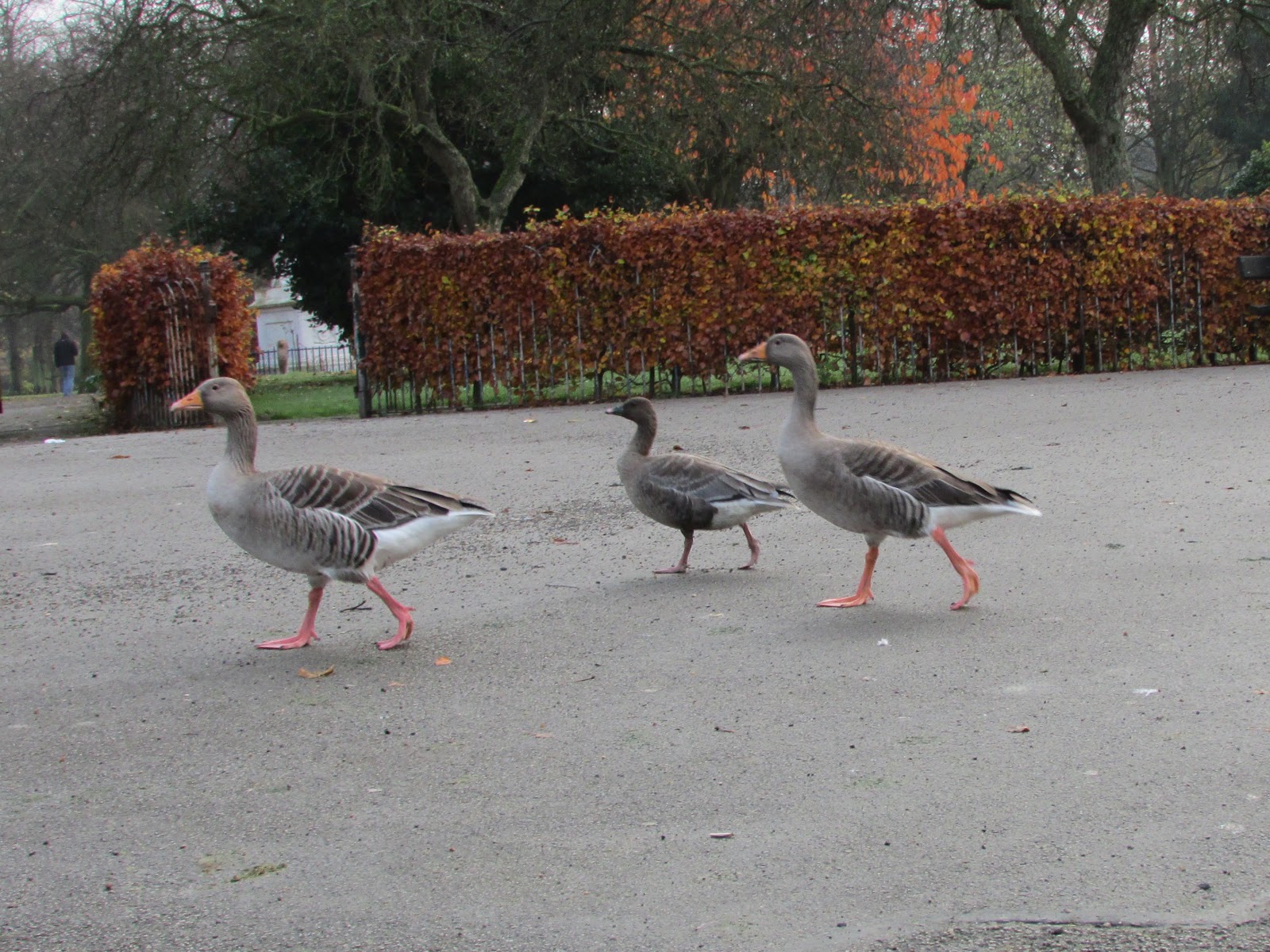
  On my way to work, walking through the park, a flock of Canada Geese and another of Greylag geese were about. While counting them I noticed a much smaller goose, a Pinkfoot, amongst the greylags. They have small bills, marked with pink, much darker head, contrasting with the slaty back. I think this individual was a young bird born this past summer, as you can see two types of feathers in its flanks and back, as the larger adult feathers, with a pale edge, have started to grow. The furrows that adorn the neck of adult geese are not yet sharply defined. The goose wasn't welcome and was often lunged at by the Greylags. Surprisingly, it was quite relaxed in the park, despite proximity to people, and it got very close to me as it followed the other geese across the lake and then to the grass to feed.
 I other occasions when had previously seen other Pinkfoot with greylags, it was also young birds. I wonder if leaving with your own species as the flock departs takes some learning. Geese need to reach a consensus before leaving as a flock, a decision that takes place by increasingly noisy vocalisations and movements of the birds of the flock when they are ready to leave. If a young bird misses the cues, it will fail to take off might miss the flock altogether, becoming stranded possibly with another geese species. Geese have long lives and move about, so most likely, while following the greylag flock in its travels, it will eventually meet a Pinkfoot flock and the young bird will be reunited with other members of its species.
A Greylag drives the pinkfoot away from its partner

Walking towards the grass. The difference in size between both species is evident here.

Saturday, 12 April 2014

Summer and winter Blackcaps and evolution

ResearchBlogging.orgDuring April, Blackcaps return to thickets and woodland, where the male's beautiful song joins the resident birds. These Blackcaps have just arrived from their winter quarters in Spain and North and coastal West Africa. We tend to think of migration behaviour as something fixed, but recent research shows that many birds have recently changed their migration routes. One of these is the Blackcap.
In the last 50 years or so, a small contingent of Blackcaps have started to winter in the UK. About 30% of gardens have a wintering Blackcap in recent years. Is it because these birds are staying here year round? Surprisingly not, they are migrants from the continent, mostly from Germany, where they breed. This migration behaviour has evolved in a few generations, with these birds taking advantage of milder winters, increased food availability in gardens and a shorter migration route. They usually migrate to Britain and Ireland as winter berry and winter temperatures drop at the beginning of the year. The direction in which blackcaps prefer to migrate is innate, strongly influenced by one or a few genes: the offspring of blackcaps migrating NW prefers to migrate NW, and the offspring of hybrids between NW and SE migrants have an intermediate migratory direction. Birds with both migration strategies coexist in South Germany and Austria. The different migration routes mean that they arrive at their breeding grounds at different times, and therefore tend to pair with birds with a matching migration strategy. The birds involved in the shorter Germany-UK migration trips have evolved shorter, more rounded wings than the Mediterranean migrants. In addition, they have slightly different plumage colour, with might also help them find the right mate. Bill shape is also different, possibly reflecting a different diet: birds wintering in the Mediterranean feed mostly on fruit, while British wintering birds rely mostly on fat and seeds in gardens. These differences are reflected in incipient genetic differentiation between blackcaps with different migration routes present in the same area during the breeding season, which could mean that both populations eventually become different species.
A wintering female Blackcap feeding in my garden. 26/1/2013.
A summer migrant male singing today.
More information
Rolshausen, G., Segelbacher, G., Hobson, K., and Schaefer, H. (2009). Contemporary Evolution of Reproductive Isolation and Phenotypic Divergence in Sympatry along a Migratory Divide Current Biology, 19 (24), 2097-2101 DOI: 10.1016/j.cub.2009.10.061
Fiedler, W. (2003). Recent changes in migratory behaviour of birds: A compilation of field observations and ringing data Avian migration, Springer Berlin Heidelberg., 21-38 DOI: 10.1007/978-3-662-05957-9_2

Sunday, 11 November 2012

Wandering Waxwings

ResearchBlogging.orgI have litte interest in watching birds swept away from their native grounds by a tropical storm, or inexplicably lost and found far away from their usual migratory routes. Waxwings are different, and I have been wanting to see them for years. They might be rare, or not present in great numbers every year, but the UK is part of their distribution range. The last couple of days, I have been popping in a local supermarket carpark to watch a large flock of these amazing birds. Bohemian Waxwings, Bombycilla garrulus, as other boreal bird species - like Crosbills, Siskins and Redpolls - do not fit into a regular migratory pattern, they are instead irruptive migrants. It is thought that the species common name, Bohemian, comes from these wandering habits. In irruption years, many thousands of individuals flock and wander well south of their summer grounds in the the Russian and northern Scandinavian taiga making it to the UK. Flocks then move nomadically in search of food, as it is not cold winters what prompts their movement, but unpredictable food resources. Irruption years in Waxwings correlate with poor crops on fruit and berries in their northern grounds following a good fruiting year. Waxwings are highly frugivorous birds, their exclusive diet in the winter consists of berries and fruits: Rowan, Hawthorn, Cotoneaster, Mistletoe, Rose Hips and many others both wild and cultivated. The main resource, Rowan berries, fluctuates erratically across years in their summer grounds, as Rowan is a masting species, as fruit production is synchronised in the population and totally fails some years. During these poor fruit years, Waxwings initiate their movements earlier in the year, and therefore earlier arrivals of waxwings indicate that it will be an irruption year.
 During irruptions, waxwings carry on moving through the winter as they deplete their food resources locally, and they are wanderers all year round, with little chance that they will return to the same areas where they were born in the following summer. This winter is going to be one of those irruption years, and the Waxwing invasion is well underway.
 Waxwings are surprisingly small birds, similar in size to Starlings, to which they also resemble in flight, as they flock and have pointy, triangular wings. At close range there is no mistaking them, with their soft plumage, characteristic crest and 'zorro' mask. At even closer range, you might get to see the striking bright scarlet waxy drops and yellow streaks adorning their wings. They do look smart.
 As most fruit eaters, Waxwings need to eat a large number of berries to survive - an estimation was double their body weight in berries. A flock can quickly strip down a tree. When not feeding, they like to sit atop trees, preening and just looking around, while constantly chattering, a pleasing cricket-like and jingly call.

A large flock of Waxwings resting and preening.
The top of this Rowan has already been stripped, but there are still plenty of berries at the bottom of the tree, which are harder to reach 
A circling flock of Waxwings deciding where to stop
 These three were looking up nervously, might well have been keeping an eye on the Sparrowhawk soaring above them.
The flock I was watching was resting on a Rowan tree and the birds were not quite daring to do to the bottom of the tree to start eating. They increased the rhythm of they calls like they were agreeing on something, and took to the wing. I am so pleased I finally managed to catch up with them. Bon voyage!

More information

Barbara and David Snow (1988) Birds and Berries. T & AD Poyser. 268 pp.

Ian Newton (2006) Advances in the study of irruptive migration. Ardea 94, 433-460.

Koenig, W., & Knops, J. (2001). Seed-crop size and eruptions of North American boreal seed-eating birds Journal of Animal Ecology, 70 (4), 609-620 DOI: 10.1046/j.1365-2656.2001.00516.x

Sunday, 17 January 2010

Making the best of bad weather

Birds have a range of behaviours to cope with the cold. Many - Swallows, Cuckoo, many warblers - avoid it altogether by migrating to warmer latitudes well ahead of winter, these are birds exploiting resources that are virtually non-existing in the winter such as caterpillars or flying insects. Others undergo more regional migrations, often depending on the local conditions. Here, surprisingly, there are many British species, which move south to the continent, and at the same time come to the UK from colder areas like Fennoscandia, these would include the Robin or the Blackcap. Yet another group of species simply change their habitat preferences. Some species that are found in mountain areas move down to the plains in the winter, species that feed on freshwater lakes and ponds in the summer move to the coast, where water does not freeze in the winter (Grebes and Kingfishers do this). There are a fourth group of species which change their food habits with cold weather. The Blackbird and other thrushes switch to feeding on berries when the ground is too hard to hunt for earthworms. I probably haven't exhausted the options and several of them are not mutually exclusive. For example, the Swift, a summer migrant from Africa, also undergoes substantial regional migrations in avoidance of poor weather. In addition, some of these options are only taken depending on the local conditions. The Waxwing's irruptions, when birds normally inhabitants of northern Europe, reach the UK and western Europe, happen in response to poor berry crops in the rowan of their native forests, and then to happen at irregular intervals. The last one of such invasions happened during the winter of 2008-2009.
  In the last few days, I have noticed couple of species which I don't see very often within the city have become more common. One of them is the Pied Wagtail, the other the Redwing. The first one belong to the  habitat switchers, the Pied Wagtail is most often found in gardens and towns during the winter. With its constant tail bobbing and its frantic running and direction-changing motion in chase of minute insects and bugs, to get a decent photo in the gloomy dark days we've had lately is a challenge. The Redwings, which migrate into the UK in the winter from northern Europe, feed on grassy areas - or berries - in loose flocks, they are quite wary and the photos are also not good.

Two Redwings