Showing posts with label rowan. Show all posts

Monday, 3 December 2018

Watching Waxwings

Yesterday, I got up early and had a short drive to a local supermarket to watch some Waxwings that had been reported. Waxwings are irregular winter visitors to the UK, especially to its eastern side, and are most likely to arrive to a supermarket car park near you. A lovely mild morning with sunny spells and a light wind, I walked around the quite empty car park checking the rowans, a couple of small ones still with berries. two Woodpigeons and a Blackbird were feeding on them, but no trace of Waxwings.
Woodpigeons.
Blackbird sitting on a rowan still laden with berries.

Suddenly, a flock of six Waxwings appeared silhouetted against the rising sun and landed on the tree in front of me.
The safe tree
Almost every time I've seen Waxwings, they alternate between bouts of frantic berry feeding and resting in a tree nearby. It's not just any tree, it is a particular tree. This tree attracts them like a magnet and they appear not to settle anywhere else. This time their safe tree was an ash, the tallest tree in a row on a rise by the road separating two supermarket car parks. The Waxwings spent a few seconds feeding on a yellow-berry rowan, and then they flew back to the top part of the ash tree, where they spend most of the time. Other times the flock would fly towards a rowan and return to the safety of their tree even before landing. They are extremely watchful, looking up nervously every now and then with bouts of preening, resting and calling.
Their quiff-life crests rise or flatten with their mood (compare the top shots taken a few seconds apart), sometimes becoming ruffled with the breeze. They are not particularly wary of people, some photographers assembled just underneath their tree, pointing at them with their cameras, walking right under them, and they paid no attention.

Birders and Waxwings on their safe tree.
Instead, they are watchful of predators. Being small birds, similar to starling in size, they would be easy prey for Sparrowhawks. Indeed, later on, when I go for a wander in the area, I see a Sparrowhawk flying past chased by a flock of starlings.
This is the only shot I got of the Waxwings in the rowan where they fed.
Decision making
When to go to feed? It was interesting to watch the individual Waxwings on the tree. At some point one of them appeared restless, and would fly from branch to branch around the others - which were preening or resting - or it would fly up and away from the tree a short distance, and if the others didn't follow, it would return. This individual appeared to be rallying the group to go and feed.
 Earlier in the week there had been nine Waxwings about, then the six yesterday. Today just two remained. Two Mistle Thrushes sat on a lamppost, guarding the rowans, so not sure the Waxwings will stay much longer. The two waxwings sat close in the tree and billed each other briefly, maybe passing some food?
Early arrival of Waxwings indicate an irruption year, so I do hope there's more opportunities this winter to catch up with them.

Tuesday, 26 November 2013

Having a very berry time

A few photos from my garden blackbirds taken yesterday, through two layers of glass. The rowan is still loaded with bright, fat berries, which seem to be keeping well. A female, above, about to swallow one. A male, below, had a quiet time after feeding.
This other male (below) has started visiting my garden recently. A quite distinctive individual due to the large white patches on his head. White feathers, often on the head, are quite common in my local blackbirds, but the extent of this individual white markings is the most extreme I've seen around here.


Sunday, 17 November 2013

Charming seed predators

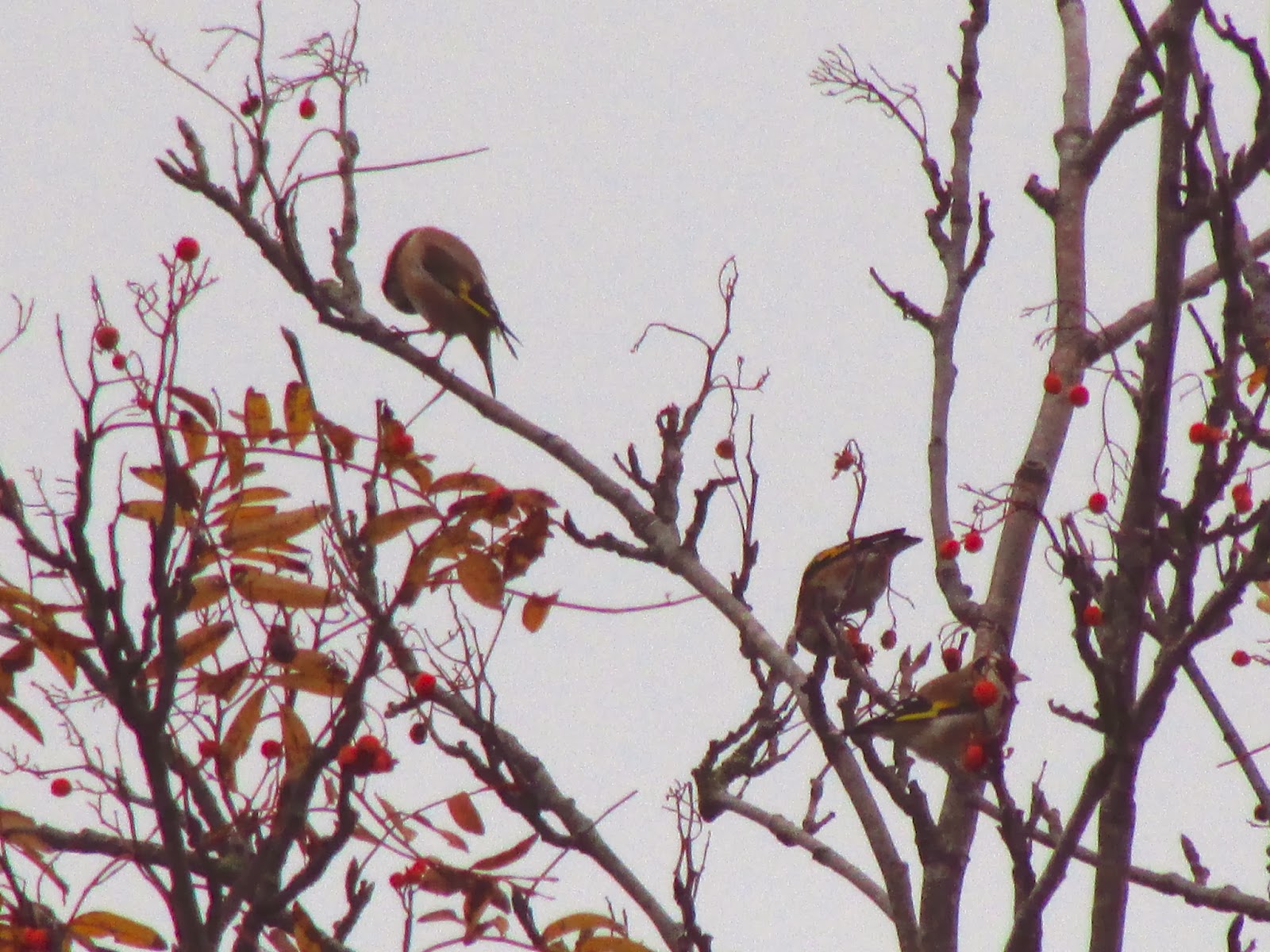
 ResearchBlogging.orgI find fascinating that when you seen something for the first time, then the chances are that you would see it again, seeing helps you see more. In the last couple of weeks a charm of goldfinches have been regular visitors in the garden feeders, gorging themselves on nyjer and sunflower seeds. I was watching the goldfinches and taking photos from inside of the house, when I noticed that one of the birds that couldn't get to the feeders was feeding on rowanberry seeds (above), discarding the pulp. This is typical of seed feeding birds like finches. Finches are seed predators, unlike thrushes, that eat the berries whole, passing the seed undigested and undamaged, in their droppings, and dispersing the seed away from the tree in the process.
 There was no mention of Goldfinches in the authoritative 'Birds and Berries' by Snow and Snow. I found a wonderful, if lone, photo on Flickr here and a line in a novel that suggested that this behaviour had been noticed before:
They went down the track through a wood where a flock of goldfinches was feeding on the rowanberries [...]
Tessa Hadley, Accidents in the home, 2002

Today on a walk in the park, I noticed a rowan on a garden and had a look. A charm of goldfinches looked busy on it. I wouldn't have normally had a closer look, but I did. They were feeding on the berries, hanging from the bunches like tits, not one, not two, but the whole flock seemed to be enjoying the berry seeds. The photos from today (below) are atrocious, as it was late and the light very poor, but a record nonetheless. After a while, something spooked the birds, a Sparrowhawk perhaps, and the Goldfinches went quiet and took to the air with a group of starlings and feral pigeons. I glimpsed what I think was a woodcock before if flew behind a roof, powerful wings and long bill, but just for a second. A Blackbird called: 'seee!' from a bush, their air predator alarm call.
 Indeed, a range of finches - including Goldfinches - are reported to feed on rowan seeds occasionally: Greenfinch, Crossbill, Brambling, Chaffinch, Hawfinch, Goldfinch, Redpoll and Siskin. Indeed, for some finches, particularly Bullfinch and Pine Grosbeak rowan seed in autumn can be their staple food. But rowan is a masting tree, where crop is very variable across years, with bumper crop, the 'masting years' interspeded with poor or failed crops in some. In the winter of 2004-2005, simultaneous irruptions of boreal Waxwing, Pine Grosbeak and northern Bullfinch occurred, all three birds liking rowan berries. Bullfinch local movements and irruptions in western and southern Europe have been linked to the strength of rowanberry fruiting crop.


This goldfinch appeared to use her foot to hold the berry in place

  A couple of weeks ago I spotted a juvenile Common Rosefinch, a rare visitor to these shores, feeding on rowan berries

Juvenile Common Rosefinch feeding on Rowan berries. 4/11/2013.

Some finches might use rowan depending on local availability. As this year rowan berries are plentiful and the thrushes have barely made a dent on the crop, Goldfinches and other birds may take advantage of this resource opportunistically.

References
Pennington, Mike G., and Eric R. Meek. (2006). The ‘Northern Bullfinch’ invasion of autumn 2004. British Birds 99: 2-24.

Munilla, I., and Guitián, J. (2012). Numerical response of Bullfinches Pyrrhula pyrrhula to winter seed abundance. Ornis Fennica, 89(3), 197-205.

Fox, A. D., Kobro, S., Lehikoinen, A., Lyngs, P., and Väisänen, R. A. (2009). Northern Bullfinch Pyrrhula p. pyrrhula irruptive behaviour linked to rowanberry Sorbus aucuparia abundance. Ornis Fennica, 86, 51-60.

Snow, B. K., and Snow, D. (2011). Birds and berries. A&C Black.

Raspe, O., Findlay, C., and Jacquemart, A. L. (2000). Sorbus aucuparia Journal of Ecology, 88 (5), 910-930 DOI: 0.1046/j.1365-2745.2000.00502.x