Showing posts with label irruptions. Show all posts

Monday, 3 December 2018

Watching Waxwings

Yesterday, I got up early and had a short drive to a local supermarket to watch some Waxwings that had been reported. Waxwings are irregular winter visitors to the UK, especially to its eastern side, and are most likely to arrive to a supermarket car park near you. A lovely mild morning with sunny spells and a light wind, I walked around the quite empty car park checking the rowans, a couple of small ones still with berries. two Woodpigeons and a Blackbird were feeding on them, but no trace of Waxwings.
Woodpigeons.
Blackbird sitting on a rowan still laden with berries.

Suddenly, a flock of six Waxwings appeared silhouetted against the rising sun and landed on the tree in front of me.
The safe tree
Almost every time I've seen Waxwings, they alternate between bouts of frantic berry feeding and resting in a tree nearby. It's not just any tree, it is a particular tree. This tree attracts them like a magnet and they appear not to settle anywhere else. This time their safe tree was an ash, the tallest tree in a row on a rise by the road separating two supermarket car parks. The Waxwings spent a few seconds feeding on a yellow-berry rowan, and then they flew back to the top part of the ash tree, where they spend most of the time. Other times the flock would fly towards a rowan and return to the safety of their tree even before landing. They are extremely watchful, looking up nervously every now and then with bouts of preening, resting and calling.
Their quiff-life crests rise or flatten with their mood (compare the top shots taken a few seconds apart), sometimes becoming ruffled with the breeze. They are not particularly wary of people, some photographers assembled just underneath their tree, pointing at them with their cameras, walking right under them, and they paid no attention.

Birders and Waxwings on their safe tree.
Instead, they are watchful of predators. Being small birds, similar to starling in size, they would be easy prey for Sparrowhawks. Indeed, later on, when I go for a wander in the area, I see a Sparrowhawk flying past chased by a flock of starlings.
This is the only shot I got of the Waxwings in the rowan where they fed.
Decision making
When to go to feed? It was interesting to watch the individual Waxwings on the tree. At some point one of them appeared restless, and would fly from branch to branch around the others - which were preening or resting - or it would fly up and away from the tree a short distance, and if the others didn't follow, it would return. This individual appeared to be rallying the group to go and feed.
 Earlier in the week there had been nine Waxwings about, then the six yesterday. Today just two remained. Two Mistle Thrushes sat on a lamppost, guarding the rowans, so not sure the Waxwings will stay much longer. The two waxwings sat close in the tree and billed each other briefly, maybe passing some food?
Early arrival of Waxwings indicate an irruption year, so I do hope there's more opportunities this winter to catch up with them.

Friday, 1 January 2016

The variable Redpoll

Redpolls are small finches with a tiny bill, a crimson spot on the forehead and a little black bib and mask giving them slanted-looking eyes. Their plumage is so dense that on their faces it can partially hide their bill, giving them a flat face. They are found from the Arctic (where they are resident), to subarctic and temperate open forest and scrub and specialise on small seeds, mainly from birch, but also alder, willow, spruce, larch (above) and pine cones. They will also feed on various wildflower seeds near the ground.
 Redpolls are very entertaining to watch as they feed, as they reach catkins and cones using acrobatic, agile movements, reminiscent of tits. In addition, they can use one foot to hold onto a stem, a bunch of seeds or catkin to reach the seeds more easily, like goldfinches. They can apparently store up to 2 g of seeds in a expandable pouch in their throat, to eat later in less exposed conditions. Redpolls have been seen 'bathing' and burrowing tunnels in the snow. These tunnels have unclear function, as they don't appear to use them to shelter from low temperatures, rather, they appear to fulfill a social role, or just be a form of play.
  Redpoll flocks have erratic, nomadic, movements in winter in search of seeds, often travelling in the company of Siskins. They also have 'irruption years', following failures on the seed crops on which they rely, or high population densities after a good crop year, often spurred by cold weather. One of the largest irruption years were in the winter of 1995-96, where Arctic and Common Redpolls arrived in the UK in good numbers.
 The taxonomy of Redpolls has been very fluid, with three species, Arctic, Common and Lesser -each with various described geographic subspecies- recognised, but at some point six were described. The browner, small and very streaked 'Lesser Redpoll' breeds in the UK. Diagnosis was based on the lightness and amount of streaking in the plumage and also bill shape and size and overall size. However identification is often difficult, as there is a lot of variation, and many individuals would fall in between the 'classic' species descriptions, resulting 'in much collective head-scratching' in the words of Riddington and colleagues.
  A recent study by Nicholas Mason and Scott Taylor from Cornell University, sampled 77 Redpolls from around their distribution range and looked at the diversity across their genomes, niche differentiation, morphological diversity and gene expression patterns. Surprisingly, all Redpolls were extremely similar genetically, with barely any genomic differentiation between 'species'. The different colour patterns and bill shape can be explained by different gene expression patterns (e.g in response to temperature), but the authors did not find a clear-cut morphological differentiation between species, as many individuals were intermediate. Although recent adaptation to particular local conditions, for example the dominant available seeds) might have happened, it is likely that the nomadic migratory movements of Redpolls result in a lot of dispersal and gene flow between populations and incipient regional varieties, preventing differentiation and subsequent speciation. Perhaps we should just enjoy Redpolls as a delightful bird on its own, and worry less about tidying individuals away into imaginary boxes.

More information
The Cornell Lab of Ornithology Cool Redpoll Facts.

Riddington, R., Votier, S. C., & Steele, J. (2000). The influx of redpolls into Western Europe, 1995/96. British Birds, 93: 59-67. Pdf here.

Gustave Axelson (2015) From Many, One: How Many Species Of Redpolls Are There? Commentary on Mason and Taylor paper on the The Cornell Lab of Ornithology blog.

Mason, N.A. and Taylor, S.A., 2015. Differentially expressed genes match bill morphology and plumage despite largely undifferentiated genomes in a Holarctic songbird. Molecular ecology, 24: 3009–3025. Here.

Collins, J. E., & Peterson, J. M. (2003). Snow burrowing by Common Redpolls (Carduelis flammea). The Kingbird, 53, 13-22. Here.

A male Redpoll feeding on Alder catkins
A Redpoll feeding on Rosebay Willowherb.

A male Redpoll on Alder
An individual on Alder, illustrating their ability to hang upside down from thin branches.

Sunday, 17 November 2013

Charming seed predators

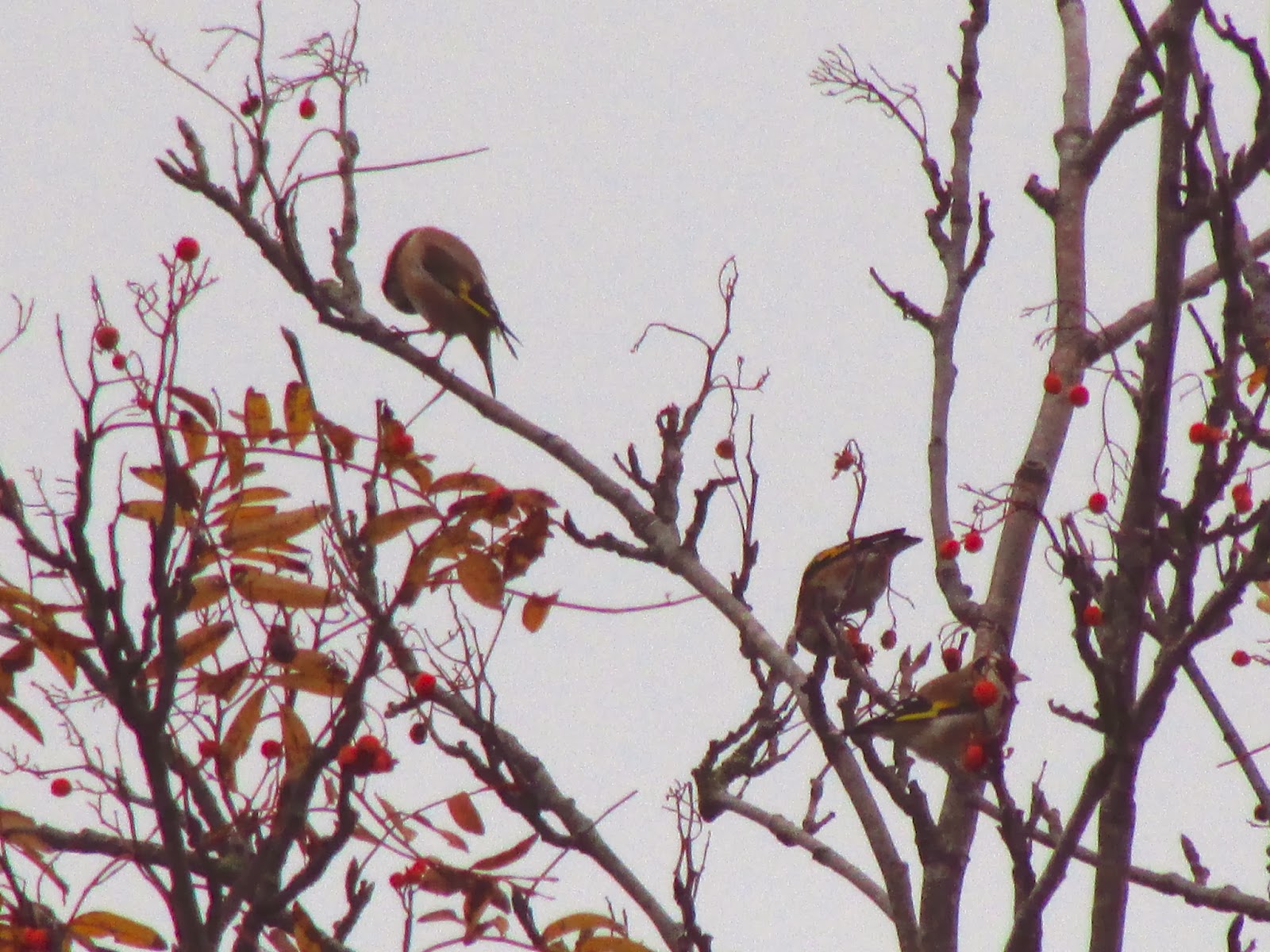
 ResearchBlogging.orgI find fascinating that when you seen something for the first time, then the chances are that you would see it again, seeing helps you see more. In the last couple of weeks a charm of goldfinches have been regular visitors in the garden feeders, gorging themselves on nyjer and sunflower seeds. I was watching the goldfinches and taking photos from inside of the house, when I noticed that one of the birds that couldn't get to the feeders was feeding on rowanberry seeds (above), discarding the pulp. This is typical of seed feeding birds like finches. Finches are seed predators, unlike thrushes, that eat the berries whole, passing the seed undigested and undamaged, in their droppings, and dispersing the seed away from the tree in the process.
 There was no mention of Goldfinches in the authoritative 'Birds and Berries' by Snow and Snow. I found a wonderful, if lone, photo on Flickr here and a line in a novel that suggested that this behaviour had been noticed before:
They went down the track through a wood where a flock of goldfinches was feeding on the rowanberries [...]
Tessa Hadley, Accidents in the home, 2002

Today on a walk in the park, I noticed a rowan on a garden and had a look. A charm of goldfinches looked busy on it. I wouldn't have normally had a closer look, but I did. They were feeding on the berries, hanging from the bunches like tits, not one, not two, but the whole flock seemed to be enjoying the berry seeds. The photos from today (below) are atrocious, as it was late and the light very poor, but a record nonetheless. After a while, something spooked the birds, a Sparrowhawk perhaps, and the Goldfinches went quiet and took to the air with a group of starlings and feral pigeons. I glimpsed what I think was a woodcock before if flew behind a roof, powerful wings and long bill, but just for a second. A Blackbird called: 'seee!' from a bush, their air predator alarm call.
 Indeed, a range of finches - including Goldfinches - are reported to feed on rowan seeds occasionally: Greenfinch, Crossbill, Brambling, Chaffinch, Hawfinch, Goldfinch, Redpoll and Siskin. Indeed, for some finches, particularly Bullfinch and Pine Grosbeak rowan seed in autumn can be their staple food. But rowan is a masting tree, where crop is very variable across years, with bumper crop, the 'masting years' interspeded with poor or failed crops in some. In the winter of 2004-2005, simultaneous irruptions of boreal Waxwing, Pine Grosbeak and northern Bullfinch occurred, all three birds liking rowan berries. Bullfinch local movements and irruptions in western and southern Europe have been linked to the strength of rowanberry fruiting crop.


This goldfinch appeared to use her foot to hold the berry in place

  A couple of weeks ago I spotted a juvenile Common Rosefinch, a rare visitor to these shores, feeding on rowan berries

Juvenile Common Rosefinch feeding on Rowan berries. 4/11/2013.

Some finches might use rowan depending on local availability. As this year rowan berries are plentiful and the thrushes have barely made a dent on the crop, Goldfinches and other birds may take advantage of this resource opportunistically.

References
Pennington, Mike G., and Eric R. Meek. (2006). The ‘Northern Bullfinch’ invasion of autumn 2004. British Birds 99: 2-24.

Munilla, I., and Guitián, J. (2012). Numerical response of Bullfinches Pyrrhula pyrrhula to winter seed abundance. Ornis Fennica, 89(3), 197-205.

Fox, A. D., Kobro, S., Lehikoinen, A., Lyngs, P., and Väisänen, R. A. (2009). Northern Bullfinch Pyrrhula p. pyrrhula irruptive behaviour linked to rowanberry Sorbus aucuparia abundance. Ornis Fennica, 86, 51-60.

Snow, B. K., and Snow, D. (2011). Birds and berries. A&C Black.

Raspe, O., Findlay, C., and Jacquemart, A. L. (2000). Sorbus aucuparia Journal of Ecology, 88 (5), 910-930 DOI: 0.1046/j.1365-2745.2000.00502.x

Monday, 21 January 2013

Siskin winter flocks

ResearchBlogging.orgI have come across a flock of Siskins in my street a couple of times this week. Today, about 20 birds were quietly feeding on seeds of a large Italian Alder (Alnus cordata), a widely planted tree along avenues. They were easily disturbed by car door slamming or a passing dog and tweeted while they flew to a higher tree. Given that my photos are quite distant, I decided to draw a male feeding on alder catkins (above).
Siskins - like Waxwings - are nomadic birds that follow unpredictable resources: tree seeds, with conifers, alder and birch being favourites. In the winter, substantial numbers of Scandinavian Siskins join the British breeding population and disperse more widely. In Scotland, Siskins appear in gardens in higher abundance in years with poor spruce cone crops, indicating more nomadic behaviour in these years and search for alternative food sources. Conversely, they barely come into gardens when their conifer seeds are found in abundance. Sitka Spruce, one of the most widely planted comercial conifer in the UK, has good crops every 3-5 years and this seems to be synchronised across large areas. The large plantations of this tree appear to have benefited Crossbills, Coal Tits and Siskins, which feed on the small seed of the tree. According to the BTO, nesting Siskin populations have increased by 77% since 2004 as the trees in plantations reached maturity and started producing seeds. But Siskins have also altered their behaviour outside their nesting grounds, increasingly using garden feeders - especially peanuts and niger seed - on poor crop years. I wonder if Italian Alder planting in streets might also make easier that we come across this lively little bird.

More information

AILSA J. MCKENZIE, STEVE J. PETTY, MIKE P. TOMS, and ROBERT W. FURNESS (2007). Importance of Sitka Spruce Picea sitchensis seed and garden bird-feeders for Siskins Carduelis spinus and Coal Tits Periparus ater Bird Study, 54, 236-247 : 10.1080/00063650709461480

Sunday, 11 November 2012

Wandering Waxwings

ResearchBlogging.orgI have litte interest in watching birds swept away from their native grounds by a tropical storm, or inexplicably lost and found far away from their usual migratory routes. Waxwings are different, and I have been wanting to see them for years. They might be rare, or not present in great numbers every year, but the UK is part of their distribution range. The last couple of days, I have been popping in a local supermarket carpark to watch a large flock of these amazing birds. Bohemian Waxwings, Bombycilla garrulus, as other boreal bird species - like Crosbills, Siskins and Redpolls - do not fit into a regular migratory pattern, they are instead irruptive migrants. It is thought that the species common name, Bohemian, comes from these wandering habits. In irruption years, many thousands of individuals flock and wander well south of their summer grounds in the the Russian and northern Scandinavian taiga making it to the UK. Flocks then move nomadically in search of food, as it is not cold winters what prompts their movement, but unpredictable food resources. Irruption years in Waxwings correlate with poor crops on fruit and berries in their northern grounds following a good fruiting year. Waxwings are highly frugivorous birds, their exclusive diet in the winter consists of berries and fruits: Rowan, Hawthorn, Cotoneaster, Mistletoe, Rose Hips and many others both wild and cultivated. The main resource, Rowan berries, fluctuates erratically across years in their summer grounds, as Rowan is a masting species, as fruit production is synchronised in the population and totally fails some years. During these poor fruit years, Waxwings initiate their movements earlier in the year, and therefore earlier arrivals of waxwings indicate that it will be an irruption year.
 During irruptions, waxwings carry on moving through the winter as they deplete their food resources locally, and they are wanderers all year round, with little chance that they will return to the same areas where they were born in the following summer. This winter is going to be one of those irruption years, and the Waxwing invasion is well underway.
 Waxwings are surprisingly small birds, similar in size to Starlings, to which they also resemble in flight, as they flock and have pointy, triangular wings. At close range there is no mistaking them, with their soft plumage, characteristic crest and 'zorro' mask. At even closer range, you might get to see the striking bright scarlet waxy drops and yellow streaks adorning their wings. They do look smart.
 As most fruit eaters, Waxwings need to eat a large number of berries to survive - an estimation was double their body weight in berries. A flock can quickly strip down a tree. When not feeding, they like to sit atop trees, preening and just looking around, while constantly chattering, a pleasing cricket-like and jingly call.

A large flock of Waxwings resting and preening.
The top of this Rowan has already been stripped, but there are still plenty of berries at the bottom of the tree, which are harder to reach 
A circling flock of Waxwings deciding where to stop
 These three were looking up nervously, might well have been keeping an eye on the Sparrowhawk soaring above them.
The flock I was watching was resting on a Rowan tree and the birds were not quite daring to do to the bottom of the tree to start eating. They increased the rhythm of they calls like they were agreeing on something, and took to the wing. I am so pleased I finally managed to catch up with them. Bon voyage!

More information

Barbara and David Snow (1988) Birds and Berries. T & AD Poyser. 268 pp.

Ian Newton (2006) Advances in the study of irruptive migration. Ardea 94, 433-460.

Koenig, W., & Knops, J. (2001). Seed-crop size and eruptions of North American boreal seed-eating birds Journal of Animal Ecology, 70 (4), 609-620 DOI: 10.1046/j.1365-2656.2001.00516.x