Showing posts with label seed predators. Show all posts

Thursday, 29 November 2018

Bullfinches eating Guelder rose berries

A group of Bullfinches were feeding just outside Dalby Forest visitor centre this afternoon. We watched them from a window, just over them, and they seemed quite unaware of us, providing a great opportunity to watch this usually shy bird in action.
 Bullfinches are seed predators of many fruit trees. Blackbirds, Thrushes and Woodpigeons are seed dispersers, they eat the berry whole, digest the pulp and the seeds drop to the ground, undigested and prepared to germinate. This is the reason trees and bush species evolved fruits, as the way to disperse their seeds. In contrast, seed predators discard the flesh and eat the seeds inside each fruit. Many finches, like Hawfinches, Greenfinches and Goldfinches, are seed predators too.
Bullfinches favourite seeds include Honeysuckle, Rowan, Elder, Whitebeam and Blackberries, each ripening at different times of the year. Today, they were feeding on the bright red berries of the Guelder Rose, a late fruiting small tree. In their fantastic book "Birds and Berries", Barbara and David Snow document how bullfinches are one of the main seed predators of Guelder Rose.
 The bullfinches stretched to reach the berries (top shot) and used two techniques to get at the seed. They either opened up the fruit and picked the seed, leaving the flesh hanging from the bush or picked the berry and deftly extracted the seed. They will even hovering in front of the bunches of fruits to reach the most difficult ones.
A male picks a berry.
Female extracting a seed...
...and dropping the flesh.
There were not only bullfinches at the tree, a lone Robin, a seed disperser, was feeding on the berries, so even though there was a lot of seed predation going on, it's likely the Guelder Roses will manage to get some of their seed seeds to germinate.

More information
Snow, B. and D Snow 1988. Birds and Berries. T & AD Poyser. 268 pp.

Monday, 15 February 2016

A pair of bullfinches

Bullfinches are generally shy and unobtrusive, they tend to stay hidden in vegetation and show little. It helps to recognise their sad contact note. I see them around regularly enough, but good views are rare. That's why I got quite excited that a pair of Bullfinches, Pyrrhula pyrrhula, recently started to frequent the local wildlife garden, giving me an opportunity to become more familiar with their behaviour. I first noticed a female, funnily enough at the Big Garden Birdwatch. I heard a specially mournful version of their call, possibly she had lost track of her mate.
The hard to photograph female amongst the bushes
The next day, both were around, skulking in the trees and hedges, occasionally coming to the ground to feed. They stayed close to each other, but still called regularly. They appeared to be feeding on buds and Guelder Rose berries.
The male feeding on Guelder Rose seeds
Yesterday, the pair was about, feeding together on Sycamore seeds, the last remaining ones on a tree, and had to stretch and balance precariously on the branches to get at them. Despite their stockiness, they are quite nimble. They peeled the seeds using only their parrot-like bills, unlike goldfinches that have to hold the seed with their feet.


 Bullfinches will feed on buds in spring. In autumn they feed on tree seeds, like Ash keys, Birch and Sycamore. Bullfinches are seed predators of berry producing trees: they discard the flesh of the berry and feed on the seed itself.

Thursday, 16 January 2014

Goldfinches feeding on ash keys


I had never seen any Ash seed predators, until today I spied a charm of Goldfinches atop a weeping ash tree in the park. The Goldfinches were sitting on bunches of keys chomping away at them. I was so surprised I checked sure they were eating the seeds and not the buds or just loitering on the tree. But, yes, they were manipulating the seeds with their bill (bottom photo). I could only find a photo of goldfinches feeding on ash keys (here). The coat of the ash seeds seems quite tough and leathery so that shows how versatile goldfinch bills are, not only extracting tiny seeds like teasel, birch or alder from their pods, but also dealing with these.


UPDATE 18/01/2014
I watched another flock in a different Ash tree today. I photographed an individual using its foot to hold the whole seed while it pecked it with its bill. Photos follow.


Sunday, 17 November 2013

Charming seed predators

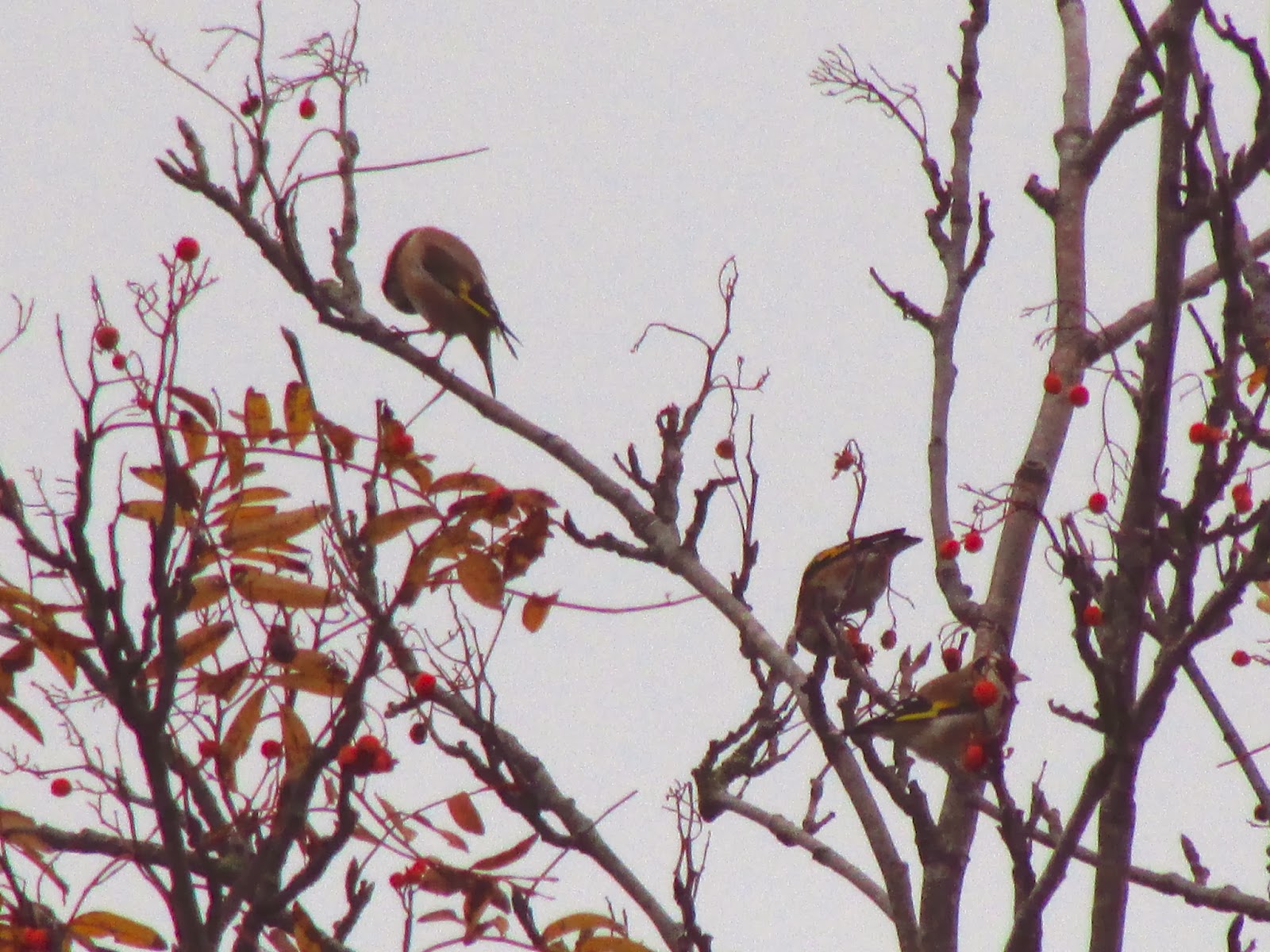
 ResearchBlogging.orgI find fascinating that when you seen something for the first time, then the chances are that you would see it again, seeing helps you see more. In the last couple of weeks a charm of goldfinches have been regular visitors in the garden feeders, gorging themselves on nyjer and sunflower seeds. I was watching the goldfinches and taking photos from inside of the house, when I noticed that one of the birds that couldn't get to the feeders was feeding on rowanberry seeds (above), discarding the pulp. This is typical of seed feeding birds like finches. Finches are seed predators, unlike thrushes, that eat the berries whole, passing the seed undigested and undamaged, in their droppings, and dispersing the seed away from the tree in the process.
 There was no mention of Goldfinches in the authoritative 'Birds and Berries' by Snow and Snow. I found a wonderful, if lone, photo on Flickr here and a line in a novel that suggested that this behaviour had been noticed before:
They went down the track through a wood where a flock of goldfinches was feeding on the rowanberries [...]
Tessa Hadley, Accidents in the home, 2002

Today on a walk in the park, I noticed a rowan on a garden and had a look. A charm of goldfinches looked busy on it. I wouldn't have normally had a closer look, but I did. They were feeding on the berries, hanging from the bunches like tits, not one, not two, but the whole flock seemed to be enjoying the berry seeds. The photos from today (below) are atrocious, as it was late and the light very poor, but a record nonetheless. After a while, something spooked the birds, a Sparrowhawk perhaps, and the Goldfinches went quiet and took to the air with a group of starlings and feral pigeons. I glimpsed what I think was a woodcock before if flew behind a roof, powerful wings and long bill, but just for a second. A Blackbird called: 'seee!' from a bush, their air predator alarm call.
 Indeed, a range of finches - including Goldfinches - are reported to feed on rowan seeds occasionally: Greenfinch, Crossbill, Brambling, Chaffinch, Hawfinch, Goldfinch, Redpoll and Siskin. Indeed, for some finches, particularly Bullfinch and Pine Grosbeak rowan seed in autumn can be their staple food. But rowan is a masting tree, where crop is very variable across years, with bumper crop, the 'masting years' interspeded with poor or failed crops in some. In the winter of 2004-2005, simultaneous irruptions of boreal Waxwing, Pine Grosbeak and northern Bullfinch occurred, all three birds liking rowan berries. Bullfinch local movements and irruptions in western and southern Europe have been linked to the strength of rowanberry fruiting crop.


This goldfinch appeared to use her foot to hold the berry in place

  A couple of weeks ago I spotted a juvenile Common Rosefinch, a rare visitor to these shores, feeding on rowan berries

Juvenile Common Rosefinch feeding on Rowan berries. 4/11/2013.

Some finches might use rowan depending on local availability. As this year rowan berries are plentiful and the thrushes have barely made a dent on the crop, Goldfinches and other birds may take advantage of this resource opportunistically.

References
Pennington, Mike G., and Eric R. Meek. (2006). The ‘Northern Bullfinch’ invasion of autumn 2004. British Birds 99: 2-24.

Munilla, I., and Guitián, J. (2012). Numerical response of Bullfinches Pyrrhula pyrrhula to winter seed abundance. Ornis Fennica, 89(3), 197-205.

Fox, A. D., Kobro, S., Lehikoinen, A., Lyngs, P., and Väisänen, R. A. (2009). Northern Bullfinch Pyrrhula p. pyrrhula irruptive behaviour linked to rowanberry Sorbus aucuparia abundance. Ornis Fennica, 86, 51-60.

Snow, B. K., and Snow, D. (2011). Birds and berries. A&C Black.

Raspe, O., Findlay, C., and Jacquemart, A. L. (2000). Sorbus aucuparia Journal of Ecology, 88 (5), 910-930 DOI: 0.1046/j.1365-2745.2000.00502.x