Showing posts with label learning. Show all posts

Tuesday, 8 December 2020

Carrion Crows feeding on Plane Tree fruits

This morning I took a walk near a local park. On a square lined with Plane Trees, some pollarded, a flock of Goldfinches fed on the bauble-like fruits, often hanging from them acrobatically, as they often do.

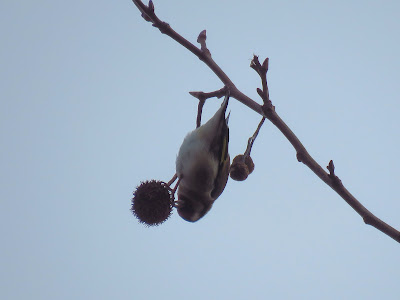
Then I noticed the crows. They flew to the tip of the branches, where the plane tree fruits clustered, once they gained their balance they moved to the tip of the branch, and picked on the fruits, pulling at their stem. Then they purposefully hanged down from their legs, then only one leg while holding the fruit on the other and attempting to break the stem. What complex thing to do! Some of the fruits had frayed stems, like they had been chewed a few times. If a crow breaks the stem but drops the fruit, the other crows will be quick to go and steal the price. I didn't see this, but I did see chases and close guarding of the fruit by the owner crow, often flying to a safer place holding onto it.

All three crows did this, often the three of them hanging from branches at the same time. At least twice I saw they were successful, and then they flew with the fruit on their bill, once transferring it to their feet before landing and starting breaking the fruit open for their seeds. I'm always amazed at crows, I have covered how they crack mussels and periwinkles at the beach.

Today's behaviour, however, really topped it up. Were they copying the Goldfinches? Crows are always to the alert, they must have noticed the Goldfinches feeding on these fruits and had a go at getting them!

This is a video made with three clips I took from them


And a few photos of the behaviour.

Hanging from one leg, holding onto the fruit with the other.


Crow with its prize.
The pink gape suggests this is a young crow, feeding on the plane fruit. I wonder if this is a family, with the young copying the adults in learning this skill.
I'll be very interested to head from anyone that have seen this behaviour in their local crows!

Monday, 13 March 2017

Carrion crows dropping mussels

Today at Sewerby beach I was intrigued by a Carrion Crow, part of a large winter flock, appeared to drop something onto the rocks at the top of the beach, then come down to eat. Sometimes the crow would fail and repeat the action. The tide was low, exposing a flat platform of rocks with rich mussel beds, and the objects being dropped were actually mussels that the crows were collecting and carrying up the beach before dropping them on the solid rock to smash them (above).
Dropping potential food items to break them open has been previously documented, and best known in Golden Eagles (breaking open tortoises) and Lammergeiers (bones). Gulls and crows of various species have been recorded dropping intertidal hard-shelled molluscs hard substates, including roads. Intertidal foraging can be an important part of the diet of coastal crows in the winter, when insects are scarce. Crows will scavenge at the tide-line, or feed on small crabs, but some of these intertidal organisms, in particular periwinkles, cockles and mussels, are consumed after smashing them open by dropping onto hard substrates. Controlled observations of wild Carrion and Hooded crows show that crows chose larger mussels, more likely to smash and also providing more food. Shell dropping is not instinctive, young crows appear to perform rather poorly. They need to perfect their technique of dropping so that the height at which the mussels are dropped is the minimum height for them to break at impact, but not much lower. Young crows take more attempts at being successful.
There are three reasons why the minimum height should be used. One, dropping from higher up means wasting more energy flapping up. Also, higher drops means higher bounces and higher chances of the shell being lost. Finally, crows and gulls often steal from each other, a behaviour called kleptoparasitism.  Therefore researchers predicted that crows dropping mussels when other crows or gulls are nearby would be more wary of being robbed, indeed, crows with other crows or gulls nearby dropped their mussels from 2 m lower that lone crows.
Crow and gulls on mussel bed, the crow has already detached a mussel, while one of the gulls is still trying. Although many crows were actually busy either collecting mussels or breaking them up the beach today, I didn't see any gulls doing this.
Mussels are strongly attached to the rock and other mussels by threads, which can be hard to reach, as the mussels cover the rock very densely, not exposing the threads. It is quite a feat the crows manage to detach them
A view of the beach at low tide.

Despite the very bright light I managed a couple of clips here:


More information

Whiteley, J. D., Pritchard, J. S. & Slater, P. J. B. Strategies of mussel dropping by Carrion Crows Corvus c. corone. Bird Study 37, 12–17 (1990).

Davenport, J., O’Callaghan, M. J. A., Davenport, J. L. & Kelly, T. C. Mussel dropping by Carrion and Hooded crows: biomechanical and energetic considerations. J. Field Ornithol. 85, 196–205 (2014).

Berrow, S. D. , T. C. Kelly & A. A. Myers. The diet of coastal breeding Hooded Crows (Corvus corone cornix). Ecography 15, 337–346 (1992).

Wednesday, 10 August 2016

The beachcombing crows

Crows are opportunistic and generalist feeders and live in a wide diversity of habitats, from woods and cities to the sea shore. They have to go through a period of learning from their parents how to forage, in particular about the best way to obtain resources for each habitat. I've been staying by the sea on the south coast on the UK for a few days, and I've spent a fair amount of time watching a family of Carrion Crows with three young. They often feed on the beach, visiting especially at low tide. The young appear capable of finding their own food, but they still regularly beg for food from their parents. The beach crows probably get live invertebrates beachcombing from the tideline, but they will also scavenge wash out crabs or fish, in competition with the local gulls.
  The adults, although tolerating the young nearby and allowing them to follow and watch what they eat, lunge to them aggressively if they are harassed too much.
Two of the young flanking one of the adults, note the size difference.

The adults are moulting and are, to put it mildly, not looking at their best. One of them is almost bald: many instances of sticking their face into the open bill of their nestlings (if, as I presume, it's the male, he will have also fed the incubating female) for a few weeks during the breeding season have taken its toll on its head feathers.
The bald adult, possibly the male.
Young are smaller than the adults, with legs that look long for their bodies and wing feathers that are not fully grown. They have a brown sheen to their head feathers and have pink mouths, obvious when they beg. This one has also some wing feather discolouration probably due to some nutritional deficiency.

The young, on the right, begs for food from both adults.

 The young crows spend some time away from their parents, walking on the beach, picking seaweed or turning a little stone to peck underneath.
Young crow watching a young Herring gull, from the family they share the beach with.

One of the young crows picked on the empty shell of a spider crab demonstrating its deft foot use (above). Another got a small crab this morning, and a Herring gull chased him. The crow persevered and ate his crab. But as soon as one of the adult crows gets something, the young crowd around.

One adult (the one not bald, which I will regard as the female) crow stole an egg from a pigeon's nest. As she landed on the beach, carrying the egg deftly in her bill, and still dragging some nest material, the three young immediately surrounded her, begging. The adult did not want sharing though, she wanted the egg all to herself. She walked up and down the beach trying to find a suitable spot for dinner, but the young followed her closely. Eventually she placed the egg on a rock, opened it and started lapping the contents. The young harassed her no end, even pulling at his tail feathers, and they only managed to taste the egg after a kerfuffle when one of the young managed to grab the egg and the adult chased him and put him down with her foot. You can watch a short video of this here:


Wednesday, 20 May 2015

The starlings jump

Today there was a clamour of 'charr!' calls from adults and fledgling starlings in my street. Several families of starlings accompanied from their noisy offspring fed on the verges. The young ones watched their parents and appear to move in slow motion compared to their frantic parents foraging on the grass and then feeding their young. Occasionally passers by would idadvertently scare the birds and the families would become separated. The young called from trees and roofs until they got together with their parents again. A fledgling spent some time on a tree, probing - in that unique starling style - with its bill open, on leaves and branches around it.
busy parent with head down and watchful young.
Calling
Probing, tasting, leaves 
Calling!
Young starlings have a heron-like look to them
Investigating
more calling!
its a big bad world out there

Friday, 28 March 2014

Problem solving Goldfinches

ResearchBlogging.orgI realised only recently that Goldfinch manipulation abilities are superb. They hold large seeds with one foot while manoeuvring them into position to feed, or fold stems back to hold berries or seeds securely, or hand upside down to reach the thinnest branches. Yesterday I watched a small flock feeding on the catkins of a silver birch. The closest bird to me held a catkin while feeding from it and even changed the foot it used to hold it.
 It happens that Goldfinch manipulation abilities have been known for a long time (Plinius and Gesner mention it). Golfinches used to feature in animal shows, as seen in this old British Pathe film demonstrating the string pulling ability of a Goldfinch. The bird alternatively pulls and holds a string to reach a container with water or food.


String pulling is a common experimental setup to investigate the problem solving ability in birds. Parrots, corvids parids and finches can pass the test. In a series of experiments on captive-reared Goldfinches and Siskins, Uta Seibt and Wolfgang Wickler set to explore the problem-solving abilities of individual birds and what factors influence success. The birds were reared in cages with no access to material with which they could experiment their manipulative abilities and were tested when less than 5 months old using a 7-cm string holding a thimble with food at the end.
The researchers found that there were three groups of bird. 'Inventors' (23% of goldfinches and 62% of siskins) solved the string-pulling test by themselves, some times in the first experimental session, whereas ‘imitators’ (25% of goldfinches; 10% of siskins) were successful after watching conspecifics solving the problem. The remaining birds failed the test even when exposed to an experimented model.
 Something the experiment highlighted was the remarkable behavioural plasticity of Goldfinches and Siskins as shown by the diverse repertoire of behaviours the birds used to solve the problem (getting the food in the thimble):
Several individuals of both species hovered in flight near the thimble. They never succeeded in taking food, but still tried to reach food this way when they were already able to eat via string pulling and holding. A few goldfinches and siskins stretched from the cage fence towards the thimble but without successfully touching it. Two siskins and one goldfinch reached the thimble while hanging down from the perch head down like bats. Several siskins climbed down the string and ate from the thimble. Three other siskins shed some food from the thimble by heavily shaking the string and pecked the grain from the floor. (Goldfinches never moved to the cage floor.) Eight goldfinches and seven siskins invented a special method to flick the string around the perch, thus lifting the thimble indirectly. Some individuals used several of these techniques.
In addition, some individuals showed a preference for one or the other foot to hold the string.
Additional experiments tested the effect of being reared with access to branchlets. These seemed to facilitate success, but they were not necessary in several individuals. Similarly, the presence of a model facilitates success for a large proportion of the birds (the 'imitators'). Finally, the presence of food in the thimble was also necessary for the goldfinches to lift the string.
Bird species which instinctively used their feet to clamp food or branches while foraging - like the Goldfinch - should be able to solve the test, but the experiments show that birds still vary in their predisposition to experiment with the string and in their success. What proportion of wild Goldfinches use foot-bill coordination when foraging is hard to assess, but one would expect that given that natural conditions this would be higher than in the experiments. The wild birds are exposed to a much richer rearing environment, as they have very diverse diets and have to extract seeds from an array of plants from small perennials with soft pliable stems to trees with variably flexible branchlets (dandelion, teasel, lavender birch, ash, alder, rowan to give some examples). In addition, Goldfinches are highly social birds that feed together in flocks, so the learning opportunities would be plentiful.
Goldfinch holding birch catkin with left foot. Note that the catkin is still attached to the branch and the foot helps immobilise it, facilitating food retrieval.
More information
Seibt, U., & Wickler, W. (2006). Individuality in Problem Solving: String Pulling in Two Carduelis Species (Aves: Passeriformes) Ethology, 112 (5), 493-502 DOI: 10.1111/j.1439-0310.2005.01172.x . Here.

Wednesday, 25 July 2012

Watch and learn

I watched a pair of Carrion Crows with a juvenile today. From a distance, you would say adults and young look the same, but young ones appear smaller than the adults, have a thinner bill, and lack the purplish-blue sheen of the adults feathers, with an overall impression of a dull, dark brown bird. The young one today followed one of the adults carefully, watching his every move, often having to trot to keep pace - even if the adult seem to walk normally. If the adult appeared to find a morsel, the young one begged, bill open and wings flapping. Crows being such adaptable birds, the young ones have lots to learn on how to find food. About three months after fledging, the young crows will become independent.