This morning, while I walked around the park I heard a distant loud cheerful chatter. As I approached I realised there was a flock of Goldfinches up a large horse chestnut and many of them were singing. It is the second time this week that I witness this behaviour, the first time it also happened in the morning, the flock of Goldfinches singing together from a bare sycamore. Some seemed to amuse themselves pecking the branches, but in general they were just calling and singing. Goldfinches are very social birds, they often nest in loose colonies, and, although individuals might squabble for a particular food source, they often feed together in flocks. Whereas in the summer they like the seeds of teasels, thistles and other herbaceous plants (even lavender seeds!), in the winter, they can often be seen feeding on trees, like Alder, Plane, Ash and Birch. I haven't managed to find much information about chorus singing in Goldfinches, but the behaviour has been described in the closely related American Goldfinch and Siskin, where the males in the flock joining in chorus song in winter and spring.
Goldfinch flock singing (two bulkier Greenfinches are amongst them)
There are now two Moorhen pairs in the park. They own each one end of the pond, a pair owns the island and the other the 'rock' with a couple of clumps of marginal plants. Today the island pair was very cosy, both individuals together, the one on the left preening around the neck of its partner. Moorhen males are slightly larger and heavier than females, so the larger individual on the left is likely to be the male. The Coot pair abandoned the park after their two failed breeding attempts on the stolen Moorhen nest.
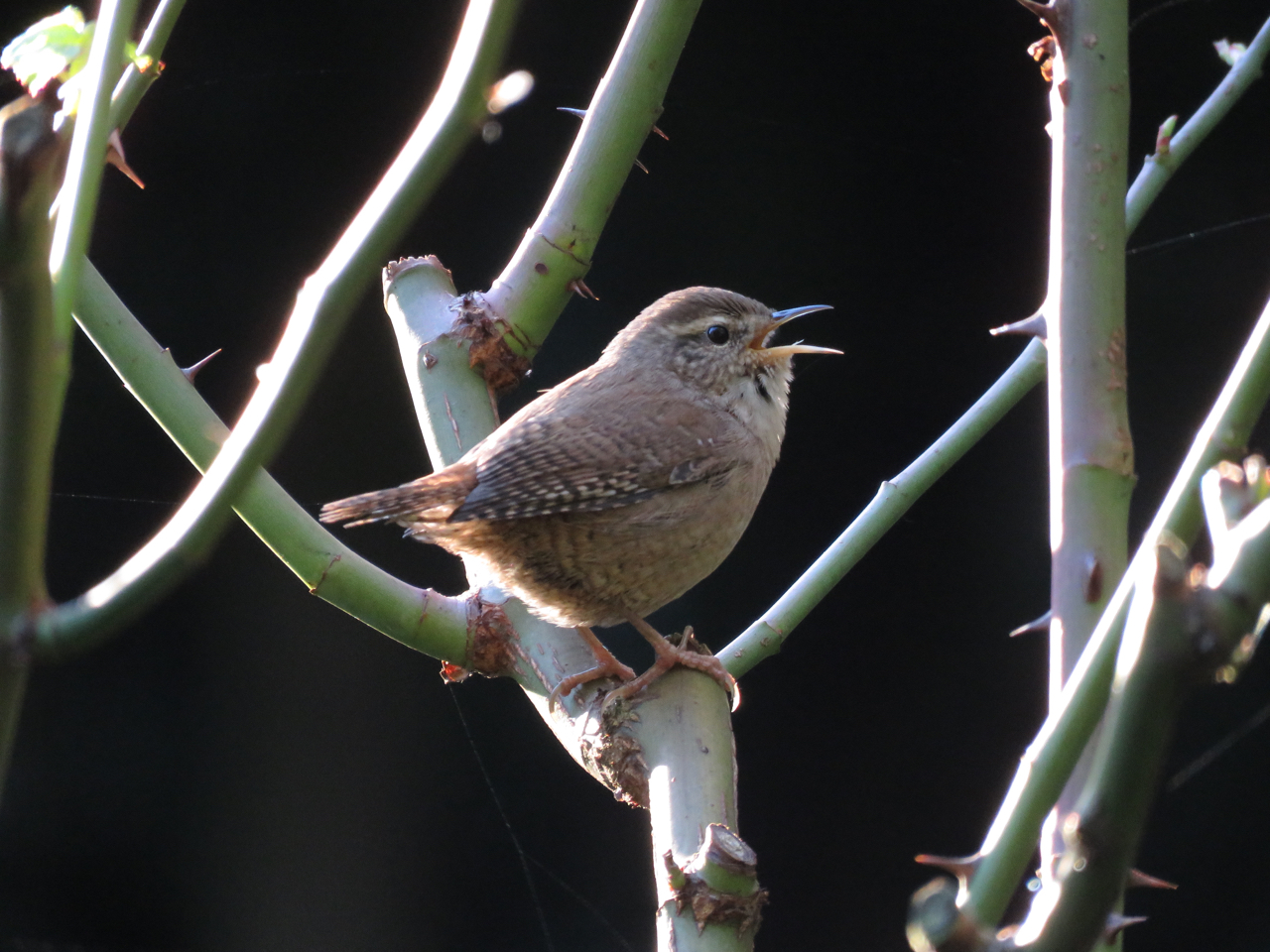
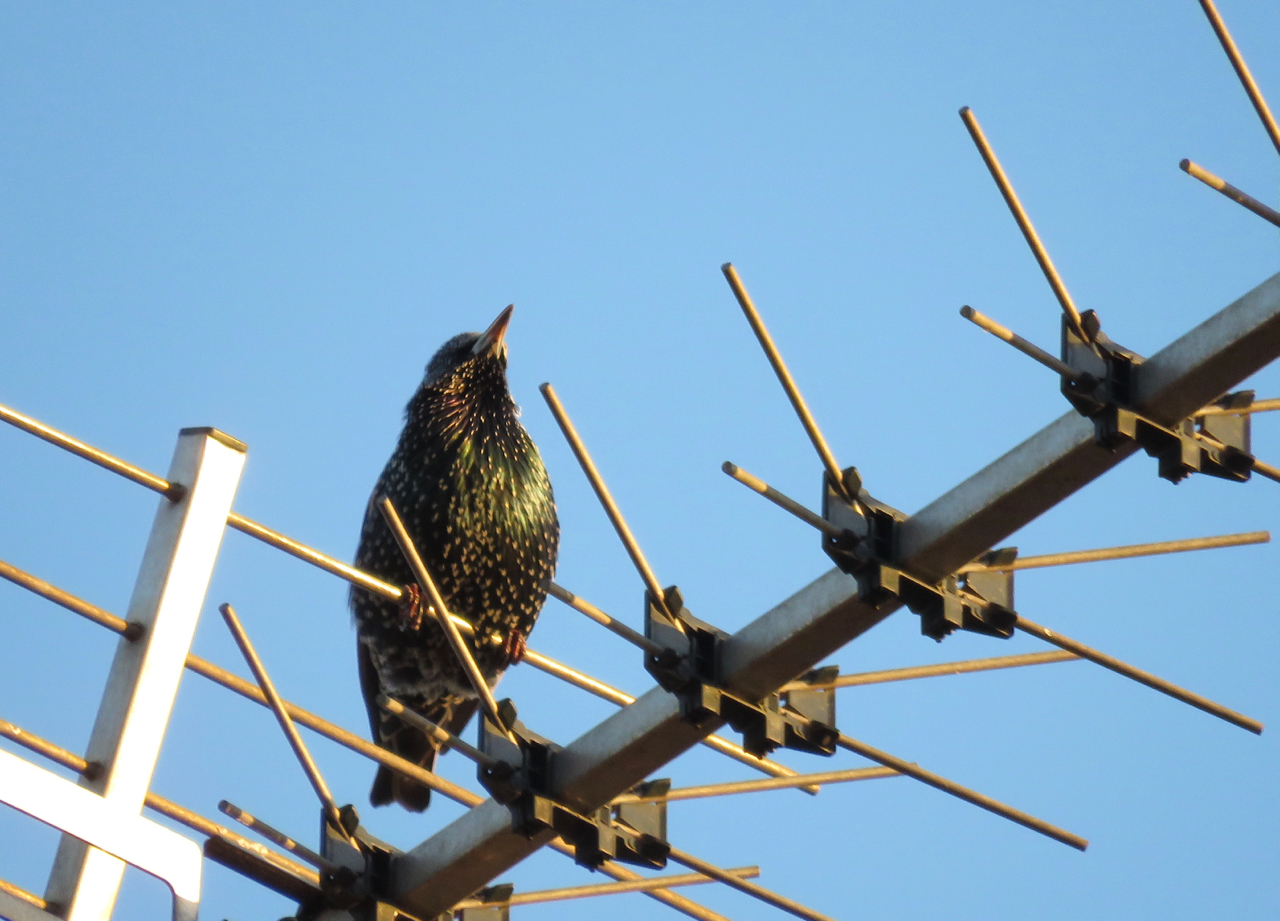
It is not unusual to hear bird song in December. Robins and Goldfinches sing year round, Wrens will burst into song at any time. Do Starlings ever stop singing? I don't think they do. Collared Doves and Stock Doves, after a short rest at the end of their breeding season, can now be heard calling again.
In sunny winter days, Song Thrushes will start singing, maybe more towards January.
Wren in full song in October
Collared dove singing a couple of days ago.
Starling singing yesterday
Today I heard two bird species singing, however, which I've never heard singing at this time of year. This morning I heard distant fluting phrases that sounded like a Mistle Thrush. I went to investigate and there it was, a Mistle Thrust atop a tree, singing contentedly.
Blackbirds, normally will sub-sing in the winter. This is an eery, very quiet song, that usually subadult individuals carry out, as if 'practising' singing, well hidden in bushes. But as I was leaving work today, as it happened last week, I heard the surreal full song of a blackbird, its beautiful notes raising over the cacophony of the Carrion Crow roost at campus, and transporting me into spring. I had to check this out. There it was a full adult male Blackbird was singing from a wall. Given that it was quite dark at 16:15, the photo on top was the best I could manage without using the flash, but I recorded a short video of it. A very very unusual thing to happen in early December. I wonder if the unseasonally mild weather we are having is confusing this normally spring songster.
As I took the kids to school this morning, I noticed a couple of crows on the grass on the school grounds. One of them was hunched up and I thought it looked like a young one. As I was leaving I went to check. Still looking like it would be more comfortable sitting in its cosy nest, it looked curious as I approached, and it didn't flee. It's first encounter with a camera, taking things in. As human babies, Carrion Crows young ones have dark blue eyes, which will darken to rich brown as adults. The blue eyes, pink mouth and brownish feathers help tell young from adults, but the general attitude is different too, as young crows tend to be much tamer than the adults.
Today there was a clamour of 'charr!' calls from adults and fledgling starlings in my street. Several families of starlings accompanied from their noisy offspring fed on the verges. The young ones watched their parents and appear to move in slow motion compared to their frantic parents foraging on the grass and then feeding their young. Occasionally passers by would idadvertently scare the birds and the families would become separated. The young called from trees and roofs until they got together with their parents again. A fledgling spent some time on a tree, probing - in that unique starling style - with its bill open, on leaves and branches around it.
Mallards are notorious for their unorthodox sexual practices, which include same sex mating and necrophilia (of Ignobel Prize fame, see reference below). This morning, in the apparent absence of a female, four drakes mallards took it on an unfortunate one. I have previously watched apparently consensual male-male copulation in mallard, preceded by courtship, but in this case they behaved exactly like when a gang of males carry out a forced copulation on a female. The series is not very clear, but these are the best I got.
...and the harassed drake eventually flew off!
I do wonder if the many non reproductive pairs and trios that are now found away from water around the verges of the avenues and even on campus, where there is no pond, are actually seeking some peace and quiet from all this pond sexual excitement.
More information
Moeliker, C. W. The first case of homosexual necrophilia in the mallard Anas platyrhynchos (Aves: Anatidae). Deinsea 8 (2001): 243-247. here.
I haven't blogged on Carrion Crows this year at The Rattling Crow, and that needs to be amended. So today, I bring you a sequence from this morning, when I documented a Cawing Display. This is a series of movements carried on when cawing from a prominent perch, often by territory holders. The whole body arches and bows as the same time that they call loudly, giving the impression that they put all their might into it. This pair were sitting initially close together and I thought they were getting ready to preen each other, but then they must have spotted an intruder in their territory, as they started performing the cawing display in amazing synchrony. Each display involved cawing and bowing three times, while fanning their tails, and keeping their belly feathers raised. I noticed that in many of the photographs (see the top one, in the middle of a caw) the nictitating membrane - which makes their eyes look cloudy - was drawn at the same time that they called, something that is only possible to notice with photographs.
The pair watching intently. Their tails are touching and slightly fanned and their belly feathers are also a bit ruffled.
The start of a caw.
The end of a caw.
The intruded came closer and both birds called noisily and gave it chase.
Carrion Crows pair for life, which is often not that long (average 4 years, with a maximum recorded age of 9) and the pair remains together all year round. Only territory holders breed, with one year old birds and non-territory holders often moving in a flock and intruding in territories in search of food, leading to squirmishes with the territory holders, in which both members of the pair participate.
More information
Coombs, Franklin (1978) The Crows. B.T. Batsford Ltd, London. 255 pp.