Sunday, 19 February 2023

Waxwing gift passing display

 After a long hiatus, I came across some Waxwings today. Six individuals were perched high up on a Lime tree, taking the sun in. They were quite active, changing branches, pecking the shiny, red tree buds. Two in particular called my attention, as they approached each other touching bills, then coming apart. I took plenty of photos, some unfocused by branches getting in the way, but, looking at them in more detail back at home, I noticed that the two individuals 'billing' were doing more than that, they were exchanging an object, probably one of the tree buds, in a ritual display called 'gift passing' (top shot). The behaviour is seen both in the Bohemian Waxwing, which we get in irruption years in the UK, and in the American Cedar Waxwing. 

The behaviour consist on passing an object, then the individual with the object jumps away, then joins its mate, which 'receives' the object, then the behaviour is repeated and the object passed backwards and forwards repeatedly.

The individual on the left has the gift now.
The individual on the right has it now. Note the raised crests.
Here a Waxwing shows interest in the bright red, shiny buds of the lime tree.
And here, another individual holds some buds in its bill.

I found a description of the behaviour, based on captive individuals and illustrated with photos, which shows that the display is also accompanied from fluffed rump and belly feathers, raised crest and lowered tail, the latest something not very obvious in my photos. The male appears to initiate the behaviour, obtaining the object, and sidling to the female, presenting it. If successful she will accept the object and reciprocate, after jumping away, then close. It is difficult to sex Waxwings, males apparently have longer crests and a more clearly delimited black chin patch.

This is a clip of the behaviour in the Cedar Waxwing, there seems to be a lack of recordings for the Bohemian Waxwing, although the description and my observations fits both species sharing this wonderful display.


More Information
Meaden, F. M. & Harrison, C. J. O. Courtship display in the Waxwing. British Birds 58, 206–208 (1965)


Sunday, 4 September 2022

Goldfinches feeding on Horse Chestnut leaf miners

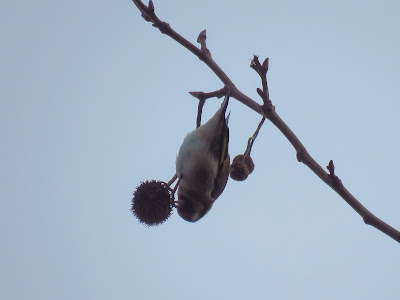
Goldfinches' diet is mainly composed of small seeds that they can deftly extract from seed heads using their long, thin bill. I have blogged before on their agility and skill manipulating seeds and stems with their feet.  Loose flocks will move about in search of food. In spring they feed on dandelions, later in the summer on teasels and creeping thistles, whilst in the winter they feed on tree seeds including alder, birch and ash. They are an adaptable species, and have taken to feeding on garden feeders, especially on niger seeds and sunflower seeds. They have also learned to feed on the dangling fruits of plane trees, planted in city avenues. They are also seed predators of Rowan trees, feeding on the seeds and discarding the pulp of the rowan berries. Finally, in the winter they spend a lot of time pecking tree branches, and it is still a mystery to me what they are doing in there!


A Blue Tit feeding on Horse Chestnut miners. Several tit species are able to use this plentiful resource.

In a visit to my local cemetery I wasn't totally surprised when I found a group of Goldfinches feeding on leaf miners amongst Blue Tits. Using their feet to hold onto a leaf, they were extracting the miners, presumably pupae given the time of year (note the brown blotches on the leaves on the photos). The horse chestnut leaf miner, Cameraria ohridella, is a micromoth that has expanded its range throughout Europe from its native Balkans and is now widespread in cities and towns across Europe, responsible from the early browning of Horse Chestnut leaves in summer.

This is the first time I see Goldfinches feeding on invertebrates, but they are already known to be one of the few predators of this newly arrived species of moth (see Ralph Hancock's blog here). In a previous study, only tits, including Blue Tits, Great Tits and Marsh Tits were fed on the late larval or pupal stage of the miner. The bird species known to predate the miner are all small, dextrous and agile, and able to use their feet to hold onto leaves. This food resource is plentiful for a few months, as there are several generations of miner per year, so the miner provides a great resource of food in the summer months. The adult moth is also a source for food for other insect-eating birds.


UPDATE 26/09/25. Watch this video of a young Goldfinch feeding on leaf miners, one of the flock of Goldfinches on a heavily infested tree.

More information

Grabenweger, G., Kehrli, P., Schlick‐Steiner, B., Steiner, F., Stolz, M., & Bacher, S. (2005). Predator complex of the horse chestnut leafminer Cameraria ohridella: identification and impact assessment. Journal of Applied Entomology, 129(7), 353-362.

Saturday, 4 December 2021

Mistle thrush pairs defending berry trees

Several bird species hold territories during the winter, like Robins or Wrens defending their patch and singing through the winter. It is rarer that a pair will defend a winter territory. I have covered examples like Stonechats and Pied Wagtails before. The former usually include a male and a female, but they are unlikely to be a mated pair.

A pair of Mistle Thrushes near their cotoneaster tree. Northern Cemetery 30/11/21.

Earlier in the week I saw some Rowans heavy with berries along a street. A Mistle Thrush sat on a taller tree nearby. Then another individual flew from the berry tree, a pair! Later in my walk, I saw another pair of Mistle Thrushes near their defended cotoneaster (above). I then realised seen paired Mistle Thrushes in the winter before, near their defended trees. Are they a resident pair? Is a pair better than a single individual defending their berry larders?

             
Clockwise from top left, Yew, Ivy, Rowan and Holly ripe berries.

The berries

Mistle Thrushes are well known for their winter defence of berry resources. Holly is one of the most important defended trees in the UK, followed by Hawthorn, Mistletoe, Yew and, later in the winter, Ivy. At Hull, I've seen Mistle Thrushes defend Holly, Yew, Rowan, Whitebeam and Cotoneaster. Often the same trees are defended year after year.

Mistle Thrush on defended holly, one of an Avenues of Hollies at East Park defended by a pair, 23rd November 2021.
Mistle Thrush overlooking its defenced Rowan, 1st February 2021.
Mistle Thrush on General Cemetery on its defenced Whitebeam at Pearson Park. 17th October 2014.
Mistle Thrush on its defended berry-laden Yew.
A Mistle Thrush atop the church rooftop checks the yew opposite, on Cottingham Road Community Church garden. 14th November 2017.

Defence behaviour

Aggressive tree defence behaviour is spectacular: The Mistle Thrushes use their loud rattling or churring calls, repeatedly and chases other birds away from their tree. Most aggressive interactions involve repelling other Mistle thrushes, but also any other thrushes, like Blackbird, and various finches, Great Spotted Woodpeckers, Waxwings and even single Woodpigeons. Defence consists on chasing intruders, often silently and even if the birds were feeding on fallen berries under the tree. If there is a conflict then the individual might flick its tail and wings, their white underwings flashing, while churring persistently. Churring also occurs in flight during chases. Their defence is effective due to their large body size - they are the largest European thrush. Curiously Barbara and David Snow, who studied this behaviour in the UK note how the Mistle Thrush chooses who to attack carefully and it will chase only some species away so long as they are food competitors for the particular tree it is defending. For example Starlings are left alone in hawthorn and holly (whose berries they rarely eat) but chased from Ivy, which they eat. Greenfinches and Great Tits, are chased from Yew (they feed on the seeds) but not from Holly, which they don't eat. Eventually, after a few attacks, the local birds will learn to avoid the defended trees, and the Mistle Thrush just watches from a distance, and often this is how you'll find a Mistle Thrush, sitting on a vantage point near its precious tree.

Establishment of the guarded tree

Snow and Snow describe that the system of tree defence is established in October or early November, when song might be occasionally heard and other Mistle Thrushes are vigorously driven off until the territory is set. That way they can exclusively feed on these berries through the winter when they are needed. The defended trees become their winter larders, standing out on the landscape, packed full of berries when all other trees have been stripped out. Mistle Thrushes actually avoid feeding on the berries of their defended tree if they can, especially when the weather is mild and the ground is soft and they can rely on worms and other invertebrates. You need to pay attention to these trees full of berries later in the winter to recognise that the reason they are there is that a Mistle Thrush is just sitting atop a tree or aerial nearby, preening or resting. Unfortunately this effort will be worth nothing if a hard weather spell drives flocks of winter thrushes or Waxwings onto their area, then the Mistle Thrushes despite their best efforts may be unable to maintain their tree defence and lose their berry crop in a day or two. If the weather is mild, the tree can hold its berries until spring, and then, usually by the end of March, trees stop being defended. The Mistle Thrushes start nest building, often nearby. In the case of their defence of holly, the long-lasting berries, which can remain in the tree for up to nine months, are often used to feed their young. The hard work of defending the tree through the winter pays off not only to increase adult survival but as parental investment.

A pair of Mistle Thrushes near berry laden rowans at Auckland Avenue, 14th November 2017.

Pair defence

If Mistle thrushes stay to breed on the area near their defended tree, it would make sense that the pair defends the tree, rather than one individual. Snow and Snow describe how pair defence is more common and successful than single individual defence, although no data is given as to the proportion of pair defence. They say that "nearly all trees successfully defended throughout the winter were jointly defended by a pair of Mistle thrushes" and that  “pairs or individuals centred on a source of fruit which, if all goes well, will be defended through the coming winter.” In contrast, research on Mistle Thrushes defending Mistletoe clumps in woodland in Poland did not find evidence of pair defence. Could it be that pair defence occurs in some situations or for some berry sources and not for others? Anecdotal observations, however, suggest that members of a pair can defend different trees in the same area, and join forces if one of the pair loses their tree. On their article on Mistle Thrush defence Barbara and David Snow comment:

"When fruit territories are first established, in autumn, each defended tree may be guarded by a single Mistle Thrush or by a pair. It is probably common for members of a pair to establish themselves at neighbouring fruit-trees. Thus we had three cases where two Mistle Thrushes began by defending separate trees quite near to one another (60-180 m) and later, when one of the trees was stripped (as a result of the onslaught by Fieldfares and Redwings in the severe weather of December 1981), the two jointly defended the tree that still had fruit. In another case a pair of Mistle Thrushes jointly guarded the same holly tree from October or November in the two successive years, continuing throughout the winter in the first year but losing the fruit to invading Fieldfares and Redwings in the second year."
Snow and Snow indeed suggests that the same individuals, if they survive, may defend the same trees year after year, but their birds weren't ringed, so we can't know for sure. I'm surprised there is still so much to known about this widespread bird!

More information
Skórka, P. & Wójcik, J. D. Population Dynamics and Social Behavior of the Mistle Thrush Turdus viscivorus During Winter. Acta Ornithol. 40, 35–42 (2005).

Snow, B. K. & Snow, D. W. Long-term defence of fruit by Mistle Thrushes Turdus viscivorus. Ibis 126, 39–49 (2008).

Snow, B., & Snow, D. (2010). Birds and berries. A&C Black.

Wednesday, 31 March 2021

Anting Carrion Crows


I've wanted to film crows anting for quite a while. Anting is a behaviour carried out by a range of birds (I dealt with Blackbirds anting in a previous post), but it is rare to observe it. Anting can be active - the birds picks an ant (or ants) and rubs it on its feathers - or passive - the bird allows the ants to climb onto its plumage. The behaviour involves distinctive movements such as sitting close to the ground or partially opening the wings and tail dragging. The bird movements on top of the ant's nest or direct disturbing of the nest will also encouraging the ants to come out of the nest and climb over their feathers, as anyone who has had a picnic on an anthill will attest.

A Carrion Crow anting at my local park. 27/07/2016.

 The first time I watched anting behaviour in crows I was driving, waiting on a red light. It is a very distinctive behaviour, but I had no chance for a video or a photo! I have seen it a few more times, but didn't get a good video of it. Today, as I got out of my car I noticed the local pair of crows on the verge opposite. I used the car as a hide and filmed them. First, one of them first seemed intent in getting some nest lining material, but the other went to the base of a tree trunk and pecked, and pulled some vegetation from around the tree. Then it pressed its body against the ground. The second crow joined the first and both enjoyed an 'anting' session.

Watch both clips and a clip of the ants nest:


Why anting?
It might be surprising, but is still unclear why birds carry out anting behaviour and there are a range of hypotheses. Some claim that it is some form of feather maintenance. Species of ants that eject formic acid (Formica, Lasius and Camponotus) as part of nest defence are preferred for anting. Formic acid has insecticidal and acaricidal properties. One of the first hypothesis is that the formic acid kills or repels bird ectoparasites such as feather lice or mites. This has had some support. In the summer of 1943, in Transbaikalia, Dubinin killed four Blyth's Pipits that had been anting, counted all the feather mites and checked the mites behaviour. Many mites were already dead and a total of a third of the mites died over the next 12 h, and the rest seemed very mobile. The birds feather smelled very strongly of formic acid even 12 h after the shooting. The control for this experiment were four pipits that hadn't been anting. Only 0.9% of the mites died after 24 h, and they stayed more or less immobile. However, other experiments tested this hypothesis were inconclusive.
Another hypothesis draws on the formic acid has anti-bacterial and anti-fungal properties, and could be beneficial to keep in check bacteria and fungi that feed on feathers. Although the experiment showed that pure formic acid inhibits feather bacteria and fungi's growth, the results were not conclusive when more natural doses were used that reflected ant's formic acid content. An ornithological enigma!

More information

Morozov, N. S. Why do birds practice anting? Biology Bulletin Reviews 5, 353–365 (2015).

Tuesday, 19 January 2021

Mute Swans leaving home

There was a news item yesterday regarding a Mute Swan that had crashed through someone's bathroom window. The swan was treated for cuts and taken for further treatment. The photos suggest that this was a young mute swan. What was it doing to crash in such a way?

Young leaving home 

This time of the year young Mute Swans will be leaving their parents' territories, in search of new homes. Cygnets share their parents territory for a few months, but as the parents start preparing for a new breeding season, the male, called 'cob' becomes more and more intolerant of his offspring, busking to them and trying to keep them out of the water. This blog post was prompted by the arrival of a young mute swan to my local patch, which I saw this morning for the first time. It has possibly dispersed from a nearby lake, where they have bred this year.

A newly arrived Mute Swan at the drain today.

Parents vary in their tolerance to immature swans in their territory, or this may depend on the size of the lake, possibly smaller territories may prompt cobs to chase their offspring earlier. One pair in a local park has two batches of young, the oldest were being chased on Saturday out of the water by the cob.

26th December 2020. Adult pair of swans chase their yearling outside the water.

Cob busking to young, followed by the pen.

Fly practice

Swans are one of the largest flying birds. They are also not amazingly manoeuvrable, and collisions (for example with electric lines) are one of the main mortality causes in swans. Taking off involves paddling on the water while flapping wings, they need a clear length of water to do this and then upon starting their flight they will need to fly up so that they clear any obstacles such as trees and houses on their way. 

Mute Swan in flight.

Watching swans in my local area, I've become aware of practice flying in which young and adults participate. This activity may help the young acquire key flight skills, taking off, landing and strengthen their wings  A short chase by the male may end with several members of the family flying along the lake, to land at the other end, but I've also seen lone young practicing when alone. There is a very good description of practice flying in the blog Swan Life.


Cob encourages young to fly. I described the behaviour in my Wild at Hull blog on the 8th December:  "As I got to the lake I saw the Mute Swan family gathered on the north edge of the lake. The adult pair had their two yearlings, born in 2019, and three young born in spring 2020. Usually swans chase their young away from their territory in the autumn, but this pair tolerates their young for much longer, probably because of the large size of the lake and plentiful food. The cob, however, was all fluffed wings and lowered head, a behaviour called 'busking' to one of the two older young. After a short chase, the young started flying, followed by a younger sibling and dad, and all three flew to the other end of the lake. I watched this happened three times while I was there. The swans only needed to drift on the wind to the top of the lake, and then take advantage of the gentle head wind for an easier lift. They yearlings might be getting ready to finally leave their natal lake, practicing taking off and landing".

Another clip of the 'practice flight' next. This is not a take off that failed, the trees and the end of the pond make it impossible that the swan would be able to take off in this direction. Practice flying and landing seems to be the motivation behind it. Note the feet propel the swan over water increasing speed and lift, and are also key to brake when landing.


More information

Collins, R. Sex Differences in the Movements and Mortality of Mute Swans. Waterbirds: The International Journal of Waterbird Biology 25, 157–161 (2002).

Frost, D. (2008) The use of ‘flight diverters’ reduces mute swan Cygnus olor collision with power lines at Abberton Reservoir, Essex, England. Conservation Evidence 5, 83-91.

Birkhead, M. and C. Perrins (1986) The Mute Swan. 

Monday, 4 January 2021

Ice-breaking Mute Swan


The ponds and lakes in town are all covered on ice after the last frosts. The other day I watched as part of a family of swans landed on ice on their lake, the young walking tentatively on the slippery ice. Today a pair of swans reached the edge of the ice and the cob seemed determined to move on. It pushed its chest onto the ice and broke it, moving forward each time. I noticed how after each break, it did a tail shake, as they often do after landing. I wonder if the swan feels like it is in unchartered territory and is nervous while breaking the ice. Tail shaking is something waterfowl do after an exciting event (mating, landing). The cob fed under where the ice had been, but then it decided to turn round to its partner.

Cob mute swan ice breaking.

Often lakes that have swans have some open water, as the large, heavy swans are able to break the ice. If they can't and the lake becomes fully iced over, then all waterfowl leaves in search of some open water. 

These are some photos of a mute swan family in a different lake.
Initially one of the young was on its own.

Its family had landed on the other side of the lake, on the ice, and it flew towards them.
The young was then keen to return to the open water.
The pen was happy to stop to preen and rest on the ice.

Tuesday, 8 December 2020

Carrion Crows feeding on Plane Tree fruits

This morning I took a walk near a local park. On a square lined with Plane Trees, some pollarded, a flock of Goldfinches fed on the bauble-like fruits, often hanging from them acrobatically, as they often do.


Then I noticed the crows. They flew to the tip of the branches, where the plane tree fruits clustered, once they gained their balance they moved to the tip of the branch, and picked on the fruits, pulling at their stem. Then they purposefully hanged down from their legs, then only one leg while holding the fruit on the other and attempting to break the stem. What complex thing to do! Some of the fruits had frayed stems, like they had been chewed a few times. If a crow breaks the stem but drops the fruit, the other crows will be quick to go and steal the price. I didn't see this, but I did see chases and close guarding of the fruit by the owner crow, often flying to a safer place holding onto it.

All three crows did this, often the three of them hanging from branches at the same time. At least twice I saw they were successful, and then they flew with the fruit on their bill, once transferring it to their feet before landing and starting breaking the fruit open for their seeds. I'm always amazed at crows, I have covered how they crack mussels and periwinkles at the beach.

Today's behaviour, however, really topped it up. Were they copying the Goldfinches? Crows are always to the alert, they must have noticed the Goldfinches feeding on these fruits and had a go at getting them!

This is a video made with three clips I took from them


And a few photos of the behaviour.

Hanging from one leg, holding onto the fruit with the other.


Crow with its prize.
The pink gape suggests this is a young crow, feeding on the plane fruit. I wonder if this is a family, with the young copying the adults in learning this skill.
I'll be very interested to head from anyone that have seen this behaviour in their local crows!